Tag: AfCFTA

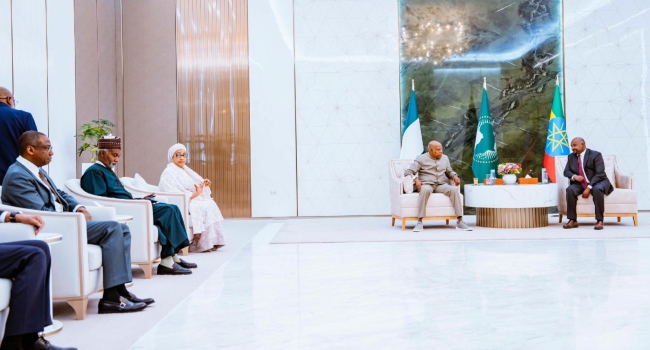
  • VP Shettima Leads Nigerian Delegation to 2026 African Union Summit in Ethiopia

    VP Shettima Leads Nigerian Delegation to 2026 African Union Summit in Ethiopia

    Reporting by Channels TV indicates that Vice President Kashim Shettima has departed Abuja to represent President Bola Tinubu at the 2026 African Union (AU) Summit in Addis Ababa, Ethiopia. The summit, which officially opens this weekend, focuses on regional integration, security, and the implementation of the African Continental Free Trade Area (AfCFTA) amidst global economic shifts.
    The Vice President is expected to participate in high-level discussions concerning the continent’s food security and the reform of the AU’s financial architecture. His agenda also includes bilateral meetings with other African leaders to strengthen Nigeria’s diplomatic ties and economic cooperation within the West African sub-region and the broader continent.
    Further validation from Premium Times and Leadership Newspaper highlights the importance of this trip for Nigeria’s foreign policy. Premium Times reported that “Shettima’s visit is pivotal for Nigeria’s push for a permanent seat on the UN Security Council via AU consensus,” while Leadership quoted a presidency spokesperson saying, “The Vice President will push for collective African action against terrorism and unconstitutional changes of government.”
    Echotitbits take: This summit is a critical litmus test for Nigeria’s leadership role in Africa. With the AfCFTA entering a more mature phase in 2026, Shettima’s ability to secure favorable trade terms and security commitments will be vital for Nigeria’s domestic economic stability and regional influence.
    Source: Channels TV – VP Shettima Leads Nigerian Delegation to 2026 African Union Summit in Ethiopia
    , February 14, 2026
    Photo credit: Channels TV

  • Nigeria to Host Major Conference on Africa’s Digital Economy

    Nigeria to Host Major Conference on Africa’s Digital Economy

    ThisDay reports that Nigeria has been selected to host the 2026 Conference on Africa’s Borderless Digital Economy.

    The event is expected to convene policymakers, tech entrepreneurs, and investors to discuss digital payments integration and harmonized data regulation across Africa, with an AfCFTA implementation lens.

    The Nation and BusinessDay also noted anticipated focus areas such as reducing cross-border transaction costs and showcasing Nigerian innovation to a global audience.

    Echotitbits take: Hosting is an opportunity for Nigeria’s fintech and enterprise tech ecosystem, but credibility will depend on fixing the basics: affordable data, reliable power, and predictable regulation. Expect deal-making around cross-border payments, digital identity, and AfCFTA-compliant trade digitization.

    Source: This Day – https://www.thisdaylive.com/2026/01/30/nigeria-to-host-2026-conference-on-africas-borderless-digital-economy/  2026-01-30

    Photo Credit: This Day

  • Central Bank Tightens Capital Requirements for Nigerian Merchant Banks

    Central Bank Tightens Capital Requirements for Nigerian Merchant Banks

    The Central Bank of Nigeria (CBN) has issued a new circular raising the minimum capital base for merchant banks, a move aimed at strengthening resilience in a volatile global environment and ensuring specialized banks can back large-scale projects.

    Affected institutions have a 12-month window to meet the revised thresholds, with the CBN framing the directive as part of positioning Nigerian banks for cross-border competitiveness under the AfCFTA framework.

    Analysts expect the policy to trigger consolidation through mergers and acquisitions among smaller merchant banks, as the regulator insists the transition will be managed to avoid service disruptions.

    Echotitbits take: This looks like phase two of the recapitalization agenda that began in 2024. By forcing merchant banks to scale, the CBN is signaling it wants fewer but stronger institutions capable of financing industrial projects rather than just trading. Watch for fresh capital-raise announcements on the NGX.
    Source: The Punch – https://punchng.com/banks-strengthen-capital-base-as-cbn-tightens-controls-2/ 2026-01-27

    Photo Credit: The Punch

  • Nigeria moves to modernise trade data and policy coordination to deepen AfCFTA gains

    Nigeria moves to modernise trade data and policy coordination to deepen AfCFTA gains

    2026-01-02 06:00:00
    Reporting by Punch indicates the federal government is planning a policy and data overhaul aimed at improving Nigeria’s execution under the African Continental Free Trade Area (AfCFTA), including tighter coordination and clearer trade metrics.

    Officials say the push is designed to make Nigeria’s participation more measurable—capturing trade flows and ensuring the country can track performance in both goods and services under AfCFTA rules.

    The reforms also aim to improve policy clarity and reduce fragmentation across agencies involved in trade facilitation, border processes, and export promotion.

    In Nigeria’s AfCFTA Achievements Report 2025 published via the trade ministry, the plan states the AfCFTA coordination structure will “update the relevant trade data systems to include disaggregated metrics” for AfCFTA goods and services. In a public update, the minister’s office notes Nigeria is working to “reinvigorate AfCFTA implementation” and widen effective market access for Nigerian businesses through preferential terms.

    Echotitbits take: Data is the quiet engine of trade competitiveness. If this overhaul actually standardises how Nigeria counts AfCFTA trade (including informal and services flows), it will sharpen policy choices—from export incentives to port reforms. Watch for new dashboards, upgraded customs/trade reporting, and whether SMEs can access the practical “how-to-export” guidance that makes the numbers real.

    Source: The Punch — January 2, 2026 (https://punchng.com/fg-plans-policy-data-overhaul-to-deepen-afcfta/)
    The Punch 2026-01-02

    Photo Credit: The Punch

  • At Nordic-African Business Meeting, AfDB Calls for Transformational Agro-industrialisation Projects

    At Nordic-African Business Meeting, AfDB Calls for Transformational Agro-industrialisation Projects

    African Development Bank (AfDB) has made case for agro-industrialisation projects by seeking support from Nordic country partners towards adding value to the competitive production of commodities such as cocoa, livestock and cotton in order to leverage the African Continental Free Trade Agreement (AfCFTA).

    Speaking at a webinar held on Thursday by Nordic-African Business Association (NABA), Vice President for Private Sector, Infrastructure and Industrialisation at African Development Bank, Solomon Quaynor, called for a strategic investment opportunities in Africa.

    He explained that this singular gesture would allow “African production to participate more in these value chains and also to increase jobs and increase incomes to private sector and also the African economy.”

    READ ALSO:

    Buhari Presents ₦13trillion Budget, National Assembly Gets ₦128b, Housing ₦20b

    One good example of this is Africa Finance Corporation (AFC) and AP Moller Capital’s Arise Group of Companies, in partnership with Olam of Singapore.

    The digital webcast, jointly organised by NABA, Norwegian Ministry of Foreign Affairs, Scatec Solar and AFC, was part of a day-long event aimed at reconnecting Nordic businesses with the continent.

    Nordic-African Business Summit has been hosted for nine consecutive years in Oslo – with more than 3,000 guests and 300 speakers from over 40 countries taking part so far.

    Quaynor, who was joined by African Development Bank’s Executive Director for the Nordic countries, Ireland and India, Paal Bjornestad, addressed a virtual audience made up of Nordic business representatives, government and private sector and interested individuals.

    The panel entertained various questions, such as that of bankability which includes market and profitability/cashflow risk, lack of a conducive enabling environment, properly conducted Environmental and Social Impact Assessment (ESIA), and challenges of integrity of sponsors and contractors.

    Other questions focused on project financing available for investors, trade finance, and whether the bank has invested in tourism projects.

    Responding, African Development Bank said it supported “all projects which support economic development, but we have decided to be selective and focus on areas of our comparative advantage.”

    The bank is being more selective and targeting larger transformational industrialisation projects. “We also support financial institutions to indirectly support smaller projects. We will also be pivoting more from maximising our direct loans to using guarantees to crowd in other private investors,” Quaynor added.

    On the criteria for Bank support in smaller projects, he said: “In areas where the opportunities are small but very important, such as off-grid renewable energy, we support through platforms such as SEFA (the Sustainable Energy Fund for Africa)…

    “Overall we need bankable projects, credible business plans…and we need to be sure that ESG and compliance work has been done.”

    The bank’s mandate to spur sustainable economic development and social progress on the African continent, saw $9 billion in commercial and concessionary lending in 2019, Quaynor outlined, during his presentation on the bank’s activities and priority areas, which was followed by a question and answer session.

    This lending went towards its priority High5s, across its key cross-cutting themes – that is mainstreaming gender, support to fragile markets, and climate-friendly projects. Twenty five per cent was to the private sector.

    READ ALSO:

    Youths Are Pivotal Actors in Achieving Peace, Sustainable Development- Lagos Youth Commissioner

    One example of this is Boko Mine and Port in Guinea, described as a “truly transformative project.”

    The $1.4 billion integrated mining and related transport infrastructure project has benefitted from a 14-year senior loan of up to $100 million from African Development Bank, with up to a three-year grace period.

    The project is expected to add $400 million to Guinea’s GDP, $300 million to the country’s trade balance annually during the operational phase.

    Additionally, over 4,000 jobs would be created during its construction phase, as well as 700 permanent and 1,500 temporary jobs during the operational phase.

    Idowu Sowunmi