Tag: infrastructure

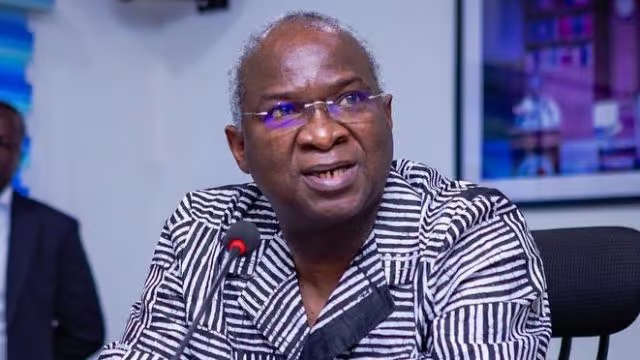
  • Wike Announces Grand Plans for FCT at 50 Celebrations

    Wike Announces Grand Plans for FCT at 50 Celebrations

    According to reporting by The Punch, the Minister of the Federal Capital Territory (FCT), Nyesom Wike, has officially announced plans for a landmark celebration to mark Abuja’s 50th anniversary. The “FCT at 50” events are expected to showcase the city’s transformation from a virgin territory in 1976 to a modern African metropolis. The Minister noted that the celebration would include the commissioning of several multi-billion naira infrastructure projects.

    The festivities are designed to promote Abuja as a premier destination for tourism and investment in West Africa. Wike emphasized that the milestone provides an opportunity to reflect on the city’s master plan and recommit to urban renewal efforts. Key highlights will include cultural festivals, investment summits, and the honoring of the city’s founding fathers.

    Daily Post and Leadership have both featured the Minister’s announcement. Daily Post reported that “the FCT administration is collaborating with private sector partners to fund the anniversary events.” Leadership Newspaper mentioned that “residents are expecting a facelift of several satellite towns as part of the celebratory projects.”

    Echotitbits take:

    Under Wike’s tenure, Abuja has seen a rapid acceleration of road and bridge construction. Using the 50th anniversary as a deadline for these projects is a clever political and administrative move to ensure completion. Expect a significant boost in the local hospitality sector during the anniversary month, though residents should prepare for temporary traffic diversions.

    Source: The Guardian – https://guardian.ng/news/abuja-50-golden-jubilee-drives-renewed-infrastructure-push-wike/, February 5, 2026

    Photo credit: The Guardian

  • Finance Minister Targets 7% Economic Growth via Private Investment

    Finance Minister Targets 7% Economic Growth via Private Investment

    As reported by Punch on February 4, 2026, Nigeria’s Minister of Finance has reasserted the government’s commitment to achieving a 7% economic growth rate by 2027. The Minister emphasized that the primary driver for this ambitious target would be the scaling up of private sector investments and the continuation of aggressive fiscal reforms aimed at deregulating key sectors like energy and transport.

    The administration’s strategy involves leveraging public-private partnerships (PPPs) to address the country’s infrastructure deficit. The Minister noted that Nigeria is “ready to collaborate with global partners” to deliver inclusive growth, particularly in the digital economy and clean energy sectors, which are seen as the next frontiers for Nigerian development.

    Validation of this economic outlook comes from ThisDay and Leadership. ThisDay reports that “global investors are showing renewed interest in Nigeria’s energy sector,” quoting a Standard Chartered analyst who says, “The 7% target is achievable if the current reform momentum is sustained.” Leadership also highlights the role of the Nxtra Data Centre in Lagos as a model for private-led growth, with a tech executive stating, “Digital infrastructure is the backbone of the new Nigerian economy.”

    Echotitbits take: A 7% growth target is highly ambitious given the current inflationary environment. However, the focus on private investment rather than government spending is a shift in the right direction. The key challenge will be ensuring that this macro-level growth trickles down to reduce the high unemployment rate and poverty levels.

    Source: The Punch – https://punchng.com/reforms-private-investment-crucial-for-7-growth-edun/, February 4, 2026

    Photo credit: The Punch

  • Federal Government Unveils Ambitious Gas Master Plan to Drive 2026 Industrial Growth

    Federal Government Unveils Ambitious Gas Master Plan to Drive 2026 Industrial Growth

    According to The Punch, the Nigerian government is set to launch over 60 critical gas projects under the newly refined Gas Master Plan 2026. This initiative is designed to transition the nation toward a gas-driven economy, significantly increasing domestic production while expanding export capacities to bolster foreign exchange reserves.

    The policy framework focuses on leveraging Nigeria’s vast natural gas reserves to power local industries and reduce the cost of energy for manufacturers. Government officials believe that by prioritizing gas-to-power and gas-to-industry projects, the country can mitigate the impact of fluctuating oil prices and create a more resilient industrial base.

    ThisDay reported that the Ministry of Petroleum Resources is actively seeking private-sector partnerships to fund the infrastructure required for these projects. A spokesperson for the ministry stated, “Our goal is to turn Nigeria into a regional gas hub within the next twenty-four months.” The Guardian also validated the report, noting that the plan includes significant pipelines and processing plants, with an analyst quoting: “The execution of these 60 projects will be the true litmus test for Nigeria’s energy transition.”

    Echotitbits take:

    This move is a strategic pivot toward “Gas as a Transition Fuel,” aligning with global energy trends. The success of this master plan could drastically lower production costs for Nigerian businesses, which are currently crippled by high diesel prices. However, the primary challenge remains security for pipeline infrastructure and the ability to attract the massive capital investment required to see these projects to completion.

    Source: The Punch – https://punchng.com/nnpc-unveils-gas-master-plan-to-boost-nigerias-energy-sector/, and February 2, 2026

    Photo credit: Vanguard

  • Federal Government Pegs Nigeria’s Housing Deficit at 14.9 Million Units

    Federal Government Pegs Nigeria’s Housing Deficit at 14.9 Million Units

    Reporting by The Guardian indicates that the Federal Government has officially released updated data on the country’s housing crisis, placing the national deficit at 14.9 million units. This figure, released by the National Housing Data Technical Committee, aims to provide a credible baseline for future planning and investment in the real estate sector. The Minister of Housing and Urban Development, Architect Ahmed Dangiwa, noted that the lack of accurate data had previously hindered the government’s ability to tackle the shortage effectively.

    The report underscores the growing pressure on both the public and private sectors to deliver affordable housing, particularly in urban centers where migration remains high. Unlike previous years where the “17 million” figure was frequently cited without empirical evidence, this new data is expected to guide the allocation of resources under the National Housing Program.

    Vanguard corroborated the report, quoting the committee chairman, Dr. Taofeek Olatinwo, who said, “The country’s housing deficit stood at 14.925 million as of late 2025.” ThisDay also covered the launch, noting that “investors are now looking at the data to identify high-demand regions for affordable housing projects.”

    Echotitbits take: A lower-than-expected deficit figure might sound like good news, but 15 million is still a staggering number. The focus will now shift to whether the government can provide the necessary land titles and infrastructure to make private-sector participation viable.

    Source: The Guardian – https://guardian.ng/news/fg-puts-nigerias-housing-deficit-at-14-9-million/ January 28, 2026

    Photo Credit: The Guardian

  • Nigeria’s Power Infrastructure Suffers Second National Grid Failure Within Five Days

    Nigeria’s Power Infrastructure Suffers Second National Grid Failure Within Five Days

    According to reporting by Premium Times, the Nigerian electricity supply has once again been thrown into total disarray following the collapse of the national power grid on Tuesday. This latest incident marks the second time in less than a week that the country has experienced a nationwide blackout, severely impacting economic activities and residential comfort across various states. Distribution companies, including those in Abuja and Eko, confirmed the loss of power supply, stating that they were awaiting technical resolution from the Transmission Company of Nigeria (TCN).

    The recurring failure of the transmission system has sparked renewed concerns regarding the Federal Government’s ability to stabilize the energy sector. Analysts note that these frequent disturbances undermine industrial productivity and increase the cost of doing business as firms are forced to rely on expensive alternative energy sources. While the TCN typically attributes such collapses to technical “disturbances” or “system frequency fluctuations,” the lack of a permanent solution remains a point of contention for energy stakeholders.

    The Daily Trust also confirmed the development, noting that “Nigeria’s electricity grid yesterday recorded its third collapse in a month,” highlighting a rapid decline in grid stability since the start of the year. Similarly, ThisDay reported on the widespread darkness, quoting an industry source who stated, “The national grid collapsed on Tuesday afternoon, leaving power supply across most of the country at near-zero levels.”

    Echotitbits take: This frequent grid instability suggests deep-seated infrastructural decay that the 2026 budget allocations must address urgently. Watch for the Ministry of Power to provide a formal roadmap for grid decentralization, which experts argue is the only long-term solution to these recurring collapses.

    Source: The Guardian – https://guardian.ng/news/national-grid-bounces-back-after-crashing-to-39mw/ January 28, 2026

    Photo Credit: The Guardian

  • FG signals Lagos–Calabar coastal road may be tolled after commissioning

    FG signals Lagos–Calabar coastal road may be tolled after commissioning

    In an update published by The Punch, the federal government says the Lagos–Calabar Coastal Highway could be tolled after it is commissioned, signalling a user-pay approach to long-term maintenance and financing.

    Officials argue tolling helps keep roads serviceable, but critics often worry about transparency, value-for-money, and whether toll revenues will translate into better road quality and safety.

    The policy debate is also about affordability: tolls can shift costs to commuters and logistics operators, potentially affecting prices of goods—especially if alternative routes remain poor.

    The key question now is the framework: toll rates, exemptions, electronic collection, and an independent mechanism to track proceeds and maintenance performance.

    Echotitbits take: Tolling isn’t inherently bad—opaque tolling is. Watch for a clear tariff regime, public disclosure of concession terms (if any), and measurable service standards (repairs, lighting, security, response time).

    Source The Punch – https://punchng.com/lagos-calabar-coastal-highway-to-be-tolled-after-unveiling-umahi/ 11 January 2026

    The Punch 2026-01-11

    Photo Credit: The Punch

  • Jersey to Repatriate $9.5m Abacha Funds for Abuja–Kano Road Completion

    Jersey to Repatriate $9.5m Abacha Funds for Abuja–Kano Road Completion

    According to The Punch, the Bailiwick of Jersey will return more than $9.5 million in forfeited funds to Nigeria, with the money earmarked for the final stages of the Abuja–Kano Road project.

    The report frames the move as part of Nigeria’s wider asset-recovery push, with officials emphasizing visible infrastructure outcomes from recovered proceeds.

    For road users and contractors, the key question is how quickly the repatriated funds translate into measurable progress on the corridor.

    Daily Post also described it as “fresh $9.5m Abacha loot” being returned from Jersey, while Tribune Online similarly reported “more than $9.5 million” headed back to Nigeria for the Abuja–Kano route.

    Echotitbits take: Watch procurement and project transparency—implementation details, milestone reporting, and independent monitoring will decide whether this becomes a trust-building win.

    Source: PremiumTimes – https://www.premiumtimesng.com/news/headlines/848587-jersey-to-repatriate-over-9-5m-abacha-loot-to-nigeria.html January 10, 2026

    PremiumTimes 2026-01-10

    Photo Credit: PremiumTimes

  • Cooking Gas Prices Hold Around ₦1,000/kg as Supply Improves

    Cooking Gas Prices Hold Around ₦1,000/kg as Supply Improves

    Details shared by The Punch indicate liquefied petroleum gas (LPG) prices have steadied at about ₦1,000 per kilogram in several major cities, after months of volatility.

    Industry sources linked the stability to improved supply conditions and more dependable local output, which has reduced pressure from imports.

    Marketers, however, warned that distribution costs—driven by logistics challenges and diesel prices—remain a risk factor.

    **Echotitbits take:** Stable LPG pricing is a meaningful relief for households and small businesses. The next test is infrastructure: without better distribution networks and cheaper logistics, price stability can quickly unravel.
    Source: The Punch — https://punchng.com/cooking-gas-stabilises-around-n1000-kg-as-supply-improves/ 2026-01-08

    Photo Credit: Punch Newspapers.

  • Senator says subsidy removal saves Nigeria ₦10tn yearly, urges patience with reforms

    Senator says subsidy removal saves Nigeria ₦10tn yearly, urges patience with reforms

    Figures cited by Punch show Ogun West senator Solomon Adeola says removing petrol subsidy is saving Nigeria over ₦10tn annually, arguing the funds can support economic predictability and infrastructure.

    Adeola also defended tax-law implementation, insisting the versions being rolled out align  what lawmakers passed and were not altered after signing.

    The remarks reflect the government’s broader reform narrative—short-term pain for medium-term fiscal stability—though citizens continue to weigh claims against lived inflation pressures.

    Echotitbits take: The savings claim will be tested by transparency: where exactly does the money go, and can Nigerians see it in services and inflation relief? Watch for audited baselines, monthly fiscal reporting, and how palliatives/infrastructure spending track against ‘savings’ narratives.

    Source: The Punch — January 3, 2026 (https://punchng.com/subsidy-removal-saving-nigeria-over-n10tn-annually-adeola/)

    The Punch January 3, 2026

    Photo Credit: The Punch

  • Nigeria construction output hits ₦13.83tn as activity strengthens on investor confidence

    Nigeria construction output hits ₦13.83tn as activity strengthens on investor confidence

    Figures cited by Punch show Nigeria’s construction sector produced ₦13.83tn in nominal output over the first nine months of 2025, pointing to a rebound in activity.

    Analysts tie the momentum to improved sentiment and project execution, though material costs, FX exposure, and logistics remain major constraints on margins and delivery timelines.

    Construction performance often signals wider economic spillovers—jobs, cement demand, and infrastructure effects that feed into manufacturing and services.

    Echotitbits take: The rebound is real, but durability depends on financing depth and stable input costs. Watch for Q4 prints, whether mortgage/real-estate credit expands, and how quickly major public works translate into verifiable on-ground output.

    Source: The Punch — January 4, 2026 (https://punchng.com/investor-confidence-lifts-construction-output-to-n13-83tn/#google_vignette)

    The Punch January 4, 2026

    Photo Credit: The Punch