


Carteret, New Jersey — On October 1st, Nigeria’s green-and-white flag once again flew proudly in Carteret Borough, New Jersey, but with an added historic touch this year. The Middlesex County Board of Commissioners officially extended its recognition of Nigeria’s Independence Day beyond Carteret Borough to the entire county. This marks a new milestone for the Nigerian community in America’s Northeast corridor.
At the heart of the celebration was Otunba Olusoga Onafowora, a respected son of Ijebu-Ode, Ogun State, Nigeria, and a cultural pillar of the Nigerian diaspora. Otunba Onafowora, who serves as a Commissioner at the Middlesex County Utilities Authority (MCUA), is a retired Permanent Secretary from Ogun State and former Bursar of Essex County College, Newark, New Jersey. He has long championed initiatives that project Nigerian culture, values, and civic contributions in the United States.
Official Proclamations: From Carteret to County

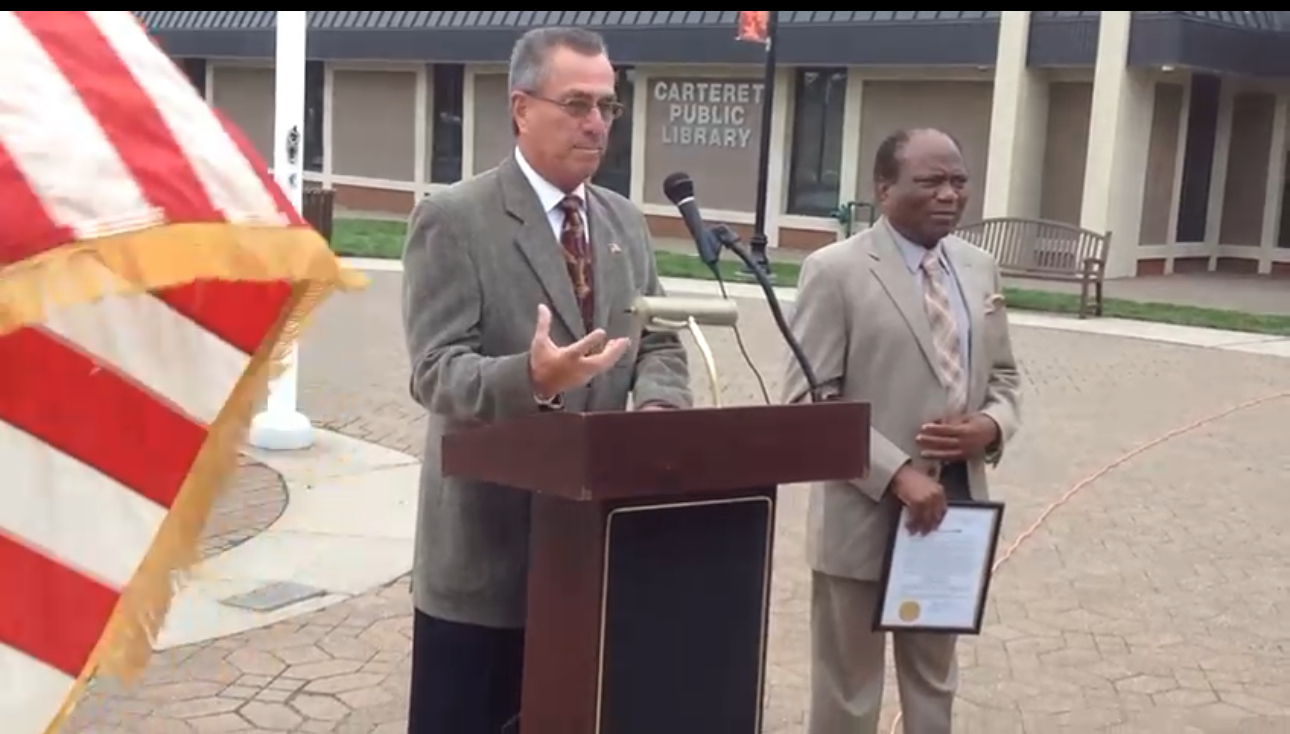
The event began with speeches at the historic Carteret Memorial Municipal Building, one of the last standing World War I memorial municipal halls in New Jersey. The Mayor of Carteret emphasized the symbolism of holding the ceremony at the monument, flanked by two lions named Liberty and Justice.
The highlight came when Ronald G. Rios, Director of the Middlesex County Board of Commissioners, presented a formal proclamation:
“On October 1, 1960, Nigeria gained its independence from the United Kingdom… In 2014, Nigeria became Africa’s largest economy, worth over $500 billion. By 2050, it is expected to be one of the world’s top 20 economies. Today, Middlesex County stands with Nigerians in recognizing their independence and their contributions here.”
Rios further acknowledged the Nigerian diaspora’s “hard work and dedication,” describing them as a community that has “helped make Middlesex County stronger through cultural, civic, and economic contributions.”
Nigerian Voices: Pride and Continuity

Taking the podium, Otunba Olusoga Onafowora expressed gratitude to the Borough of Carteret, the Middlesex County Freeholders, and the wider community for institutionalizing the annual Independence Day celebration:
“This has become a tradition in the city of Carteret. With the support of our leaders here, we are ensuring that Nigeria is recognized in this country. We thank the Board of Commissioners and extend this declaration as proof that Nigeria’s presence is felt and respected in America.”
He emphasized that such recognition serves as encouragement for Nigerians abroad and also strengthens ties with government leaders back home in Nigeria.
Community members in colorful Nigerian attire—agbadas, iro and bubas, and green-white scarves—joined in singing, prayers, and solidarity pledges. Many noted that this celebration, once limited to Carteret Borough, has now become a county-level recognition, symbolizing the growing influence of the Nigerian community in New Jersey.

Middlesex County: Economic Context
The importance of this recognition is amplified by Middlesex County’s economic weight:
• GDP (2023): $83.7 billion — larger than any Nigerian state except Lagos.
• Population: ~863,600 — the second most populous county in New Jersey.
• Per Capita Income: $75,352 — higher than U.S. national averages.
For perspective, leading Nigerian states such as Ogun, Rivers, Akwa Ibom, Imo, and Delta each have GDPs in the range of $11–20 billion, underscoring the significance of Middlesex County acknowledging Nigeria at this scale.

Conclusion
The 2025 celebration in Carteret was more than a cultural festival. It was a symbol of integration, recognition, and pride for Nigerians in America. With the proclamation elevated to a countywide declaration, Middlesex County has affirmed the Nigerian diaspora’s place in its multicultural tapestry.
For Otunba Olusoga Onafowora and the Nigerian community, the moment underscored a simple but powerful truth: wherever Nigerians go, the green-white-green flag flies high.