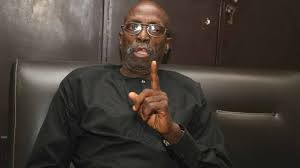
In an update published by The Punch on February 14, 2026, President Bola Tinubu has expressed profound grief over the passing of Professor Biodun Jeyifo, a renowned literary critic and former President of the Academic Staff Union of Universities (ASUU). Jeyifo, a scholar of international repute, was celebrated for his contributions to African literature and his unwavering activism for academic freedom and social justice.
The presidency described his death as a monumental loss to the global academic community and the Nigerian intelligentsia. Jeyifo was known for his critical work on the works of Wole Soyinka and Chinua Achebe, as well as his radical approach to political economy and cultural studies. Tributes have continued to pour in from university campuses across the nation, remembering him as a “scholar-activist” who never compromised his principles.
As reported by The Guardian and ThisDay, Jeyifo’s legacy remains a cornerstone of Nigerian intellectual history. The Guardian stated that “his death marks the end of an era for the radical left in Nigeria,” while ThisDay featured a quote from a colleague: “Professor Jeyifo was a titan of the mind whose pen was as sharp as his commitment to the masses.”
Echotitbits take: Jeyifo’s passing leaves a void in the Nigerian intellectual space. As ASUU continues to navigate complex negotiations with the government in 2026, his history of principled leadership will likely serve as a renewed source of inspiration for the current academic struggle.
Source: The Punch – https://punchng.com/tinubu-mourns-literary-giant-ex-asuu-leader-biodun-jeyifo/, February 14, 2026
Photo credit: Arise
Tag: ASUU
-

Federal Government Commences 40% Allowance Hike for University Lecturers
Reporting by Vanguard indicates that the Federal Government has officially begun the implementation of the renegotiated agreement with the Academic Staff Union of Universities (ASUU). Central to this development is the payment of a 40% increase in peculiar allowances, a move designed to stabilize the perennially volatile higher education sector and curb the “japa” syndrome among Nigerian academics.
The disbursement follows months of back-and-forth negotiations between the Ministry of Education, the Ministry of Labour, and union leadership. This fiscal intervention is part of a broader strategy to improve the welfare of public servants under the 2026 budget, which has been described by government officials as a “Budget of Consolidation.”
Education analysts suggest that while the 40% hike is a significant step, it only addresses one facet of the 2009 agreement that has caused decades of industrial action. The government is also reportedly looking into the release of withheld salaries for other unions within the university system to ensure a holistic peace on campuses across the country.
Further confirmation from The Nation and Daily Trust highlights the mixed reactions from the academic community. The Nation quoted a branch chairman who said, “While we acknowledge the payment, the government must also address the infrastructural decay in our labs.” Daily Trust added that “the Office of the Accountant-General has confirmed that the payroll system has been updated to reflect the new rates for all verified staff.”
Echotitbits take: This is a calculated move by the Tinubu administration to buy peace in the education sector before the 2027 election cycle heats up. Watch for whether this increase effectively stops the exodus of Nigerian professors to foreign institutions or if inflation quickly erodes these gains.
Source: The Cable – https://www.thecable.ng/asuu-agreement-fg-begins-implementation-of-40-allowance-increase-for-varsity-lecturers/, February 10, 2026
Photo credit: The Cable
-

With ASUU’s Victory over Unwilling FG, It’s Time to Reopen Public Universities in Nigeria, By Idowu Sowunmi
After the usual government’s fudge and mudge for more than eight months, the President Muhammadu Buhari-led administration has eventually been boxed into a corner and forcefully made to bend on its knees over avoidable confrontation with the Academic Staff Union of Universities (ASUU).
The recalcitrant stance of the Federal Government, insisting on using the Integrated Payroll and Personnel Information System (IPPIS) as the only viable platform in paying the lecturers’ salaries and emoluments fell on its face.
And ASUU won!
The Federal Government did not just agree to pay the lecturers’ outstanding salaries using the old methods, the Buhari administration, like a ductile substance which is capable of being drawn into wire, was constrained to adopt ASUU’s alternative University Transparency and Accountability Solution (UTAS) for payment of salaries and others.
READ ALSO:
Magu’s Troubles Likely Worsens as Buhari Receives Inquiry Report on Ex-EFCC Chairman
Not done, ASUU also succeeded in forcing the Federal Government to offer a cumulative sum of N65 billion to address earned academic allowances and revitalisation of universities.
Minister of Labour and Employment, Chris Ngige, said a sum of N15 billion from the amount offered by the government would be used to revitalise the universities.
The minister added that the fund was in addition to N20 billion paid earlier, making it a total of N35 billion committed as revitalisation fund by the government.
Reacting to the development, ASUU said: “The negotiation between the Federal Government and ASUU today (November 20) yielded very good results.
“The government has agreed to use the old platform before IPPS to pay all withheld salaries.
READ ALSO:
Debate Relevance of N’Assembly to Nigerians, not ‘Jumbo Pay’ – Senate President
“UTAS is still undergoing usability test.
“On revitalisation, the government offered N15 billion in addition to the N20 billion pledged earlier.
“ASUU would now consult with its council and then get back to the government in a short while to make their final intention known; if the strike will be suspended or not.”
Sure, our lecturers have upperhand now and they are expected to return to classes after eight months of avoidable disruption.
It’s hoped that going forward the Federal Government would make enough room for effective dialogue to take its primacy, so as to avoid future disruption of this magnitude.