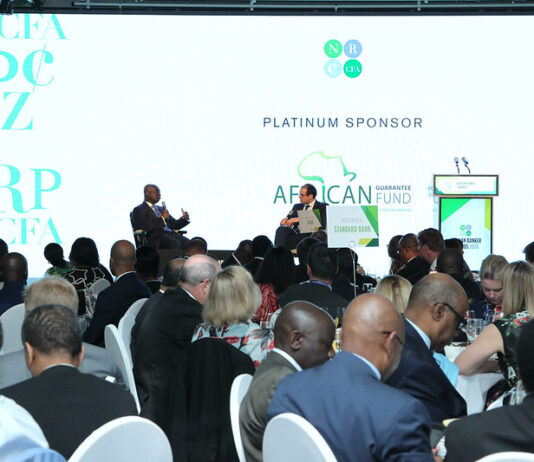

African Development Bank has designated representatives from 80 government institutions, civil society organisations and universities for training as experts in developing climate financing proposals.
Following a thorough independent selection process, 80 participants were chosen, with approximately 40 from English-speaking countries and 40 from French and Portuguese-speaking countries.
The trainees would pass on their knowledge to potential beneficiaries of the Green Climate Fund, a $10 billion endowment set up in 2010 to help countries implement their climate agenda through loans, equity, guarantees and grants.
The 120-hour training programme would be managed by Climate Change and Green Growth Department of African Development Bank, with funding from Korea-Africa Economic Cooperation Trust Fund.
The scheme is being built on ongoing work by African Development Bank, Green Climate Fund and other partners to support the bank’s regional member countries to directly access Green Climate Fund resources.
“The Green Climate Fund is expected to be a major source of climate finance for the African continent. Accessing finance from the Fund is challenging because of the complexities of designing climate change projects to fulfill the funding criteria.
“This training will boost capacity amongst African nationally determined authorities, governments and consultants by training trainers to run future training courses,” said Manager of the Environment and Climate Finance Division in the Department of Climate Change and Green Growth at African Development Bank, Gareth Phillips.
The Coronavirus (COVID-19) pandemic has made the training to be shifted from in-person to online. This has the advantages of making it less costly to run and more carbon efficient.
The project’s theory of change is based on three main components, which complement ongoing work by the bank to enhance the capacities of several African countries to access Green Climate Fund resources through small grants from the Africa Climate Change Fund.
These components include: developing training materials and an online platform to support direct access to the Green Climate Fund, training a pool of experts and certifying them to support African governments and institutions, and facilitating south-south learning.
Former Minister of Finance, Ngozi Okonjo-Iweala and Nigeria’s nominee for the position of the Director-General of the World Trade Organisation (WTO) is set to emerge winner of the competitive race to the highly coveted head of the international body.
Reuters on Wednesday reported that a key group of WTO ambassadors proposed Okonjo-Iweala to lead the trade organisation on Wednesday,
The official announcement is expected to be made later today by WTO.
Okonjo-Iweala served as Finance Minister twice, that was during the tenures of former presidents Olusegun Obasanjo and Goodluck Jonathan.
She has experience working at international governance bodies as a former managing director of the World Bank and as a chairman at the Global Alliance for Vaccines and Immunization.
Once officially announced, Okonjo-Iweala will be the first African and first female director-general of the international body in its 25-year history.
A technology approach to solving some of the challenges faced in pension administration has been introduced with the development of I’M Alive, a pensioner verification solution by Chams Plc.
The Group Managing Director (GMD) of Chams Plc, Gavin Young, at an interactive session with journalists on Monday, at the firm’s corporate headquarters in Victoria Island, Lagos, said the solution, which is a mobile application, is designed to ease verification processes for both pension administrators and pensioners.
The I’M Alive solution, according to the Lagos based firm will verify pensioners remotely in the comfort of their homes using a facial biometric mobile app that facilitates quick and easy verification for both government and private pensioners, and provides pension administrators with comprehensive reporting to ultimately facilitate pension payments.
In his remark while explaining the impact, Young noted that the I’M Alive solution would go a long way towards solving a major process-intensive hurdle for the Pension Industry.
“For both pensioners and pension payers, I’m Alive solution is convenient, saves time & money, easy-to-use, less administrative bottle neck and headaches. The Solution is fully equipped with features that will make life easy for pensioners as it is supported by Artificial Intelligence which will detect liveliness and authenticate the Pensioner for payment processing.
“The app and pensioner are not linked to a particular phone number or mobile handset. Any smartphone with a functionality that aides selfie alignment and lighting quality can be used, ensuring a higher success rate for pensioners using the app.
The firm’s GMD expressed confidence about the security of the application noting that it cannot be hacked, stressing that no third party can impersonate a registered and verified pensioner on the app.
“Every data is encrypted and it cannot be copied. In addition, Chams Plc adheres to data protection compliance regulations as specified by NITDA”, he stated.
Speaking on the sustainability of the solution, Young admitted that while the priority for now is to solve the basic problems of inconvenience and overhead cost associated with the current physical presence verification, the mobile verification app solution can still do a lot more. He added that more features such as linking payment to the app could come later.
The GMD, giving further explanation on the product said “the design had in mind users that are not tech savvy and in the remote areas as pensioners don’t have to be tech-savvy to use the app as it is user friendly and has detailed explanations, including the ability to work in an offline mode.
“The verification can be done on any smartphone, owned by anybody. Once you have your BVN & retiree number ready, it takes less than three minutes as verification is real-time.
“Through this product, Chams has continued to expand operations through strategic partnerships and innovative products and solutions that are tailored to the Nigerian and African Markets” Young said.
Earlier this year, Chams Plc, a Nigerian company of over 35years experience at providing digital solutions across a broad range of customer segments in Nigeria embarked upon a new vision and strategy that focuses on consumer-facing innovative digital solutions that are mobile phone based and not only beneficial to Nigerians but the greater African market.
African Development Bank (AfDB) has made case for agro-industrialisation projects by seeking support from Nordic country partners towards adding value to the competitive production of commodities such as cocoa, livestock and cotton in order to leverage the African Continental Free Trade Agreement (AfCFTA).
Speaking at a webinar held on Thursday by Nordic-African Business Association (NABA), Vice President for Private Sector, Infrastructure and Industrialisation at African Development Bank, Solomon Quaynor, called for a strategic investment opportunities in Africa.
He explained that this singular gesture would allow “African production to participate more in these value chains and also to increase jobs and increase incomes to private sector and also the African economy.”
One good example of this is Africa Finance Corporation (AFC) and AP Moller Capital’s Arise Group of Companies, in partnership with Olam of Singapore.
The digital webcast, jointly organised by NABA, Norwegian Ministry of Foreign Affairs, Scatec Solar and AFC, was part of a day-long event aimed at reconnecting Nordic businesses with the continent.
Nordic-African Business Summit has been hosted for nine consecutive years in Oslo – with more than 3,000 guests and 300 speakers from over 40 countries taking part so far.
Quaynor, who was joined by African Development Bank’s Executive Director for the Nordic countries, Ireland and India, Paal Bjornestad, addressed a virtual audience made up of Nordic business representatives, government and private sector and interested individuals.
The panel entertained various questions, such as that of bankability which includes market and profitability/cashflow risk, lack of a conducive enabling environment, properly conducted Environmental and Social Impact Assessment (ESIA), and challenges of integrity of sponsors and contractors.
Other questions focused on project financing available for investors, trade finance, and whether the bank has invested in tourism projects.
Responding, African Development Bank said it supported “all projects which support economic development, but we have decided to be selective and focus on areas of our comparative advantage.”
The bank is being more selective and targeting larger transformational industrialisation projects. “We also support financial institutions to indirectly support smaller projects. We will also be pivoting more from maximising our direct loans to using guarantees to crowd in other private investors,” Quaynor added.
On the criteria for Bank support in smaller projects, he said: “In areas where the opportunities are small but very important, such as off-grid renewable energy, we support through platforms such as SEFA (the Sustainable Energy Fund for Africa)…
“Overall we need bankable projects, credible business plans…and we need to be sure that ESG and compliance work has been done.”
The bank’s mandate to spur sustainable economic development and social progress on the African continent, saw $9 billion in commercial and concessionary lending in 2019, Quaynor outlined, during his presentation on the bank’s activities and priority areas, which was followed by a question and answer session.
This lending went towards its priority High5s, across its key cross-cutting themes – that is mainstreaming gender, support to fragile markets, and climate-friendly projects. Twenty five per cent was to the private sector.
One example of this is Boko Mine and Port in Guinea, described as a “truly transformative project.”
The $1.4 billion integrated mining and related transport infrastructure project has benefitted from a 14-year senior loan of up to $100 million from African Development Bank, with up to a three-year grace period.
The project is expected to add $400 million to Guinea’s GDP, $300 million to the country’s trade balance annually during the operational phase.
Additionally, over 4,000 jobs would be created during its construction phase, as well as 700 permanent and 1,500 temporary jobs during the operational phase.
President Muhammadu Buhari Thursday explained that the recently passed Companies and Allied Matters Act, 2020 (CAMA) in Nigeria will enhance transparency and corporate accountability in the fight against corruption.
President Buhari spoke in a video message presented at the Open Government Partnership (OGP) 2020 Virtual Leaders’ Summit on the sidelines of the 75th Session of the United Nations General Assembly (UNGA75) in New York, United States, Special Adviser on Media and Publicity, Femi Adesina stated in an official statement.
”Since the inception of our Administration in 2015, the Government has been committed to changing international and domestic perceptions regarding Nigeria’s commitment to fight corruption and foster good governance.
”We focused on the task of dealing head-on with this destructive monster, which led to us joining the Open Government Partnership and making reform commitments such as to establish a public central register of beneficial owners of corporate entities.
”Since then, we have made significant progress in implementing tougher anti-corruption measures, including my recent assent to the Companies and Allied Matters Act, 2020.
”The Act provides a legal framework for the implementation of Beneficial Ownership Information Disclosure in Nigeria.
”Being an OGP member-country has helped Nigeria learn from other countries tackling similar challenges, and to build a coalition to support these reforms across the private sector and civil society. It has also aided our journey towards building citizens’ trust in government,” he said.
As COVID-19 cases continue to accelerate worldwide, President Buhari told the Summit that it had become clear that governments cannot solve all the challenges of the pandemic alone, stressing it is only through open governance and working with citizens that nations can succeed.
”We face a significant contraction in the global economy in 2020; the world is facing the unprecedented twin challenges of managing the health and economic impacts of the pandemic.
”In these times, citizens worldwide are seeking more information, engagement, and support from their governments,” he said.
The Nigerian leader pledged that his administration would continue to use its OGP membership to ensure that open government approaches strengthen the pandemic management, adding that the Nigerian government will sustain consultations and engagements with citizens through Civil Society Organisations and the Organised Private Sector on COVID-19 response and recovery plan.
According to the President, ”these consultations are in line with the effort of our administration to encourage public participation in government policies and programs.
”Our recovery package includes support to businesses, to vulnerable communities and an expansion of public works. Our aim is to make all these efforts more effective by making them open. ”
President Buhari recounted that soon after joining this partnership, Nigeria had the privilege of being elected to the OGP Global Steering Committee.
As a leader in the OGP Steering Committee, President Buhari acknowledged that Nigeria has learnt from both government and non-government counterparts on international best practices.
”I am also glad that Nigeria’s pioneering sub-national Open Government Partnership Model has become one of the leading examples driving the expansion of the Open Government Partnership Local Programme.
”Nigeria will also champion the tenets of the Open Government Partnership through our leadership role in regional institutions.
”We aim to expand the partnership on the African Continent by continuing to play a leading role in the International Steering Committee.
”As we look forward to celebrating 10 years of the existence of the Open Government Partnership next year, it is my earnest wish that all countries in the world will adopt Open Government principles and help democracy live up to the expectations of citizens having a voice at and beyond the ballot box, ” he said.
President Buhari thanked the leadership and staff of the OGP Global Support Unit for the enormous work they do to ensure that voices are not only heard but valued. He encouraged Nigerians to get involved in the OGP and help shape and sustain the country’s democracy now and in the future.
Among those who participated in the virtual event were Heads of State and Government of Argentina, Canada, France, Georgia and Germany as well as civil society leaders who have played a central role in their countries to ensure a full, fair, and inclusive response and recovery.
Inflation rate in Nigeria has spiralled up to hit 13.22% as the end of August, a record that broke a 29-month moving average.
The Consumer Price Index (CPI), which measures prices of goods and services, released by the National Bureau of Statistics (NBS) on Tuesday revealed that the 13.22 percent is 0.40 percent points higher than the 12.82 percent recorded in July.
The CPI stated that inflation rate rose by 1.34% on a month-on-month basis, indicating they August inflation rate was the highest since April 2018.https://echotitbits.com/poultry-farmers-demand-total-ban-on-importation-of-poultry-products/
Year-on-year inflation rate declined from 13.34 percent in March 2018 to 12.48 percent the following month. It had remained between 11 and 13 until last month.
According to The Guardian, data contained in the CPI report showed that the food category recorded 17.3 percent to emerge as the item with the highest price increase in the year. The prices of imported foods increased by 16.6 percent in the period.
Furthermore, items such as – food, imported food, footwear/clothing, transport, health, communication, education, restaurant/hotels, food/non-alcoholic beverage, recreation/culture, furnishings/household, equipment,, maintenance, housing, water, electricity, gas, other fuel and alcoholic beverage, tobacco, kola, as captured by CPI basket within the 12-month period reviewed experienced decrease in prices (deflation).
The CPI stated further in its review that year-on-year inflation in urban areas moved from 13.40 percent in July to 13.83 percent in August while month-on-month increased from 1.27 percent to 1.40 percent.
in rural areas, year-on-year inflation rose from 12.28 percent in July to 12.65 percent in August while as per month-on-month, it rose up slightly – from 1.23 percent to 1.27 percent.
States that led the pack being above national average in food inflation as at August 2020 were Kogi, Kwara, Edo and Delta, with 22 percent, 19.1 percent, 19 percent and 17.9 respectively. In the North, Gombe, Kano and Bauchi experienced lower than the national average.
However, Nigeria’s leader, President Muhammadu Buhari in his reaction to current food price hike across the country appealed to residents for calm.
File Photo of Nigeria’s President Muhammadu Buhari.
President Buhari, at the yearly Chartered Institute of Bankers of Nigeria (CIBN) Conference in Abuja, which he declared opened, assured Nigerians that prices would trend down soon
The president, represented by the Minister of Finance, Budget and National Planning, Mrs. Zainab Ahmed said: “Amidst the uncertainty created by the pandemic, we’re confident that the Nigerian economy will bounce back strongly within the near term with the right policy responses to the multidimensional crises.
“Since we cannot simply wait for things to get better on their own, we have to formulate appropriate policies and implement them steadfastly to address the challenges head on”, the President said.
Giving account of efforts to mitigating the economic challenges occasioned by the COVID-19 pandemic, the President explained that so far, the Federal Government had implemented a wide range of fiscal, prudential and monetary measures that squarely addressed four key necessities.
He said government is ensuring sufficient liquidity, in part to support its programmes for saving lives and livelihoods. He listed others to include maintaining stability of the financial system, ensuring continued delivery of financial services to the public, and shoring up confidence to cushion economic activity.
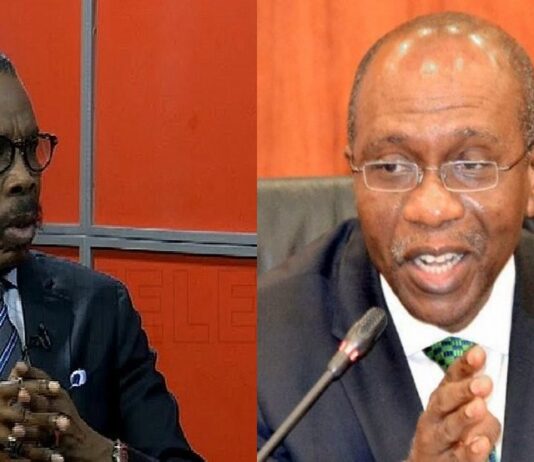
Also speaking at the conference, the Governor of the Central Bank of Nigeria [CBN], Mr. Godwin Emefiele expressed hope for price moderation, just as he blamed the increase in prices to some fiscal measures adopted recently.
File Photo: Governor of Central Bank of Nigeria, Godwin Emefiele speaks at the Nigeria Capital Markets and Banking Forum. Chris J Ratcliffe / Bloomberg
He gave a historical perspective to the inflation trajectory in the country in the beginning of the first quarter of 2020 and response action taken by the apex bank to hedge the trend.
“Inflationary pressure persisted in the first and second half of the year due to several factors.
“In addition to the disruption to global and domestic supply chains as a result of COVID-19, inflation was exacerbated by the increase in VAT rate, exchange rate adjustment and seasonal food supply shocks due to the onset of the farming season and other structural bottlenecks.
“Inflation in July 2020 stood at 12.8 percent. We, however, expect inflation to begin to moderate towards the end of the fourth quarter, as we approach the harvest season, along with the phased withdrawal on restrictions of movement and other measures imposed as a result of COVID-19”, CBN Governor, Emefiele said.
The US Export-Import Bank has reaffirmed its commitment to the growth of the US-African cooperation by constituting Sub-Saharan Advisory Committee for 2020 and 2021.
The committee is composed of pro-investment and pro-business advisors who understand Africa and would be instrumental in growing the US-African cooperation and flows of goods, services and technology.
The Sub-Saharan Advisory Committee is chaired by the Senior Vice President and Director of the Programme on Prosperity and Development at the Centre for Strategic and International Studies (CSIS), Daniel Runde.
Other members of the committee include: Chief Executive Officer, Energy and Natural Resource Security, Inc., Derek Campbell; Senior Vice President, African Affairs and President, US-Africa Business Centre, US Chamber of Commerce, Scott Eisner; Founder and Chief Executive Officer, AppsTech, Rebecca Enonchong; Executive Director/Americas Export Finance Head, JPMorgan Chase Bank, Lori Helmers; President and Chief Executive Officer, Corporate Council on Africa, Florizelle Liser, Chairman, AfricaGlobal Schaffer,
Mima Nedelcovych; Principal, The OKPA Co., EE Okpa; Director Customer and Industry Relations, Progress Rail, a Caterpillar Company, Marise Duff Stewart; President – International Business, Acrow Bridge, Paul Sullivan; and Chief Executive Officer, United Bank for Africa (UBA), America, Sola Yomi-Ajayi.
By working to provide funding for trade and development deals in Africa for American companies, the US EXIM Bank could become an increasingly important source of financing for Africa’s critical energy infrastructure.
US companies have important products, experience and expertise in several key segments of the energy value chain that would be extremely beneficial if properly matched with opportunities on the continent.
This is especially relevant to the natural gas value-chain which has become a key priority for most African governments, and for which American technology and services could help transform the continent’s energy industry.
Equally important is the focus given to small and medium-sized enterprises (SMEs) within the committee.
The African Energy Chamber’s own US-Africa Committee has identified the collaboration between US and African SMEs as a major requirement to grow investment and technology transfers between the US and Africa.
Commenting on the latest appointments, a prominent member of the Africa Energy Chamber’s US-Africa Committee, Jude Kearney, said: “The African Energy Chamber notes and welcomes the recent appointment of the US Exim Bank’s Sub-Saharan Advisory Committee.
“The renewed interest and appetite for investing in Africa shown by Exim Bank and other US trade agencies is welcome in Africa, and the continent’s energy sector is listening and open to doing business and making the kind of deals that will propel the continent towards a prosperous future.”
“The African Energy Chamber looks forward to supporting further US involvement in Africa and to developing new ways of working together and pushing for a pro-African investment agenda in the US public and private sectors,” said Kearney, who’s also the former Deputy Assistant Secretary for Service Industries and Finance at the US Department of Commerce during the Clinton Administration and currently President of Kearney Africa Advisors.
On his part, Director of Strategy at the Africa Energy Chamber, Mickael Vogel, said: “We are very proud to see Rebecca Enonchong on this board. She more than anyone understands the challenges of small businesses and has personally built and mentored many such businesses.
“With her you know you have someone who will work towards making America a good partner of the African business community and ensuring that civil society is not left behind. She is an inspiration for so many women in business.”
“We are grateful that our own C. Derek Campbell will add value to this work.
“Derek has a proven track-record on issues that concern trade with Africa and also on Energy Security.
“Advancing and protecting Africa’s energy sector, empowering Africans and openings doors for so many that he has never met has been the work of his life,” noted the Executive Chairman at the African Energy Chamber, NJ Ayuk.
The increased attention given to SMEs on both sides of the Atlantic is extremely encouraging for the future of US-African cooperation and its ability to create jobs and value for both regions.
An Integrated ICT services provider, Internet Solutions Limited, has rebranded and set to operate as Dimension Data from the end of this year in all its operating companies.
The company said the rebranding was part of Dimension Data’s larger plan to consolidate its businesses, enhance efficiency, and better delivery of the changing technology needs of its clients in Nigeria and beyond.
To this end, Olugbenga Olabiyi has been appointed as the Country Manager to head the company’s business operations in Nigeria.
Speaking on the new developments, Olabiyi assured clients that the company would continue to deliver services seamlessly and efficiently even as the firm works through the rebranding and integration process.
He noted that the company would be focusing on developing uniquely tailored IT solutions as well as providing value-driven services through customer engagement and outstanding technology infrastructure – that advance productivity and business growth.
According to him, “We are happy to have received the government’s approval allowing us to rebrand and operate as Dimension Data.
“Our vision is to be a partner of choice for businesses; delivering innovative, game-changing technology and solutions not only in Nigeria but in the Middle East and Africa.”
The Dimension Data Group of companies is also consolidating and rebranding all its subsidiaries in the Middle East and the rest of Africa where it has operations.
The realignment saw Internet Solutions Managing Director Richard Hechle appointed to head the group’s consolidated business in East and West Africa.
Dimension Data East and West Africa Managing Director, Richard Hechle, said consolidating the company’s business would help the firm unlock opportunities for greater innovation, as well as giving clients the power to build their futures using game changing technology.
“Bringing all our people and operating companies together will allow us to effectively and efficiently execute our go-to market strategy and enable our clients’ success in a digital-first world.
“This digital-first world is characterised by technologies that are converging to deliver unified, hybrid and holistic solutions for real business impact,” he said.
As the market continues to evolve, he said the company was conscious of the need to remain relevant by delivering products and services that enable clients to meet the increasing demand for personalisation and customisation.
He added that leveraging technology is critical for businesses and our products and services play a vital role in empowering them to build their future.
The group is reorganising around five go-to-market areas to deliver intelligent technology and services that are aligned to our clients’ journeys, including Intelligent Infrastructure, Intelligent Workplace & Customer Experience, Intelligent Business Applications, Intelligent Innovation, and Intelligent Cyber Security.
“Reorganising ourselves to deliver what the market demands is driven with growth in mind and we are very excited about the future and are committed to bringing these changes online quickly.
“The role of technology in business is changing, therefore, how it is consumed, and the decisions related to technology are also changing. We are adapting to align our organisation to that of our client choices,” Hechle said.
“The way we collaborate with our clients is where we create the most significant value and sustainable business outcomes for them. The logic is clear: the more we focus on seamless client experiences, the more focused we become on delivering solutions that work. We believe that when we understand our clients’ needs, we deliver better solutions,” he noted.
Founded in 1983, Dimension Data is a USD8 billion global leader in designing, optimising, and managing today’s evolving technology environments. Headquartered in Johannesburg, Dimension Data employs 28,000 people across 46 countries.
After spending 16 months reviewing data from various the International Oil Companies (IOCs), Kariya Energy Monday announced its readiness to enter into various definitive agreement to acquire upstream and midstream oil and gas assets in African countries.
Kariya Energy would pursue profitable small-scale Liquefied Natural Gas (LNG) projects across Africa, a niche that its leadership has been skilful in building and making it profitable and scalable, boasting significant potential across the African market.
With its technology, the company could turn around African small-scale LNG and work with partners in addressing off-grid power generation for industrial and residential needs in remote locations and deal with issues around energy poverty.
Kariya Energy’s technical and financial strength puts it in a position to bring Canadian and American ingenuity into the growing oil and natural gas market in Africa.
The company and its management team’s engagements and experience with various deep and shallow water projects in Mozambique, Nigeria, Senegal, Congo DRC, Congo Republic and Gabon makes these countries great investment possibilities.
It would be pursuing acquisitions of various exploration and development plays either through farm-in deals or operatorship through risk service contracts, or direct negotiations with sovereign governments.
Kariya Energy would continue with its current and ongoing support by providing technical, financial, and operational support for oil and gas companies currently operating in Nigeria, Congo and Gabon.
The firm’s strategy has focused on the innovation and evaluation of new opportunities for resource extraction with great technology that has produced results.
A leading Nigerian conglomerate with focus on manufacturing, infrastructure and agriculture, BUA Group, has ventured into oil and gas sector and signed a deal with France’s largest hydrocarbons group, Axens, to refine 200,000 barrels per day of crude oil in Nigeria.
Located in Akwa Ibom State, South-south Nigeria, the project is expected to see Axens license key refinery technologies to BUA Group. This was contained in a contract that was signed between both parties in France on Tuesday.
Chairman of BUA Group, Abdulsamad Rabiu, signed on behalf of his company, while the Chief Executive Officer of Axens, Jean Sentenac, did same at a ceremony presided over by France’s Minister Delegate for Foreign Trade and Economic Attractiveness, Franck Riester.
Speaking after signing the contract, Rabiu described the project as a very viable one given the economics of fuel importation in Nigeria.
“Nigeria imports 90 per cent of its petroleum products. We spend 35 per cent of our foreign exchange on importing petroleum products.
“President Emmanuel Macron has given special determination and support to this project,” Rabiu told The Africa Report.
BUA Group chairman expressed belief in the project’s sustainability, noting that the investment would pay off in the long run, as new fuel standards continue to evolve along with the climate crisis.
According to him, “It is in the DNA of BUA Group; look at our cement plants, the most sustainable in Nigeria, same with our sugar plants. This is the hard part, we cannot get this wrong. It is like in an aeroplane, you always look at who built the engine, it is the most important thing.”
Rabiu said there’s space for another project, despite the growing international glut of refinery projects, the tapering of transport fuel use globally and the strong local competition.
His projection was based on the high rate of fuel consumption in Nigeria, saying the country today consumes about 500,000 to 550,000 barrels a day of petrol and partly because of demand in the region.
He said: “We will have the marine infrastructure for easy export, and the external market for polypropylene (the other major product from the refinery) is very strong.”
Rabiu has been serving as the Chairman of the Macron-initiated Franco-Nigerian Investors’ Club.
Also speaking, Sentenac described the technologies that Axens would be licencing as a chance to breathe easier in Nigeria, with the plant having the ability to refine biofuels.
Sentenac said: “We are the world leader in the Euro 5 fuel standard; this has already reduced car pollution in Europe by a factor of 5 or 6, and it also allows Nigeria to start using the latest generation of fuel efficient engines, the first step towards fighting global warming.”
He added that his company, which makes systems to convert oil and biomass to cleaner fuels, would provide technology for the greenfield project designed to produce Euro-V fuels and polypropylene targeted at domestic and regional markets.
In his remarks, Riester said the deal would be “one of the things that will help build up the necessary intrapersonal relationships” between industrial players in the two countries, part of a wider French strategy of greater engagement in Anglophone Africa.”
The new refinery is expected to be operational in 2024. The refinery would be built using an undisclosed mix of debt and equity, with several development and commercial banks in negotiations with BUA Group.
The new project is expected to directly compete with Nigeria’s other large refinery project, piloted by Dangote Group, which would be operational by 2021.
Axens beat the US company, Honeywell UOP, which got through to the final round, according to sources close to the bid.
The bidding process was managed by energy consultants, KBR, which would also be handling subsequent rounds for the engineering and construction phase, currently underway.
Idowu Sowunmi
We use cookies to ensure that we give you the best experience on our website. If you continue to use this site we will assume that you are happy with it.