
Category: Business

  • 5 Consequences of Staying Behind a Digital Future

    5 Consequences of Staying Behind a Digital Future

    By Tobiloba Kolawole

    We couldn’t have forgotten so soon how Ebola, Zika, and Severe Acute Respiratory Syndrome (SARS) viruses have in recent years ravaged the world’s social-economic settings.

    More than we could ever imagine, with thousands of people dead including many business and institutional deaths, the year 2020 will remain a remarkable year for millions of people around the world. From South Africa to Nigeria, Britain to United States, China to Korea, our lives, businesses have experienced a kind of disruption that is only to be imagined.

    In no small ways, organizations and businesses in Nigeria, just like in any other parts of the world have been severely impacted and are still experiencing COVID-19 disruptions. There were concerns about how Board of Directors of organizations would meet as the law requires, how Annual General Meeting were to hold and even conduct elections and how to keep the distribution channel running. In other areas, there were issues of how pensioners, who only rely on monthly pension allowances would be verified so their pay doesn’t stop. Organizations like cooperative societies, professional and societal associations whose administration rely on elected officials had to think outside the box to carry on pending election electronically, yes, this is possible with some electronic voting system.

    Organization’s exposure to COVID-19 did not only leave many Nigerians unemployed, it impaired distribution network, increased cyber security and fraud risk, increased the burden of both customer and employee relations.

    COVID-19 isn’t the only disruption that we have seen, it is a part of the black swan experience of 2020 if we consider the changes in global oil prices, Naira devaluation and the EndSARS protest that turned violent. All of these fuels the shocks that test the balance and survival of organizations – where their operations are directly or indirectly affected.

    As though the COVID-19 lockdown of not less than 4 months and attendant restrictions following the gradual easing wasn’t disruptive enough, the EndSARS protest also added its bite on an already stressed business environment.

    These disruptions gave credence to the campaign ‘The Future is Digital’. Organizations had to seek alternatives

    Because we haven’t possessed the capacity to really figure out when the next crisis will happen, it is important for businesses and organizations to position for resilience in the face of the next global threat.

    “We expect that the COVID-19 threat will eventually fade, as the Ebola, Zika, and Severe Acute Respiratory Syndrome (SARS) viruses have in recent years. However, social-economic impact will still be felt long after the virus fades”, KPMG stated in an introduction to its series of publications under the title COVID-19: A Business Impact Series.

    The words out there now is that The Future is Digital. Embracing digital processes is what has aided the survival of a many organizations in the tumultuous 2020 year of the COVID-19.

    In just three months from May to July, Zoom reportedly recorded higher sales and profit than it did in all of 2019, as more people work and learn remotely during the coronavirus pandemic.

    Getting onboard digital cannot be overemphasized as those who fail to do so will suffer the consequences. The world will apparently not remain the same, digital is its future. Whether for strategic meetings, corporate sector elections, verification processes and or any other identification needs, the solutions are available.

    For some organizations, digital transformation may appear costly and unnecessary investment. Although, the process takes time, investment and patience, ultimately, it’s the businesses that adapt and adopt that are reaping the rewards. In other words, going digital isn’t really an option. It’s a necessity.

    Here is what organizations and businesses that won’t digitalize are likely to suffer.

    1) Competitive disadvantage

    It is not easy keeping up when new companies come in with innovation that disrupt the industry. You should know that keeping up is pertinent, and digital capabilities are the best ways to stay sprightly. A popular reference is the Blockbuster and Netflix story.

    In the predigital era, you’d have to walk into a Blockbuster to rent a film or video game. Blockbuster is one of the most glaring examples of a business unwilling to adapt to digital. The mistake cost them an entire empire.

    You must have learned about the story. Netflix’s Reed Hastings approached former Blockbuster CEO John Antioco in 2000 and asked him to pay $50 million for the company he founded. Today Reed Hastings is worth $5 billion.

    Apparently, Antioco didn’t take the offer to buy Netflix as he couldn’t imagine a film business without customers walking into a rental store just like many Nigerians would not foresee that elections at all levels, especially private sector elections, can be conducted without voters walking into a polling venue and get the process done fast and with less cost.

    Netflix, an online DVD ordering and mailing service at the time saw a world of digital transactions and convenience.

    Take a big turn from that box of traditional methods and think outside it innovatively. Failure to think outside the box and innovate can keep companies moored to traditional tried and tested methods. In today’s digital landscape, experimentation is required to find new paths to a customer and new ways to make revenue.

    2) Inability to collect key analytics

    In today’s world, consumers are far less brand loyal than they were 3 decades ago. This is a wakeup call to businesses and organizations on the need to understand their stakeholders and consumers to promote loyalty.

    In the case of an election, unlike the paper-based polling process with all the attendant manual input of data, an electronic voting solution simplifies the rigorous processes and draw data in the simplest form.

    Data allows companies to tailor content, engage on the platforms that matter, and continuously learn what does and doesn’t work. Without this type of insight, companies and organizations can make detrimental strategy errors.

    Data provided by digital platforms is invaluable in shaping the knowledge a process or brand has of a stakeholders and customers respectively. By missing the opportunity to capitalize on data and take a digital approach, companies can struggle to thrive and even survive.

    3) Lose relevance

    It is so easy to be lost in an ocean of high speed-moving digital era when an organization is not digitally positioned. The speed at which digital move is as much as 5 times faster than traditional business methods.

    When the iPhone 6 launched consumers realized the new model of phones were prone to bending. Seeing an opportunity, Kit Kat’s marketing department took to Twitter to play off the news cycle.

    Kit Kat leveraged hashtags that were trending and news that was hyped across hundreds of news outlets to gain visibility.

    Their quick wit and digital effort made the brand relevant at the right moment, and the company achieved over 25,000 retweets bringing them timely exposure.

    Wise digital strategists look for these types of opportunities every day, and those who are successful continue to steal the spotlight. Without a digital presence, it is impossible to compete with the pace of modern marketers. https://digitalmarketinginstitute.com/blog/what-is-the-cost-of-not-going-digital-for-a-business

    4) Stifle company and revenue growth

    A lack of digital activity will make growth a challenge. Take Kodak as an example. The decades-long decline of film-based business ended in bankruptcy due to the resistance of change. For the company, digital change was realized as early as 1975.

    And, in 1981 researchers at Kodak suggested the company still had the chance to stay relevant if they embraced a digital transformation. Researchers anticipated, that for a full business revamp, the change would take approximately 10 years— but it was still possible.

    The problem is that, during the 10-year window, Kodak did little to change. Even as late as 2007, a Kodak marketing video continued to emphasize “Kodak is back” disregarding the new digital landscape.

    These strategic errors stifled the company’s ability to grow and in January 2012, Kodak filed for Chapter 11 bankruptcy.

    Acknowledging change is not enough, a company needs to embed that change into its practices, culture and processes in order to realize its full potential. The change apparent and it will sweep away resistance.

    In June, the Governor of Lagos State, Babajide Sanwo-Olu demonstrated an understanding of the changing times from traditional tom digital process when he approved the conduct of year 2020 biometric verification of pensioners tagged “I am Alive” virtually (online) in line with government’s efforts to reduce the effect of COVlD-19 pandemic in the state and ensure physical distancing.

    When it comes to digital transformation, brands and indeed organizations need to engage in the process and look at how it can be integrated to drive digital maturity.

    5) Struggle to retain (and hire) valuable talent

    The largest demographic in the current workforce is millennials, and soon Gen Z will infiltrate.

    Both of these generations grew up in a digital world, where technological innovations are an expectation rather than a novel thought. As such, when given the choice, it’s likely that these cohorts will opt to work for companies that embrace digital workflows.

    This is proving true with the rise of the gig economy, which now accounts for 34% of the US workforce.

    More specifically, we can point to Uber vs taxi services, and the growth of each industry. As taxis fail to take a digital approach, they continue to lose staff numbers.

    Currently, there are 13,587 yellow cabs on New York City streets. The total number of black cars associated with ride-hailing apps total 60,000, with more than 46,000 specifically connected with Uber.

    The imbalance between drivers for Uber and taxi are accounting for a large productivity difference. As of December 2017, ride-hail apps performed 65% more rides per month than taxi drivers did in New York City.

    Though yellow cabs are still in business, as more drivers shift to jobs at Uber, Lyft, and other app-driven taxi services, the fate of old-school taxi and cab services looks uncertain.

    As more digital disrupters enter the marketplace across industries, it’s key to have an agile workforce that can adapt to change and rise to challenges. Cultivate a culture of collaboration and learning that prepares employees for the pace of the digital world.

    #tech #technology #covid19 #future #digital #futureisdigital

  • Local investors fear ‘forceful takeover’ by foreigner, against converting dividends to shares

    Local investors fear ‘forceful takeover’ by foreigner, against converting dividends to shares

    Local investors have expressed fear that economic challenge in Nigeria, said to have continued to dampen investment drive and trigger apathy in the Nigerian capital market since the 2016 recession and now fueled by the effect of COVID-19 lockdown may lead to a forceful takeover of investments by foreigners.

    The Chief Research Officer of Investdata Consulting Limited, Ambrose Omordion said if the Federal Government fails to make Forex available to foreign investors to repatriate their dividend, it would not only push local investors away from multinationals operating in Nigeria, it would also increase the quantum of unclaimed dividend in the capital market.

    “If they find it difficult at the Forex market, they may decide to buy more shares with the money and if this happens, Nigerian investors will be short-changed while foreign investors will eventually take over the companies.

    Omordion exercised fear about the unhealthiness of the situation for the market and urged that local investors must be encouraged to participate actively in multinational firms to create more wealth for the country.

    The fear is might be valid as a research by The Guardian revealed that foreign investors constitute a large proportion of unclaimed dividends in multinational firms listed on the Nigerian Stock Exchange (NSE) such as Nestle, Unilever, and Nigerian Breweries, among others.

    It was further reported that shareholding structure of Nestle Plc, the biggest multinational company on the NSE showed that Nestle S.A Switzerland controls 66.50 per cent, while Stanbic IBTC Nominees hold 6.28 percent. Free float (Others) constitute 27 per cent. For Unilever Plc, Unilever Overseas have 75.96 per cent stake Stanbic IBTC Nominees control 5.01 per cent, while 19.03 per cent is free float.

    “The Securities and Exchange Commission (SEC) and NSE have been working hard to reduce the quantum of unclaimed dividend so that people will have access to their return on investment.

    “Government should find a way to make sure that these people have access to Forex, even if they want to invest, it should be a fresh investment. Before now, they find it easy to repatriate their money and that is why they can invest more because they know that they are getting good returns from Nigerian companies” Omordion said.

    Sunny Nwosu, the founder of the Independent Shareholders Association of Nigeria (ISAN), said local investors are ready to sell off their shares to foreign investors at any additional value on the share price.

    “If they add N10 or N20 to the value of shares, Nigerians will sell because there is much hunger in the land, most of these retail shareholders have no money to meet needs of their families.

  • Lekki deep seaport begins operations in 2023, investor assures Lagos govt

    Lekki deep seaport begins operations in 2023, investor assures Lagos govt

    Commercial operations at the Lekki Deep Seaport in Lagos Free Zone (LFZ) will begin in the first quarter of 2023, Governor Babajide Sanwo-Olu, on Friday, Tolaram Group, the frontline investor handling the project gave the assurance on Friday.

    The Governor and members of the State’s cabinet are currently on a two-day working tour of the three free trade zones established in Ibeju Lekki area of Lagos.

    The port, which is being constructed by China Habour Engineering firm, is occupying 90 hectares in the entire 830 hectares of land carved out for the Lagos Free Zone, created in 2012 to enhance economic position of Lagos as manufacturing and logistics hub in West Africa.

    The first phase of the seaport project, which is being financed by $629 million facility from China Development Bank (CDB), is at 48 per cent completion.

    After going through the project master plan, Sanwo-Olu said his administration remained committed to delivering project, stressing that the deep seaport and other investments happening in the corridor had the potential to increase the State’s GDP in multiple folds.

    He said: “Given the report I got and what I have seen here, I can say that Lagos Free Zone has made tremendous improvement. We have seen the level of partnership Tolaram Group is bringing in terms of international investment and local brands on this corridor.

    “I commend all stakeholders that are with us on this journey we have found ourselves. With the level of work we have seen, I’m truly excited. It is more gratifying that, we are taking up this assignment with all energies required and we all can see what we can achieve when we work together.

    “Since we signed a loan agreement less than 18 months ago, we have demonstrated strong capability in bringing the project to reality. This is the first quarter of 2021 and we have seen the project in about 48 per cent completion. The investors have given us the commitment on first quarter of 2023 completion date. We will fulfill all our parts to make sure this date becomes reality.”

    Sanwo-Olu, who noted that he had been part of the conversation for the development of the free zones as a Commissioner for Commerce and Industry in 2006, said his administration had recorded significant progress in bringing the projects to reality.

    The Governor said the priority accorded to the construction of complementary infrastructure projects along the corridor was a demonstration of his Government’s fulfillment of its pledge to Lagos residents. He promised the State would work with the timeline to ensure all projects mapped out in the zones are deliver.

    Sanwo-Olu said the size of the deep seaport will allow 18,000 TEU capacity vessels, which are four times bigger than the ones berthing at Apapa seaports, thereby scaling down the cost of container transportation from any part of the world.

    He said: “The interesting part is that, our youths and young women will be the beneficiaries of this project. The project managers have engaged large number of our citizens in the construction parts of the work; all personnel are not expatriates. All the technical work and technology deployed have local component to it.

    “For us a Government, this is the strongest point we have made with the project. I am fully convinced that the delivery of this project will transform commercial architecture of West Africa and bring about quick turnaround time in maritime sector.”

    When it is completed, the deep seaport is expected to generate more than 170,000 direct and indirect job opportunities for Lagos residents, and serve as alternative in an effort to decongest the Federal Government-owned seaports in Apapa.

    Chief Executive Officer of Lagos Free Zone, Mr. Dinesh Rathi, said Tolaram Group, a Singaporean coy, initiated a $2 billion investment in the Lagos Free Zone, out of which the investor committed $950 million to developing manufacturing hub in the zone.

    When the deep seaport is completed, Rathi said the maritime project was expected to generate more than 170,000 direct and indirect job opportunities for Lagos residents, and would serve as alternative in an effort to decongest the Federal Government-owned seaports in Apapa.

    Chairman of Lagos Free Zone Development Company, Mr. Biodun Dabiri, hailed the State Government for its commitment towards changing face of commerce in Africa, stressing that all statutory permits, licenses and endorsement for the Lekki port project were already secured.

    “There is strong guarantee that the port will be delivered before time, going by the inflow of capital investment and technical services,” Dabiri said.

    The Governor and his entourage also visited Africa’s second largest manufacturing plant of Kellogg Tolaram, manufacturer of cornflakes, which is built in Lagos Free Zone. The Governor toured the processing unit of the firm and inspected the production chain.

    Also joining the Government’s team in the tour are the Chief Executive Officer of Lekki Freeport LFZ, Mr Du Ruogang, and Head of Marketing for LFZ, Ms. Chinju Udora, among others.

    CAPTION:

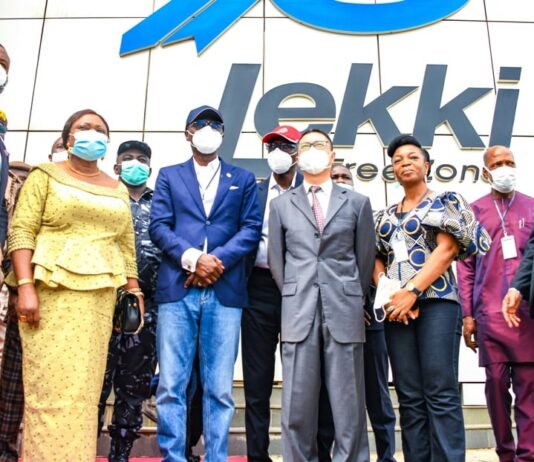
    PIX 1 L-R: C.E.O, Lagos Free Zone, Mr. Dinesh Rathi; Director, Lekki Port; Alhaji Bode Oyedele; Lagos State Governor Mr. Babajide Sanwo-Olu; Chairman, Lekki Free Zone Development Company, Mr. Abiodun Dabiri; Commissioner for Commerce, Industry & Cooperatives, Dr. (Mrs) Lola Akande; Special Adviser to the Governor on Commerce & Industry, Mr. Oladele Ajayi and Commissioner for the Environment and Water Resources, Mr. Tunji Bello, during the Governor’s working visit to the Lekki Free Trade Zone, Ibeju-Lekki, on Friday, March 19, 2021.

    PIX 2 L-R: Chief Technical Officer, Lekki Port, Mr. Steven Heukelom; Managing Director, Lekki Port, Mr. Du Ruogang; Lagos State Governor Mr. Babajide Sanwo-Olu; Commissioner for the Environment and Water Resources, Mr. Tunji Bello; Chairman, Lekki Free Zone Development Company, Mr. Abiodun Dabiri and Commissioner for Commerce, Industry & Cooperatives, Dr. (Mrs) Lola Akande, during the Governor’s working visit to the Lekki Free Trade Zone, Ibeju-Lekki, on Friday, March 19, 2021.

    PIX 3 L-R: Chairman, Lekki Free Zone Development Company, Mr. Abiodun Dabiri, Lagos State Governor Mr. Babajide Sanwo-Olu and Chief Technical Officer, Lekki Port, Mr. Steven Heukelom during the Governor’s working visit to the Lekki Free Trade Zone, Ibeju-Lekki, on Friday, March 19, 2021.

    PIX 4: Lagos State Governor Mr. Babajide Sanwo-Olu, pointing to a place of interest on the Lekki Port architectural presentation board during his working visit to the Lekki Free Trade Zone, Ibeju-Lekki, on Friday, March 19, 2021.

    PIX 5 L-R: Special Adviser to the Governor on Commerce & Industry, Mr. Oladele Ajayi; Managing Director, Lekki Port, Mr. Du Ruogang, presents a pictorial frame of the Lekki Port to Lagos State Governor Mr. Babajide Sanwo-Olu; Chairman, Lekki Free Zone Development Company, Mr. Abiodun Dabiri and Commissioner for Commerce, Industry & Cooperatives, Dr. (Mrs) Lola Akande, during the Governor’s working visit to the Lekki Free Trade Zone, Ibeju-Lekki, on Friday, March 19, 2021.

    PIX 6 R-L: Managing Director, Lekki Port, Mr. Du Ruogang; Lagos State Governor Mr. Babajide Sanwo-Olu; Commissioner for Commerce, Industry & Cooperatives, Dr. (Mrs) Lola Akande; Special Adviser to the Governor on Commerce & Industry, Mr. Oladele Ajayi; Commissioners for Physical Planning and Urban Development, Dr. Idris Salako and others during the Governor’s working visit to the Lekki Free Trade Zone, Ibeju-Lekki, on Friday, March 19, 2021.

    PIX 7 R-L: Lagos State Governor Mr. Babajide Sanwo-Olu, Managing Director, Lekki Port, Mr. Du Ruogang and Chief Technical Officer, Lekki Port, Mr. Steven Heukelom during the Governor’s working visit to the Lekki Free Trade Zone, Ibeju-Lekki, on Friday, March 19, 2021.

    PIX 8 L-R: Deputy Managing Director, Lekki Free Zone Development Company (LFZDC), Mr. Emmanuel Balogun; Commissioner for Commerce, Industry & Cooperatives, Dr. (Mrs) Lola Akande; Lagos State Governor, Mr. Babajide Sanwo-Olu; Managing Director of LFZDC, Mr. Huang Xigong; Executive Director, Finance & Administration, Mrs. Yemi Olusunya; Assistant General Manager, Stakeholders’ Management, Mr. Emmanuel Aguda and Commissioner for the Environment and Water Resources, Mr. Tunji Bello, during the Governor’s working visit to the Lekki Free Trade Zone at Ibeju-Lekki, on Friday, March 19, 2021.

    PIX 9: Aerial view of the ongoing Lekki Port project inspected by Lagos State Governor, Mr. Babajide Sanwo-Olu during his working visit to the Lekki Free Trade Zone, Ibeju-Lekki, on Friday, March 19, 2021.


  • Telcos suspend withdrawal of bank transfer service as CBN, NCC okays N6 per transaction

    Telcos suspend withdrawal of bank transfer service as CBN, NCC okays N6 per transaction

    Planned withdrawal of Unstructured Supplementary Service Data (USSD) short code service that enables bank transfer from mobile device, has been suspended by telecommunications operators in the country.

    The withdrawal of the said suspension of service, which was to take effect from Monday, March 15, came as the Central Bank of Nigeria (CBN) and Nigerian Communications Commission (NCC) announced that bank customers would begin to pay N6.98 kobo per USSD transaction as against N4.

    The telco’s decision to suspend the USSD bank transfer service was justified by the failure of banks and other financial service providers to remit the sum of N42 billion debts incurred by banks in the last eight months through the use of the service.

    But at a meeting of stakeholders on Monday evening in Abuja by the Minister of Communications and Digital Economy, Dr. Isa Pantami, the telcos agreed to suspend service withdrawal.

    All parties at the meeting on Monday agreed that effective March 16, USSD services for financial transactions conducted at DMBs and all Central Bank of Nigeria (CBN) licensed institutions would be charged at a flat rate of N6.98 per transaction. The agreed new price regime now replaces the current N4 per session billing.

    The Acting Director, Corporate Communications, Central Bank of Nigeria (CBN), Osita Nwanisobi, and the Director of Public Affairs at NCC, Dr. Ikechukwu Adinde, said in a joint statement that the new approach will ensure transparency and same cost, regardless of number of sessions per transaction.

    With the new USSD price structure, there is now a flat fee per USSD session however long or whatever the number of messages making up the session.

    Before this new rate, a session usually last 20 seconds, meaning that for each session N4 is charged, even if the transaction is not completed or failed along the line. But in this new rate, 20 seconds session has been abolished, and no cost implication until a transaction is completed.

    According to CBN’s Nwanisobi and NCC’s Adinde, the new USSD charges will be collected on behalf of MNOs directly from customers’ bank accounts. It pointed out that banks would not impose additional charges on customers for the use of USSD Channel.

    On the N42 billion USSD service debt owed by banks, stakeholders came to terms on settlement plan for outstanding.

    The statement restated DMBs and MNOs’ commitment to strategies that lower cost and enhance access to financial services.

    “With the above resolutions, the impending suspension of DMBs from the USSD channel is hereby vacated. Therefore, DMBs shall no longer be disconnected from the USSD channel.

    “The general public is hereby reminded that the USSD channel is optional, as several alternative channels such as mobile apps, Internet banking and ATMs may be used for financial transactions.

    “The CBN and NCC shall continue to engage relevant operators and all stakeholders to promote cheaper, seamless access to mobile and financial services for all Nigerians,” the statement read.

    A source at the meeting told The Guardian that the two sectors agreed on N1.63k price and N4.50 price cap while a flat fee of N6.98k will be for the transaction.

    According to the source, banks will now charge customers for the USSD transaction done on their accounts and settle the telecom operators.

    He said the two parties also agreed to work together to deepen and expand digital financial inclusion of the Federal Government and come out with modalities and strategies on USSD.

    Stakeholders who attended the meeting included the Deputy Governor, Financial Systems Stability Central Bank Of Nigeria, Aisha Ahmad, who represented the CBN Governor, Godwin Emfiele; Access Bank Group MD, Herbert Wigwe, Chairman of the Committee of Bank CEOs; MTN Nigeria CEO, Karl Toriola; Airtel Nigeria CEO, Segun Ogunanya; 9mobile Executive Director, Abdulrahman Ado; the EVC of NCC, Prof. Umar Danbatta; and Executive Commission, Technical Services, NCC, Ubala Maska and among several banking and telecom stakeholders.

  • Extramarital Allegations: Nigerian Bank Replaces Embattled MD with Acting Managing Director

    Extramarital Allegations: Nigerian Bank Replaces Embattled MD with Acting Managing Director

    To protect its image in view of the ongoing allegations of extramarital affairs with an ex-staff of the bank, First City Monument Bank (FCMB) has announced that Yemisi Edun would act as Managing Director/Chief Executive Officer, while the embattled Adam Nuru would proceed on leave.

    “In line with normal corporate practice, Mrs. Yemisi Edun is Acting as the Managing Director of FCMB in the interim period, while Mr. Adam Nuru is on leave.

    “She (Edun) has not been appointed as the substantive Managing Director,” said a statement by the bank’s management.

    It would be recalled that Nuru has been embroiled in an extramarital crisis involving a former staff of the bank, Moyo Thomas and her late husband, Tunde Thomas.

    READ ALSO:

    Lagos Govt Makes U-turn on Resumption of Schools Below Tertiary Level

    Edun holds a first degree in Chemistry from University of Ife, Ile-Ife (now Obafemi Awolowo University) and a Master’s degree in International Accounting and Finance from University of Liverpool, United Kingdom.

    She is a Fellow of Institute of Chartered Accountants of Nigeria and a CFA Charter holder. She is also an Associate Member of Chartered Institute of Stockbrokers; an Associate Member of Institute of Taxation of Nigeria; a Member of Information Systems Audit and Control, U.S.A; and a Certified Information Systems Auditor.

    READ ALSO: Nigerian Opposition Figure Sells $100m Intels Shares, Blames Buhari-led Govt for Woes

    The acting managing director began her career with Akintola Williams Deloitte (member firm of Deloitte Touché Tohmatsu) in 1987, with main focus in Corporate Finance activities.

    Edun joined FCMB in year 2000 as Divisional Head of Internal Audit and Control before assuming the role of Chief Financial Officer of the bank and now as the Managing Director/CEO.

    Idowu Sowunmi

  • Nigeria National Assembly Passes N13.5trn 2021 Budget, N500bn Higher than Initial Proposal

    The Senate on Monday passed the 2021 Appropriation Bill of N13.5 trillion.

    This followed the adoption of the report of Senate Committee on Appropriations at plenary.

    The News Agency of Nigeria (NAN), reports that President Muhammadu Buhari had on Oct. 8, presented the 2021 budget of N13.08 trillion to the joint session of the National Assembly for approval.

    Similarly, the House of Representatives also passed the 2021 budget of N13.5 trillion for the Year 2021 has been passed by Nigeria’s National Assembly on Monday ahead of the Christmas and New Year break.

    READ ALSO:

    COVID-19 Second Wave: Lagos Restricts Church Gathering Again, Bans Concerts, Others

    The passing of the budget, which followed consideration of a report by the committee on appropriation is N500bn higher than the N13.08 Trillion earlier presented before the joint session of the National Assembly by President Muhammadu Buhari.

    Details of the budget include about N6 Trillion allocated for recurrent expenditure, N4.2 trillion for Capital expenditure and N3.32 Trillion for Debt servicing.

    READ ALSO:

    SIM registration: FG Backtracks on NIN Retrieval Fee

    Presenting the report on the floor of the house, Chairman of the Committee on appropriation, Alhaji Aliyu Betera, while presenting the committee’s report on the floor of the House confirmed that sectors with highest allocation in the 2021 Appropriation Bill includes Defence with about N840bn (eight hundred and forty Billion naira); education with over N545bn (five hundred and forty five Billion naira), Police Affairs about N438bn (four hundred and thirty eight Billion naira) while health sector received over N380 (three hundred and eighty Billion naira.)

    The nation’s 2021 budget estimate is based on a $40 per barrel assumption, with crude oil production at 1.86million barrel per day.

  • SIM registration: FG Backtracks on NIN Retrieval Fee

    SIM registration: FG Backtracks on NIN Retrieval Fee

    The N20 USSD fee imposed by Nigerian telecommunications and National Identity Management Commission on subscribers for National Identification Number retrieval requests has been canceled.

    The Minister of Communications and Digital Economy, Isa Pantami directed the Nigerian Communications Commission and the National Identity Management Commission to remove the fee.

    Recently, NCC directed telecommunication service providers to block SIM cards not registered with NIN, giving a two weeks deadline for SIM holders in Nigeria to respond.

    Authorities had listed 173 centres and 30 state government institutions approved for NIN enrolment across country.

    Part of issues arising from the directive was that subscribers who had enrolled for NIN in the past might not remember their identification numbers, a situation telecos and government’s registration agency, NIN sought to exploit by requiring citizens to pay a fee for the retrieval.

    According to a statement on Friday by the spokesperson for the minister, Uwa Suleiman, the government ordered telcos to stop the deduction for NIN retrieval.

    “The Minister of Communication and Digital Economy, Isa Pantami, Orders Cancellation Of NIN Retrieval Charge Across All Networks’.

    “The Minister’s directive which takes immediate effect, is an intervention aimed at making the process easier and affordable.

    “In a letter conveying the implementation of the directive, the Executive Vice Chairman NCC and the Director-General of NIMC informed Dr Pantami that the relevant authorities had met with, and negotiated a waiver with the Mobile Network Operators in that regard.

    “By this waiver, all Nigerians, subscribers and applicants can access the service using the *346# code for their NIN retrieval at no charge for the duration of the NIN/SIM Card integration exercise”, the statement read.

  • Nigerian Media Monitoring Agency Revamps Audit Reporting

    Nigerian Media Monitoring Agency Revamps Audit Reporting

    As part of measures aimed at enhancing clients’ efficiency, an independent public relations (PR) measurement and evaluation agency, P+ Measurement Services has revamped its Independent public relations(PR) performance audit reporting services.

    This was contained in a statement by the firm’s media representative, Glory Nnabugwu Tuesday, stating that the newly improved audit reporting template will help the agency broaden and maximise its offerings, by providing inference driven PR measurement and performance audit services for stakeholders in the communications industry.

    According to the agency, the revamped performance audit reporting “aims to create an easy-to-read and ready-to-use dashboard for clients and communications analysts, using a multi-platform strategy to incorporate all communications efforts into one dashboard.

    “It also features a multiple view dashboard, inclusive of trends, themes, sentiment, CEOs performance, using qualitative and quantitative data which allows structured analysis and inference”, the statement read.

    The Chief Insight Officer of the Company, Philip Odiakose said. “We have moved fast to come up with a comprehensive audit report that helps PR agencies, media planners, analysts and marketing communications clients make a difference in their business.”

    Odiakose affirmed that the company reviews its audit report annually and upgrade when necessary for clients’ easy implementation into their PR strategy.

    “The organisation upgraded its audit report for easy-to-read, dark-mode feel and valid metric in line with clients PR objectives in eradicating the request for AVE as well as noises from the machine” Odiakose stated.

    The P+ boss pointed out that having the right data, insights and recommendations goes a long way in scaling and analysing communications effort, while an easy-to-read dashboard propagates quick-decision-making for clients.

    “We remain committed to promoting awareness for the Independent media monitoring and measurement market in Nigeria, and by creating world-class structures and standards such as this. We believe we are on the right path to facilitating a balanced communications industry for brands and organisations in the country.

    “The report is valuable to communication and PR professionals wanting to define the value they bring to the brand having return on objective (ROO) in mind rather than AVE that is industry denounced, subjective, inconsistent in delivery value and can be manipulated”, he said.

    The company which celebrated its fifth-year anniversary last month, also celebrated its recently concluded AMEC measurement month as the only AMEC Member in the country.

    As Nigeria’s fast growing media intelligence agency, P+ Measurement Services continues to spur media measurement and evaluation literacy campaign for brands, agencies, non-governmental organisations (NGOs) and government agencies, in a bid to standardise a procedure that enables stakeholders to understand that implementing the right media measurement and evaluation campaign is critical.

  • Continental Chamber Releases African Energy Outlook 2021

    Continental Chamber Releases African Energy Outlook 2021

    African Energy Chamber has released its Energy Outlook for 2021, assessing Africa’s competitiveness compared with other frontiers, while highlighting the countless opportunities that continue to emerge and exist across the entire energy value chain.

    The report explored the forces shaping up continent’s energy market after the historic shocks of 2020, and analysed the upcoming recovery on the back of the global energy transition and persisting market uncertainties.

    After a year of historic crisis, the outlook offered guidance and solutions for African energy stakeholders to navigate troubled waters and support a strong recovery in 2021 and beyond.

    The report provided detailed information in areas of critical importance, and included sections examining jobs and employment, cash-flow and profit forecasts, the expenditure and investment outlook, carbon emissions, oil and gas market projections, and regional production outlook.

    READ ALSO:

    Head of Nigeria’s Electoral Commission Hands Over to Surbodinate Pending Re-appointment

    Pressing issues including notably the Organisation of Petroleum Exporting Countries (OPEC)’s production cuts, ongoing regulatory reforms, the impact of the Coronavirus (COVID-19) by region and country, and offshore drilling demand across multiple continental shelves are analysed in detail.

    ‘’It goes without saying that Africa has witnessed its fair share of difficult times this year.

    “Even though oil and gas activities have taken a hit, optimism surrounding African projects, fiscal regime and investments still exist but requires all of us as stakeholders to do more.

    “There has always been opportunity in drastic and unprecedented times, which gives us a lot to look forward to,” said the Executive Chairman of the African Energy Chamber, Nj Ayuk.

    The outlook was the result of strong regional and international cooperation between actors of government, and public and private sector stakeholders across sub-Saharan Africa.

    It gathered the latest available data on sub-Saharan Africa’s hydrocarbons markets, and benefits from the insights of key local, regional and international companies, experts and economists, making it the most comprehensive resource to date on the future of African energy markets.

    ‘’The report highlights the expected outcome of post COVID-19 mitigation strategies to the African energy sector in 2021 and beyond.

    “It also assesses Africa’s competitiveness compared with other frontiers, and highlights the countless opportunities that continue to emerge and exist across our entire energy value chain.

    “We look forward to this report serving as a basis for sound decisions towards a thriving energy industry in Africa,’’ said Senior Vice President at the African Energy Chamber, Verner Ayukegba.

    READ ALSO:

    Lagos Governor Presents N1.155trn Budget Rebuild Nigeria’s Commercial Capital

    African Energy Chamber issued rallying call to all industry stakeholders to work together on a reform agenda to keep African natural resources competitive and create jobs; short-term outlook for African oil and gas remains marked by COVID-19 and uncertain market conditions expected to result in a $30 billion cut in Capex spending (2020-2021); South Western Africa expected to emerge as the next energy frontier on the continent on the back of high-impact wells coming up in 2021 and 2022; the continent’s production of oil and gas is expected to increase in 2021 as OPEC’s sanctions ease and on the back of increase oil output from Libya and increased gas production from Algeria and Egypt.

    The pandemic notably came at a particularly difficult moment in Africa, exacerbating already challenging market conditions on the back of a competitive American shale industry, the delaying of major projects due to regulatory uncertainty, and increasing global attention to decarbonisation.

    African Energy Chamber notably expected a CAPEX spending cut of $30 billion over the 2020-2021 period, and has identified a further $80 billion of investment whose sanctioning would depend on improving market conditions, along with bold policy and fiscal reforms from African regulators.

    Idowu Sowunmi

  • Climate Change Financing: AfDB Appoints 80 Experts towards Accessing $10bn Green Climate Fund

    Climate Change Financing: AfDB Appoints 80 Experts towards Accessing $10bn Green Climate Fund

    African Development Bank has designated representatives from 80 government institutions, civil society organisations and universities for training as experts in developing climate financing proposals.

    Following a thorough independent selection process, 80 participants were chosen, with approximately 40 from English-speaking countries and 40 from French and Portuguese-speaking countries.

    The trainees would pass on their knowledge to potential beneficiaries of the Green Climate Fund, a $10 billion endowment set up in 2010 to help countries implement their climate agenda through loans, equity, guarantees and grants.

    The 120-hour training programme would be managed by Climate Change and Green Growth Department of African Development Bank, with funding from Korea-Africa Economic Cooperation Trust Fund.

    The scheme is being built on ongoing work by African Development Bank, Green Climate Fund and other partners to support the bank’s regional member countries to directly access Green Climate Fund resources.

    “The Green Climate Fund is expected to be a major source of climate finance for the African continent. Accessing finance from the Fund is challenging because of the complexities of designing climate change projects to fulfill the funding criteria.

    “This training will boost capacity amongst African nationally determined authorities, governments and consultants by training trainers to run future training courses,” said Manager of the Environment and Climate Finance Division in the Department of Climate Change and Green Growth at African Development Bank, Gareth Phillips.

    The Coronavirus (COVID-19) pandemic has made the training to be shifted from in-person to online. This has the advantages of making it less costly to run and more carbon efficient.

    The project’s theory of change is based on three main components, which complement ongoing work by the bank to enhance the capacities of several African countries to access Green Climate Fund resources through small grants from the Africa Climate Change Fund.

    These components include: developing training materials and an online platform to support direct access to the Green Climate Fund, training a pool of experts and certifying them to support African governments and institutions, and facilitating south-south learning.

    Idowu Sowunmi