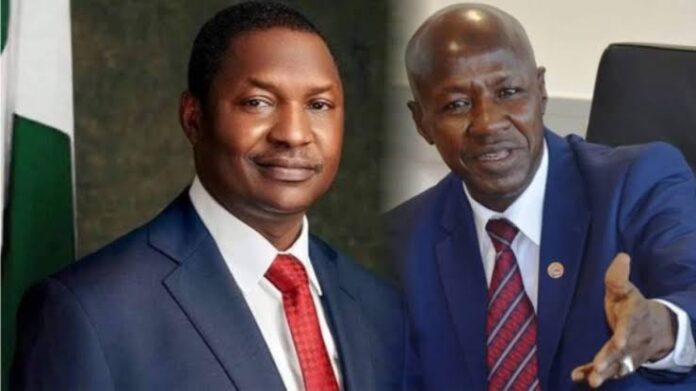
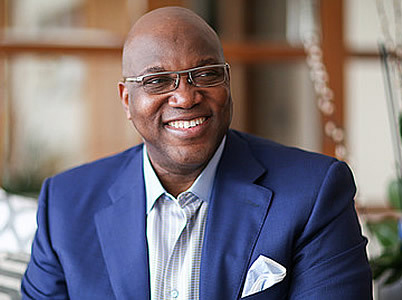
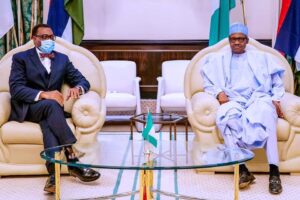
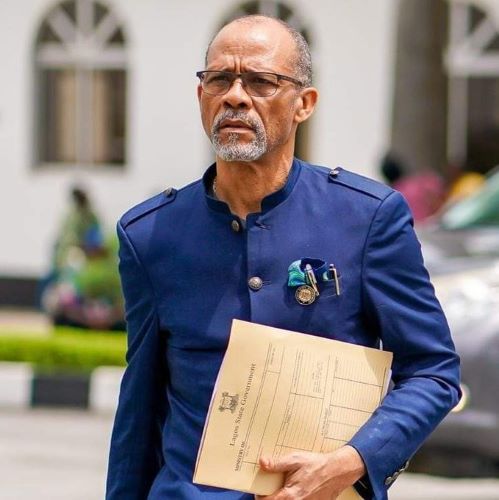
L-r: Minister of Justice, Abubakar Malami; Suspended Acting Chairman of the Economic and Financial Crimes Commission (EFCC), Ibrahim Magu.
Attorney-General and Minister of Justice Abubakar Malami has denied procuring false witnesses to testify against the suspended chairman of the Economic and Financial Crimes Commission (EFCC) Ibrahim Magu.
in a statement signed by his media aide Umar Jibrilu Gwandu, Malami said since he has not set up the investigation panel probing the erstwhile anti-graft czar, Magu, he is equally not saddled with any responsibility to procure witness(es) for the panel.
“The Honourable Attorney-General never met Giwa and has never discussed any issue with the so-called Donald Wokoma nor asked anybody, personally or by proxy, to engage the so-called Victor to testify against Magu”, the statement read.
Giwa alleged that both Malami and the said Wokoma had made a desperate move to lure him to nail Magu, an allegation Malami dismissed in the statement as “a flimsy allegation”.
Malami further said in the statement that: “The claim by Victor Giwa Esq is therefore fictitious unfounded and figment of imagination of mischief makers who want to create unnecessary attention and tarnish the good image of the Attorney-General of the Federation and Minister of Justice and labouring incessantly these days, to falsely cast aspersion on the AGF’s hard-earned reputation.”
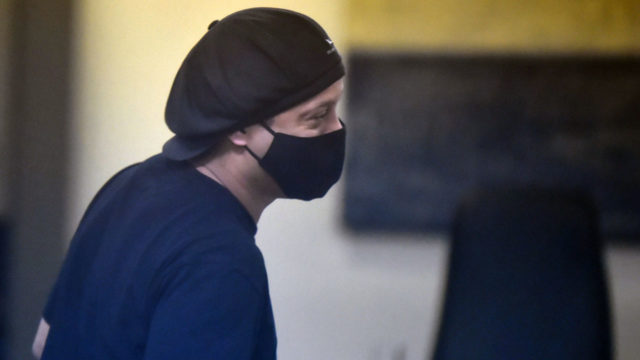
Brazilian retired football player Ronaldinho arrives for his hearing at the Asuncion’s Justice Palace, in Asuncion, on August 24, 2020. – After six months under arrest in Paraguay, former Brazil football star Ronaldinho was set for a hearing on Monday on charges of travelling with false documents, according to judicial sources. (Photo by NORBERTO DUARTE / AFP)
One time Brazilian football star Ronaldinho was on Monday released from detention by a Paraguayan Judge, Gustavo Amarilla, after five months.
The 40year old World Cup winner, who was detained over a forged passport was released alongside his brother Roberto de Assis Moreira, who for the same charge had been held for a month in jail and another four months under house arrest in a hotel in Paraguay’s capital, Asuncion.
According to Judge Amarilla, the one time international football sensation “is free to travel to whatever country in the world he wants but he must inform us if he changes his permanent residence for a period of one year.
“He has no restrictions except for the fulfilment of reparations for damage to society”, which include payment of $90,000 in damages, a decision he accepted as part of terms for his freedom.
Also, Ronaldinho’s brother, who doubles as his business manager, must pay $110,000.
in his statement, Judge Amarilla stressed that he was not issuing a “definitive dismissal” of the case but rather that Ronaldinho was benefitting from a “conditional suspension of the procedure.”
His brother, on the other hand, was given a two-year suspended sentence.
Prosecutors stated that they did not believe Ronaldinho took part in the plan to manufacture the fake Paraguayan passports but believed de Assis Moreira was aware that the passports were false.
“They flagrantly used a public document containing false content,” said Marcelo Pecci, one of the public prosecutors, who said it was a “very serious” offense.
De Assis Moreira must appear before a judge in Brazil every four months for two years and will have a criminal record.
“Ronaldinho’s situation is not the same as Roberto’s. He has no obligation to appear before any Brazilian judicial authority. He must only report a change of address,” said Amarilla, who accepted a recommendation by four prosecutors to avoid the need for an oral trial.
Before Monday’s trial, the public prosecutor said that Ronaldinho displayed no “personal characteristics or criminal behaviour that … would put society at risk.”
The brothers who arrived in Paraguay on March 4 to attend an event in support of disadvantaged children were taken into police custody when investigators raided their hotel following the discovery they had fake documents.
However, just before the Judgement, their lawyer issued a statement insisting that both brothers were innocent.
“They presented Paraguayan documents to migration authorities believing they were authentic,” said the statement. “The people they trusted deceived them vilely”, the defense lawyer argued.
The two men had been under house arrest for more than four months in a luxury hotel in the capital, on bail of $1.6 million.
Ronaldinho, who is considered one of the greatest footballers of all time, and played a crucial role in Brazil’s 2002 World Cup win celebrated his 40th birthday in dentition.
While investigation has since expanded into a case of possible money laundering and criminal association that has led to the arrest of some18 people in connection with the case, most of them immigration officials or police officers, defense counsel to the brothers stated that:
“The investigation found no indication that either participated in money laundering or criminal association”.
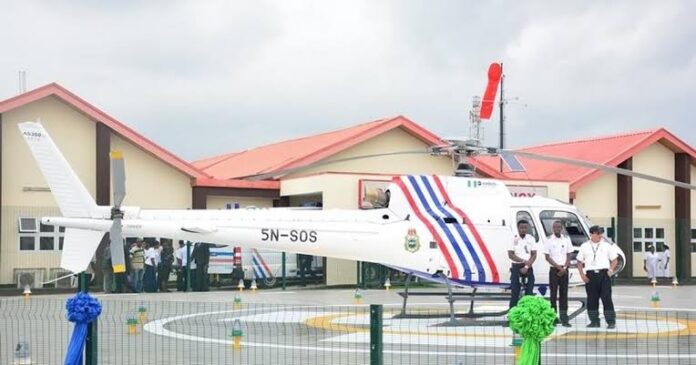
A file photo of a helicopter at the premises of the Lagos State University Teaching Hospital (LASUTH) purchased and commissioned by former Governor Akinwunmi Ambode for medical emergencies on Thursday, August 12, 2016.
Lagos State House of Assembly has challenged the Governor Babajide Sanwo-Olu administration to come forward and explain the whereabouts of three helicopters officially purchased by the state government.
The Assembly, at a plenary on Monday, summoned the governor’s Chief of Staff, Tayo Ayinde; Lagos State Commissioners for Economic Planning and Budget; Special Duties: and management team of Lagos State Security Trust Fund (LSSTF) over the whereabouts of the three helicopters belonging to the state government.
Raising the issue under Matter of Urgent Public Importance, Assembly’s Chief Whip, Mojisola Miranda, said the ministries, departments and agencies in charge of the helicopters should be written to and that the Assembly should know the agreement between the state government and Caverton Helicopters, which has been managing the helicopters on behalf of the state government.
“If you may recall, in 2007, the House of Assembly passed a bill for the establishment of Lagos State Security Trust Fund (LSSTF) for the state government to equip and strengthen the security agencies in the state.
“In 2015, three helicopters were bought under Governor Akinwunmi Ambode to strengthen security in the state. But, the helicopters are nowhere to be found now.
“I will want us to look at it and get the concerned parties to tell the House the location of the three helicopters to see if they are just lying fallow or if the state government has entered into an agreement with an entity on the equipment and see to what extent the agreement has been working,” Miranda said.
Assembly Speaker, Mudashiru Obasa, in his contribution, pointed out that the helicopters were meant for dual purposes of tackling security challenges and commercial activities.
Obasa noted that the Assembly wished to know what has accrued to the state in terms of revenue from the helicopters so far, saying this was the first time the Assembly would be talking about the equipment.
“What we have said so far has nothing to do with the image of the state or the Assembly. What the Chief Whip has done is not too much. We need to know what has happened to the helicopters,” he said.
In his contribution, Rotimi Olowo (Shomolu 1) said the Assembly approved the purchase of two helicopters during the era of former governor Babatunde Raji Fashola.
Olowo added that a commissioner told the Assembly then that they had an agreement with Caverton Nigeria Limited to operate the helicopters so that the state government would make some money from the operations.
He revealed that one helicopter was bought under former governor Akinwunmi Ambode making it three, and that it was important to know how they have been managed so far and the whereabouts of the revenue from these helicopters.
Also speaking, Fatai Mojeed (Ibeju Lekki 1) said the assets were purchased for security purposes and to generate money for the state government.
He added that the Assembly sseks to know what has happened to the helicopters and that a committee should be set up to look into the matter.
This was corroborated by Abiodun Tobun (Epe 1), who added that the helicopters should be at the reach of the state for security purposes, probity and accountability and that revenue from the equipment should reflect in the account books of the state.
Tobun noted that whoever is in charge should give account of what has been done with the helicopters, and there location/hangers.
On his part, Gbolahan Yishawu (Eti Osa 2) said the issue was very germaine, adding that the money that’s used to fund the operation of the helicopters passed through Special Duties.
Noheem Adams (Eti Osa 1) said the helicopters were purchased for commercial purposes, while Rotimi Abiru (Shomolu 2) however cautioned that the Assembly ought to have approached the office of the Chief of Staff on the said matter.
Another lawmaker, Olawale AbdulSobur Olayiwola (Mushin 2) said it was important to call the attention of the state government to the matter, adding that the Assembly needs to know the whereabouts of the helicopters. He noted that the vehicles that were donated for security purposes in the state were also not functioning very well.
Supporting the matter, Adedamola Kasunmu (Ikeja 1) said security is not just about life, and that security of property is also necessary.
“I want to believe that Caverton Helicopters generate money from the helicopters.
“The helicopters should have been very useful for air transport to isolation centres during this period of COVID-19 pandemic.
“LSSTF gave out the helicopters for purposes of generating funds. LSSTF should be invited – the Chairman and the Executive Secretary,” he said.
Nurudeen Akinsanya (Mushin 1), Nurudeen Saka-Solaja (Ikorodu 2) and Temitope Adewale (Ifako/Ijaiye 1) also contributed to the debate on the matter, which got the support of all the members of the Assembly.
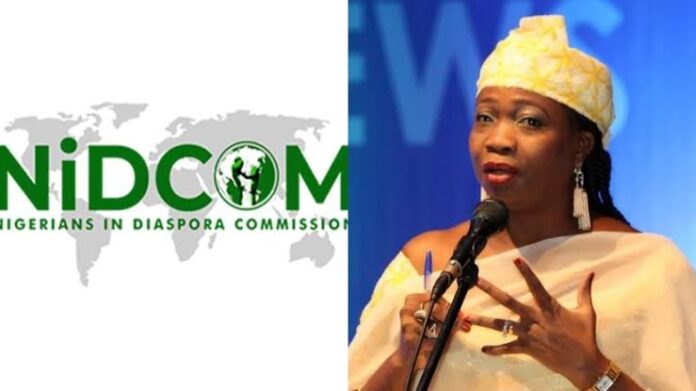
A collage photo of Nigerians in Diaspora Commission logo and its Chief Executive Officer, Abike Dabiri.
The President Muhammadu Buhari-led Federal Government Monday demanded for justice over the mysterious killings of Nigerian students in Northern Cyprus universities.
Chairman/Chief Executive Officer, Nigerians in Diaspora Commission (NiDCOM), Abike Dabiri-Erewa, disclosed this while speaking on the sudden and mysterious death of a 25-year old Nigerian student in Northern Cyprus, Ibrahim Khaleel Bello, and others killed in such strange circumstances in the country.
Speaking while receiving a petition in Abuja from a judge in Kaduna State High Court, Justice Amina Ahmad Bello, on the mysterious and inexplicable death of her son, a third-year civil Engineering student of Girne American University in Girne (Kyrenia), Turkish Republic of Northern Cyprus, Dabiri-Erewa condemned the killings of Nigerian students in Northern in that country.
NiDCOM boss called on parents to be wary of sending their wards to Northern Cyprus as the country is not recognised by the United Nations except the Republic of Turkey, adding that Nigeria has no diplomatic ties with that country.
She proposed that the country “should be blacklisted given the preponderance of Nigerian students who have died mysteriously in that country without any prosecution or compensation whatsoever.”
She assured the delegation led by Justice Bello that NiDCOM would work with the Ministry of Justice, Nigerian Mission in Turkey and other relevant agencies to ensure justice is done, saying “the death of Ibrahim khaleel Bello should be a tipping point to end the continuous killings of Nigerian students in that country.”
Dabiri-Erewa reiterated her appeals to Nigerian parents to desist from sending their children to Northern Cyprus for any studies as most of the courses are not accredited and they end up killing these students, many of them unreported.
”The time has come for us to blacklist all these universities in Northern Cyprus and advise our students from seeking any form of admission there as it portends danger to their life and future,” she said.
She added that the office of the Attorney General of the Federation has already reported the matter to Interpol for further investigation.
Earlier in an emotion-laden voice, Justice Bello, mother of the deceased, said her insistence on justice was not only for her son but also for other Nigerian students who have died mysteriously in the Girne American University Girne (Kyrenia), and other universities in Northern Cyprus.
She narrated how her son was allegedly murdered and covered up by the authorities in Northern Cyprus as well as the university authorities, claiming it was a suicide mission having fallen from a seven-story building.
She insisted that the report be investigated and all those found culpable to be prosecuted as there was nothing to show that her son committed suicide.
Justice Bello said hours before her son was killed, she spoke with him, and he was expressing fears on his safety in the university environment.
”I don’t believe it was an accident or a suicide as I went to Cyprus barely 24 hours it happened and got to the mortuary where there was no scratch or wound on his body.
”I suspected foul play that my son was killed as the school was non-challant in breaking the news to me on my arrival there,” she said.
Justice Bello said hours before the boy died, he sent her a WhatsApp message: ”Mama, Please I want to come back home. Wallahi if I stay here, I will just die here without anybody batting an eyelash. I just need to come back home. Mama, please try to understand that this isn’t a place for me.”
She alleged that it’s possible some of the killed Nigerian students’ vital organs were harvested as her son’s stomach was opened and sutured when the corpse was finally released.
Late Ibrahim Bello was among about 100 Nigerians killed and murdered in mysterious circumstances from 2016 to 2020 without prosecuting any of the assailants.
Other victims include, Kennedy Taomwabwa Dede, 28, student of Eastern Mediterranean University, killed on February 1, 2018; Walshak Augustine Ngok, a student of Marine Engineering at Near East University, murdered on April 19, 2019.
Others were: Gabriel Soriwei, a first-year student of Electrical Electronics at Cyprus International University, Nicosia; Osabanjo Adeola Owoyale, 33, went missing and found dead on July 1, 2019.
The list also included: Augustine Wallies killed on April 19, 2019; Stanley Eteimo, 28 years; Hassan Babatunde, 28, murdered; Temitayo Adigun, killed; Kubiat Abasi Abraham Okon, 24, killed; Oziegbe Gospower Airekugose; and Olasubomi Ope; among others not reported.
Mr. John Momoh, The newly appointed Interim Chairman, UNILAG Governing Council
President Muham Buhari has approved the appointment of the President of University of Lagos Alumni Association Worldwide, John Momoh, as the Chairman of the university’s Interim Governing Council.
Momoh, who is Chairman/Chief Executive Officer of Channels TV, would among other roles along with council members, ratify the election of the university’s new Acting Vice Chancellor, Folashade Ogunsola.
Ogunsola had emerged victorious with 135 votes, having defeated Prof. Ben Ogbojafor, who scored 31 votes, while one vote was generally described as voided.
The result of the election, Echotitbits gathered, has been forwarded to the Governing Council by the Deputy Registrar/Director of Academic Affairs, Olakunle Makinde.
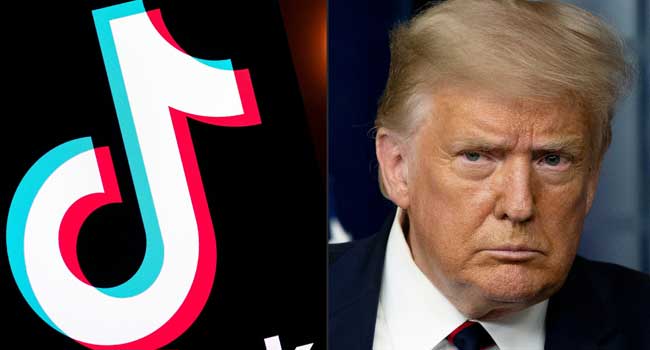
A photo collage of pictures created on August 01, 2020 shows the logo of the social media video sharing app Tiktok displayed on a tablet screen in Paris, and US President Donald Trump at the White House in Washington, DC, on July 30, 2020. JIM WATSON, Lionel BONAVENTURE / AFP
As tensions soar between Chinese and US, world’s two biggest economies, video app TikTok on Monday said it has filed a lawsuit to challenge the crackdown on the popular Chinese-owned platform.
Accusing it of being a national threat, the Donald Trump-led American government had said it will ban Tik Tok.
On August 6, President Trump signed an executive order giving Americans 45 days to stop doing business with TikTok’s Chinese parent company ByteDance — effectively setting a deadline for a potential pressured sale of the app to a US company.
In a blog post, the company stated that: “Today we are filing a complaint in federal court challenging the Administration’s efforts to ban TikTok in the US” .
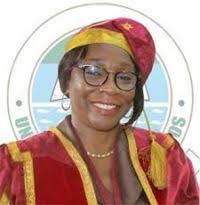
The elected Acting Vice-Chancellor of the University of Lagos (UNILAG), Prof. Folashade Ogunsola. She is the Provost, College of Medicine and current Deputy Vice Chancellor, Development Services.
The Senate of University of Lagos Monday voted Prof. Folashade Ogunsola of the College of Medicine and current Deputy Vice Chancellor, Development Services, as the new Acting Vice Chancellor of the university.
The now-dissolved university’s Governing Council led by Wale Babalakin had sacked the former Vice Chancellor, Oluwatoyin Ogundipe, in a controversial circumstance.
The situation degenerated until President Muhammadu Buhari, who is also a Visitor to the university, intervened and constituted a seven-man visitation panel to resolve the lingering crisis.
The President also tasked the university’s Senate to immediately appoint an Acting Vice Chancellor, a development which indicated that the Acting Vice Chancellor, Theophilus Soyombo, appointed by Babalakin-led Governing Council was null and void.
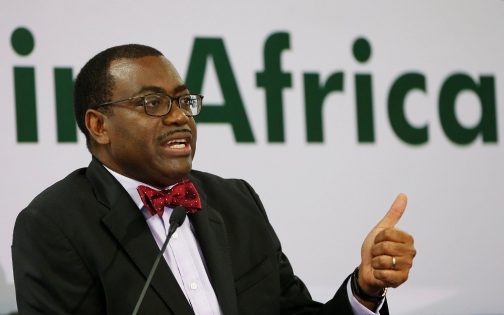
File photo: African Development Bank (AfDB), Akinwunmi Adesina.
Incumbent President of the African Development Bank, Akinwumi Adesina, is set to be re-elected for the second term in office as the multilateral development institution, for the first time in the history, holds its Annual Meetings virtually to comply with the novel Coronavirus (COVID-19) pandemic-related social-distancing guidelines.
Adesina is running as the sole candidate for a new five-year term.
The bank’s Governors’ Dialogue and the election of the president would be top of the agenda of the upcoming meetings scheduled to take place from August 26 to 27.
File photo: Nigerian President Muhammadu Buhari meets African Development Bank’s (AfDB) President, Dr. Akinwunmi Adesina
This year, which marks the 55th meeting of the bank’s Board of Governors and the 46th Annual Meeting of the African Development Fund, has the significance of being an election year for the bank’s president.
During the meetings, bank’s governors are expected to receive updates on a range of developments since the previous Annual Meetings held in Malabo, Equatorial Guinea in June 2019.
This would include the bank’s seventh General Capital increase, which the Board of Governors approved in Abidjan, Cote D’Ivoire on October 31, 2019, and which increased the bank’s capital base by a historic $115 billion to $208 billion.
The governors would vote on August 27 to re-elect Adesina as the eighth president of the bank being a sole candidate.
Adesina, the first Nigerian to hold the post, was elected for a five-year term on May 28, 2015, by the bank’s Board of Governors during that year’s Annual Meetings held in Abidjan, Côte d’Ivoire.
The bank’s governors are typically the finance and economy ministers or Central Bank Governors of the 54 African regional member countries and 27 non-regional member countries.
Since the COVID-19 pandemic hit the continent’s shores in early March, over 1,000,000 confirmed cases of the virus have been recorded in Africa. The pandemic has hit the region’s economies hard in the wake of falling commodity prices and containment measures by governments that have led to country lockdowns.
For several months, the bank has been extending support to regional member countries in cushioning their economies, health systems, and citizens’ livelihoods from parallel health and economic impacts from COVID-19.
In April 2020, the bank established a COVID-19 Response Facility of up to $10 billion to extend flexible support to African sovereign and non-sovereign operations. As of August 20, $2.29 billion in CRF funding had been approved for bank’s member countries.
A further $1.186 billion has been disbursed to bank’s member countries, with approvals ongoing.
In March, the bank also raised a record $3 billion with a COVID-19 social bond floated on London Stock Exchange.
The institution reached some major milestones during the trying times of lockdown with both Fitch and Standard & Poor credit rating agencies reaffirming the bank’s AAA rating with a stable outlook.
In December 2019, African Development Fund Donors pledged $7.6 billion, the fifteenth such replenishment, to help Africa’s poorest countries.
Lagos State Commissioner for Health, Prof Akin Abayomi.
Lagos State Commissioner for Health, Prof Akin Abayomi, has tested positive to coronavirus.
This was disclosed in a statement by the Commissioner for Information and Strategy, Gbenga Omotoso in a statement on Monday morning.
“Subsequent to close contact with persons feeling unwell and testing positive for the COVID-19 infection, the Honorable Commissioner for Health, Prof. Akin Abayomi, has tested positive for the virus”.
Omotoso added that Abayomi became aware of his status following the required testing protocol of contact tracing procedures.
“However, he is doing well with no symptoms. Adhering to the protocol of the home based strategy in Lagos State, the Honorable Commissioner will be isolating in his home for the next 14 days but will continue to discharge his duties both as the Deputy Incident Commander of the Incident Command System for COVID-19 and most especially, as the Honorable Commissioner for Health.
“Our prayers are with him and his family during his period of isolation,” Omotoso stated.
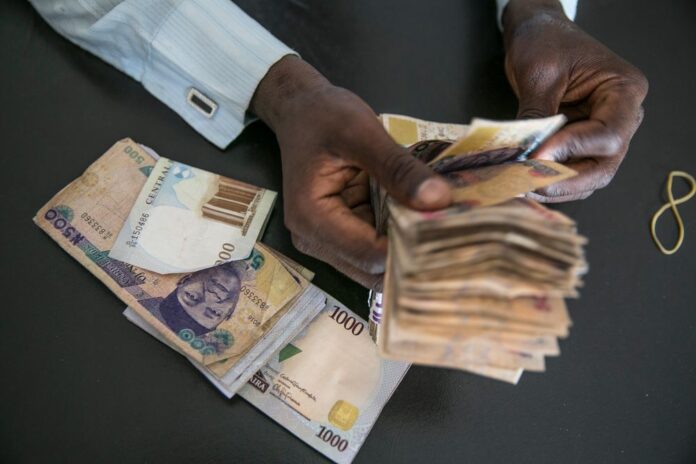
Illustration: Photo of a man handling the Nigerian Naira.
A Central Bank of Nigeria (CBN) data has revealed that the naira has fallen by 108 per cent against the West African CFA (popularly known as CFA).
As the West African CFA rallies to wipe out the hitherto wide trading gap between the two currencies, it gained 36 kobo from August 19, 2015 to close at 0.6888 CFA/N1 on the CBN rate last week. This translates to a 108-per cent loss for the struggling naira.
Exactly five years ago on August 21, 2015, the CFA, used by eight former West African colonies – Benin, Burkina Faso, Côte d’Ivoire, Guinea-Bissau, Mali, Niger, Senegal and Togo – exchanged for 33k.
Records show further that the naira, which performed better against the now-aggressive CFA in the first half of the decade reviewed, closed at approximately 29 kobo for one CFA on August 21, 2010.
Until 2013 when it started a gradual easing, it maintained its market dominance. It was not until 2015 when CFA began to take a spot as a competitive currency and started an aggressive rally that would remarkably close the previous wide differential between the two currencies. Between August 2015 and August 2016, the naira lost about 69 percent against CFA year-on-year.
The currency has recorded a similar leap in its value appreciation against the naira year-to-date, climbing from 0.5228/N1 it opened the year with to 0.6888 /N1 (translating to 32 percent) at the close of last week’s trading. The CFA, a currency that symbolises French economic imprint on the West Africa sub-region, gained 23 kobo over the naira within 12 months.
At the turn of this millennium, the CFA only traded for about 15 kobo. Currently being considred for a replacement with Eco, the proposed West Africa regional legal tender, not many Nigerians knew much about the CFA, not until the West Africa trade corridor opened for unprecedented smuggling.
CFA’s current resurgence is coming on the heels of the continued closure of the country’s border against neighbouring West African countries, especially the Republic of Benin, where Nigerians engage in unrestrained trade.
WHAT A WEAKENING exchange rate against CFA means for the economy of the eight neighbouring countries is that, it is cheaper for citizens to import their goods from Nigeria and it is more expensive for Nigerian traders to do business in those countries.
But while the cost of importing from those countries is on the increase with an average Nigerian household feeling the pains, the country does not seem to gain much in terms of export injections into Benin, Togo and others in the category.
The West Africa region, for instance, accounted for just 11.5 percent of the country’s total export value in 2019, which the National Bureau of Statistics (NBS) put at N19.2 trillion. Nigeria was not also among Beninoise top 10 import sources last year. The only two of Africa’s countries that made the list dominated by Europe and Asia were Togo, its neighbour, and Morocco.
Benin, topmost Nigeria’s smuggling source, procured 13.6 percent and 11 percent of its last year imports from India and China respectively. Much of the imported goods were passed on to Nigeria through the porous borders – a trade practice many experts have blamed for the country’s troubled real sector.
THE Federal Government, last year, closed the country’s land borders against Benin, Chad and Niger as a major strategy to battle insecurity and dumping – twin challenges that have stunted growth in recent times.
One major factor that decides Nigeria’s food price inflation is unofficial trade between it and Benin.
Last year for example, the price of rice experienced a spark few weeks after the Federal Government announced the border closure. The price has thus increased by around 100 percent in the past year.
We use cookies to ensure that we give you the best experience on our website. If you continue to use this site we will assume that you are happy with it.