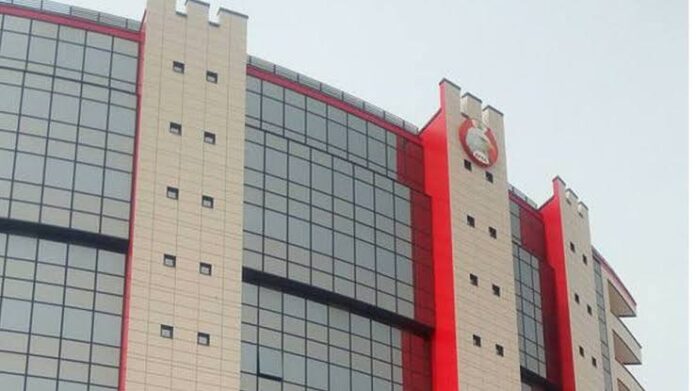
File Photo: Headquarters of the Economic and Financial Crimes Commission (EFCC) in Abuja, Nigeria.
The Economic and Financial Crimes Commission (EFCC) has debunked reports that its operatives are involved in “stop and search” operations in the Lekki axis of Lagos State.
The anti graft agency on Wednesday night in a statement by its Head of Media and Publicity, Dele Oyewale avowed that none of its operatives was in such operations.
“The attention of the Economic and Financial Crimes Commission (EFCC) has been drawn to some spurious news circulating in the social media, linking its Operatives with some contrived “Stop and Search” operations around Lekki axis of Lagos State.
“We wish to state very clearly that our Operatives were not and can never be involved in such operations”, Oyewale said in the statement.
He further distanced its operatives from the act emphasizing the professionalism of the agency.
“EFCC is a professional law enforcement agency and should not be linked with any traffic management operation on our roads.”
Oyewale however, enjoined members of the public to ignore such insinuations.
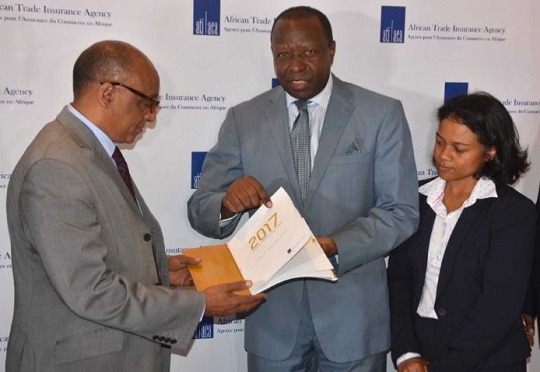
File Photo: An event where S&P affirms African Trade Insurance Agency credit rating on expansion.
African Trade Insurance Agency (ATI) has confirmed key senior-level positions that would play an important role in steering critical support to member governments.
The appointments, which were approved by the Board of Directors, included a veteran of the World Bank’s IFC, Manuel Moses, who has been appointed as the new ATI Chief Executive Officer.
Moses would assume office on November 1, 2020.
During its recently concluded virtual 20th annual meeting, ATI’s shareholders ratified the appointment of Moses as the new Chief Executive Officer based on the board’s recommendation.
Moses is a Zimbabwean national, who brings 15 years of experience from the IFC, where he most recently held the post of Country Manager of Kenya. He holds an MBA from University of Leicester in the UK and a BSc in Civil Engineering from University of Zimbabwe.
In the interim, ATI’s Chief Financial Officer (CFO), Toavina Ramamonjiarisoa, would fill the position of Acting Chief Executive Officer.
Ramamonjiarisoa has been an integral part of ATI’s management team since she was appointed CFO in 2011, where, in this position, she has helped guide the institution towards its current eight-year record-setting growth rates along with ensuring maintenance of ATI’s investment grade ratings from both S&P and Moody’s (A/Stable and A3/Stable respectively)
While Ramamonjiarisoa would be serving as the Acting CEO, the board approved Rodgers Siachitema would serve as the Acting CFO.
In addition, Benjamin Mugisha has been confirmed as the substantive ATI Chief Underwriting Officer (CUO).
Mugisha, a Senior Underwriter, who joined ATI in 2010, has been Acting CUO for the past year. He has served various functions including as ATI’s Uganda Representative, where he was responsible for field offices in Burundi, Rwanda and Uganda; and, subsequently as Senior Underwriter, where he managed ATI’s day-to-day business and a portfolio of international financial partners.
The board also recognised the substantial contribution and 19 years of service to ATI by the General Counsel and Corporate Secretary, Cyprien Sakubu, who has recently retired from the institution.
The board has constituted a special committee to oversee the recruitment of a new General Counsel and in the interim, the current Legal Expert, Elizabeth Mutafungwa, has been appointed Acting General Counsel.
ATI is increasingly recognised by the IMF, S&P, Moody’s and others as a strategic development institution for Africa that is well-positioned to provide effective support to its member governments through the pandemic.
Specifically, with the support of ATI, governments are able to manage their growing debt levels by re-profiling their costlier and riskier debts and replacing them with longer-term, cheaper debts from international commercial lenders.
ATI is currently insuring one to two per cent of the GDP of its member countries and is expected to facilitate US$2 billion of additional investments to the continent in the next 12 to 24 months.
ATI was founded in 2001 by African states to cover the trade and investment risks of companies doing business in Africa.
ATI predominantly provides political risk, credit insurance and, surety insurance. In 2019, ATI closed the year with exposures of US$6.4 billion and continued to post record results for the eighth consecutive year with 132 per cent growth on the net profit over 2018 owing to strong demand for ATI’s insurance solutions from the international financial sector and from African governments.
Since inception, ATI has supported US$62 billion worth of investments and trade into Africa. And for over a decade, ATI has maintained an ‘A/Stable’ rating for Financial Strength and Counterparty Credit by Standard & Poor’s, and in 2019, ATI obtained an A3/Stable rating from Moody’s.
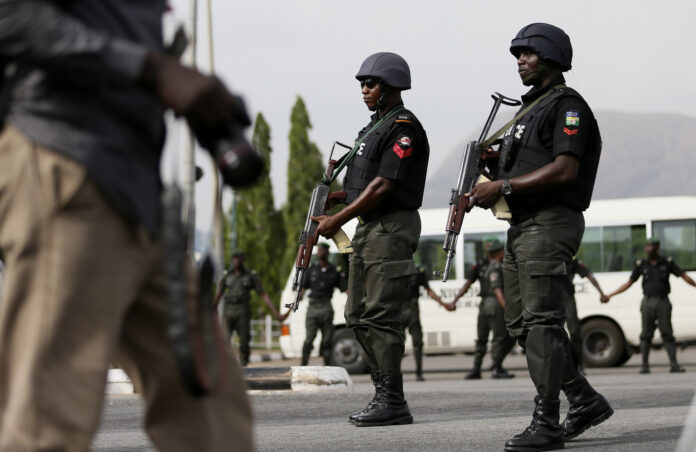
Officers of the Nigerian Police Force (File Photo)
Inspector-General of Police, Mohammed Adamu, Wednesday deployed additional investigative aids to Oyo State to complement the efforts of the state Police Command in the ongoing manhunt and efforts aimed at re-arresting Sunday Shodipe, a prime suspect in the multiple murder of innocent citizens in Moniya, Akinyele Local Government Area in Ibadan.
The additional deployment comprises crack detectives from the Intelligence Response Team (IRT) and the Special Tactical Squad (STS) of the Force Intelligence Bureau in Abuja.
Nigeria’s Inspector General of Police (IGP), Mohammed Adamu.
The team is expected to bring their vast operational, technical and investigative experience to bear in supporting ongoing efforts aimed at re-arresting and bringing the fugitive to book.
The police chief, who condemned the unfortunate escape of the suspect from lawful custody, has directed Oyo State Commissioner of Police to intensify efforts and ensure the prompt re-arrest of the fleeing suspect.
The commissioner has also been directed to speed up investigations into the circumstances that led to the escape of the suspect.
“All persons indicted in the escape are to be identified and made to face the wrath of the law. The commissioner has equally been mandated to immediately assess and rejig the security architecture in the state so as to prevent any future occurrence of untoward incidents,” said a statement by the Force Public Relations Officer, Frank Mba.
Meanwhile, Adamu has called for calm and enjoined citizens to cooperate with the police by providing useful information that could lead to the unearthing of the whereabouts of Sunday Shodipe, the suspected serial killer in Ibadan.
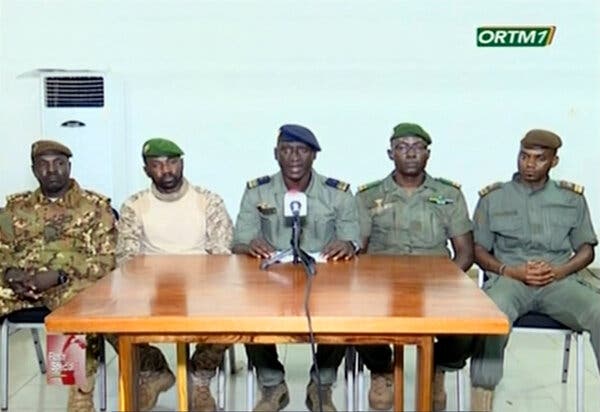
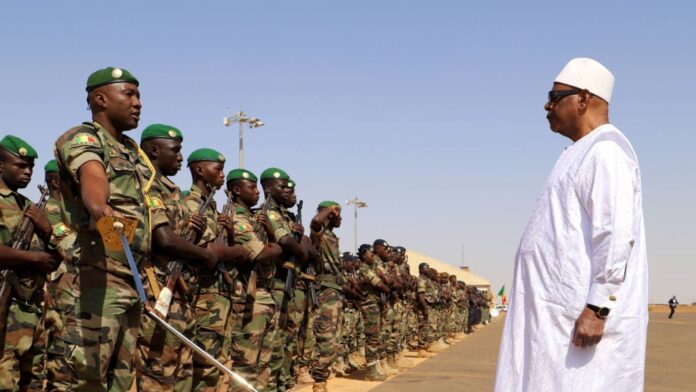
Soldiers behind the coup tagged “popular inssurrection” that toppled the about seven years administration of Ibrahim Keita as President of Mali have promised to conduct elections within a “reasonable” time.
The interventionist soldiers made this commitment on Wednesday, amidst pressure from the international community calling for civil, constitutional and peaceful resolution of the crisis that has ravaged the nation of about 20million people.
Yesterday’s mutiny and military intervention in the political unrest, which was already inflamed was followed by Keita’s resignation on national TV, a move the opposition movement celebrated across the streets of Bamako. Keita’s announcement on national TV came only hours after Mutinous troops detained him at gunpoint.
In a swift reaction, the Economic Community of West African States (ECOWAS), the region’s fifteen-nation group, moved to suspend Mali from its membership. The forceful removal of Keita sparked fears among leading nations and allies of the region, including the European Union (EU), that the region could be destabilised.
While it still wasn’t clear on Wednesday morning who was leading the military revolt or who would act instead of the ousted President, a spokesman of the mutineers, labelled National Committee for the Salvation of the People (NCSP) justified the forceful removal of Keita and Cisse-led democratic government saying they acted to prevent Mali from falling further into chaos.
However, the officer, Colonel Ismael Wague stretched a hand of invitation to Mali’s civil society and political movements to join them to create conditions for a political transition.
“Our country is sinking into chaos, anarchy and insecurity mostly due to the fault of the people who are in charge of its destiny,” he said in a statement broadcast on national TV.
“We are not keen on power, but we are keen on the stability of the country, which will allow us to organise general elections to allow Mali to equip itself with strong institutions within the reasonable time limit,” he added.
There was no immediate reaction to Colonel Wague’s offer from the opposition and leaders of recent protests. However, the presidency of the G5 Sahel group of neighbouring states called on Malians to resolve the crisis peacefully, and demanded the release of President Keita and other senior officials.
On Wednesday, European Union Industry Commissioner Thierry Breton echoed that the bloc would insist on new elections within a reasonable timeframe.
In a violent run-up to Tuesday’s coup following months of protests against alleged corruption, at least fourteen people were killed last month in protests called by a coalition of Mr. Keita’s political opponents.
Mali, the landlocked nation has struggled to regain stability since a Tuareg rebellion in 2012 which was hijacked by Islamist militants linked to al Qaeda, and a subsequent coup in the capital, Bamako, plunged the country into chaos.
The about eight year long violence has left thousands of citizens homeless
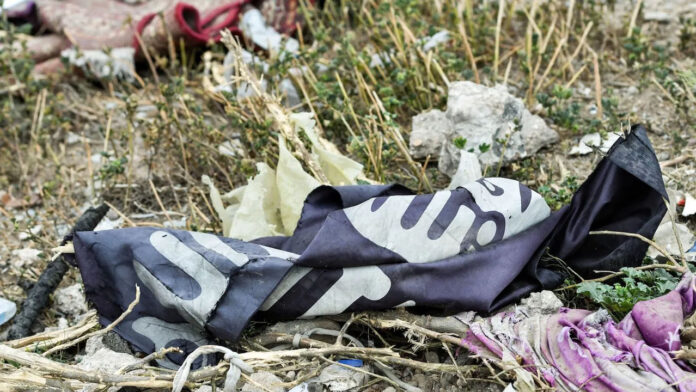
A discarded Islamic State flag lies torn on the ground (Giuseppe Cacace/AFP/Getty Images)
Islamic State West Africa Province (ISWAP) “terrorists” have been reported to have taken hundreds of hostages in Kukawa, town in Nigeria’s troubled North-East.
According to The Gaurdian, sources revealed on Wednesday that Jihadists linked to the Islamic State group overran Kukawa close to Lake Chad region, seizing people who had just returned to their homes after spending nearly two years in displacement camps, said Babakura Kolo, head of a local militia.
“The terrorists attacked the town in 22 trucks around 4:00 pm (1600GMT) yesterday and engaged soldiers guarding the town in a fierce battle,” he said.
On August 2, 2020, residents of Kukawa were escorted by the military as they returned to the town, an exercise that was facilitated by the Borno state government.
They had been living in camps in the regional capital Maiduguri, 180 kilometres (120 miles) away, where they fled following a bloody attack in November 2018.
A local chief who accompanied the residents to the town said the people had returned with the hope of cultivating their farmlands “only to end up in the hands of the insurgents”.
“We don’t know what they would do to them but I hope they don’t harm them,” said the chief, who asked not to be identified for safety reasons.
A security source who confirmed the incident to AFP said fighter jets were deployed from Maiduguri on Wednesday to “tackle the situation”, without giving details.
The decade-long jihadist conflict has forced around two million out of the homes, most of them from the northern part of Borno.
Many have moved into squalid displacement camps in Maiduguri, where they rely on handouts from international charities.
Despite concern by international charity organization on missions in the troubled region of Nigeria, suggesting that the area isn’t yet safe, local authorities have been encouraging the displaced to return to their homes in the last two years.
According to an official statement by the Coordinator of Media operations, Defence Headquarters, Major General John Enenche, Echotitbits reported on Wednesday morning that Nigeria’s Air Task Force (ATF) of the Operation LAFIYA DOLE successfully neutralized some Islamic State of west Africa Province (ISWAP) commanders and knocked out logistics facilities at Bukar Meram on the fringes of the Lake Chad in Borno State.
File photo: Minister of education, Adamu Adamu meets with key officials of Colleges of Education Academic Staff Union, (COEASU), led by the President, Mr. Nuhu Ogirima, in his office on Monday, November 20, 2017 in Abuja. Image- Federal Ministry of Information website
The Colleges of Education Academic Staff Union, (COEASU), has issued additional 14 days ultimatum after the expiration of the earlier 21 days ultimatum issued by the union to the Federal Government to address lingering and emerging issues of an industrial concern, which it says affects its members.
The General Secretary of the union, Taiwo Olayanju, in a letter of ultimatum to the minister of education, Adamu Adamu, said the 14 days extension was coming because the government was yet to respond to its demand.
Olayanju accused the government of insensitivity to issues bedeviling the advancement of the nation’s teacher education industry on the grounds that government refused to address the issues raised in the earlier ultimatum.
“Please, recall that our Union, following the decision of her Expanded National Executive Council (ENEC) meeting, issued a 21-day ultimatum within which the Federal Government was expected to address lingering and emerging issues of industrial concern, vide a memo reference no. COEASU/NS/01/19, dated 13th July 2020. As acknowledged, your office was in receipt of the memo on 15th July, 2020.
“We are, however, irked by the fact that your office till date is yet to find time in any way or pay attention in any form to our demands and ultimatum. This further qualifies governments insensitivity to issues bordering on the advancement of the nation’s teacher education industry.
“Having considered the implication of the insensitivity of the Government to all the issues of industrial concern, as they affect our members specifically, and the Colleges of Education in general, the Union may have no cause to wait any longer after fourteen (14) days, should government’s posture to our plight remain the same, but call on its members to commence a nation-wide strike action that will affect every form of service being currently rendered by them.
“The Union, therefore, expects your positive response to this extension of ultimatum so as to forestall a possible industrial action.”
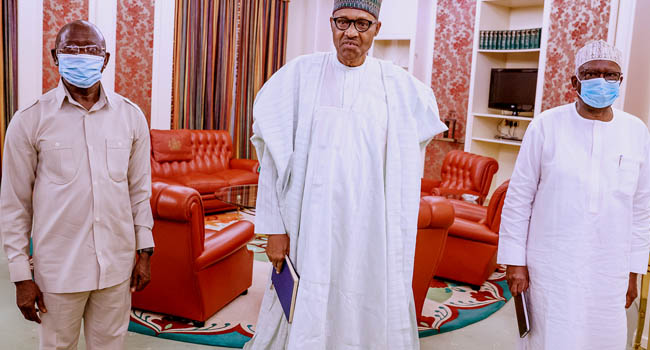
President Muhammadu Buhari is flanked by ex-Chairman of the ruling All Progressives Congress (APC) party, Adams Oshiomhole (L) and Chief of Staff (CoS) to the President, Prof. Ibrahim Gambari, State House, Abuja, Monday August 17, 2020.
Peoples Democratic Party National Campaign Council for Edo State Governorship Election has called out the Muhammadu Buhari Presidency over the trending video showing the sacked National Chairman of the All Progressives Congress (APC), Adams Oshiomhole, and the Chief of Staff to Mr. President, Ibrahim Gambari, at the Presidential Villa, in which alleged discussion on the arrests of certain individuals, ahead of the September 19 governorship election, was held.
“Nigerians were alarmed by the video in which Oshiomhole was seen emphatically urging the Chief of Staff to Mr. President on the need to clampdown on certain unnamed Nigerians to achieve political suppression and submission ahead of the Edo election.
File photo of Spokesman of the opposition Peoples Democratic Party (PDP), Kola Ologbodiyan.
“Our National Campaign holds that the presence and involvement of the Chief of Staff to the President and the fact that the discussion held within the precincts of the Presidential Villa, have made the Presidency complicit and place a huge burden on President Muhammadu Buhari.
“Already, there is anxiety in the public space that the discussion between Oshiomhole and Prof. Gambari as captured in the video is an extension of discussions that must have held behind closed doors in the Presidential Villa.
“The video has validated earlier revelations of plots by Oshiomhole and the discredited APC governorship candidate, Osagie Ize-Iyamu, to use compromised security operatives being mobilised by certain individuals in the Presidency, to arrest innocent Nigerians, including traditional, faith-based and community leaders on trumped up charges, ahead of Edo State governorship election.
“It also confirms our stance that Adams Oshiomhole and the APC candidate have completely lost ground in Edo State, hence the plot to clamp down on the people.
“Nigerians and the people of Edo State now know those to hold responsible should there be cases of illegal arrests, assassinations and unexplained killings, sudden disappearances of prominent people, accidental discharge by federal security operatives and mysterious accidents in the course of this Edo State governorship election.
“The PDP National Campaign Council on Edo State governorship election charges President Buhari to reassure Nigerians by immediately ordering that Adams Oshiomhole and Prof. Gambari be pulled in for questioning over the video.
“Anything short of a decisive action on this matter will further indict the Buhari Presidency especially coming on the heels of public anxiety over Mr. President’s widely condemned comment on the use of security forces for elections.
“Our campaign, however, wants the APC and Oshiomhole to know that their ignoble plots against the people of Edo State have come to naught as the people are at alert and will use every legitimate means available to defend their already expressed will in support of the candidate of our party, the PDP, Governor Godwin Obaseki in this election,” PDP alleged, in a statement by its Secretary, National Campaign Council on Edo State Governorship Election, Kola Ologbondiyan.
Mali’s President Ibrahim Boubacar Keita resigned late on Tuesday, hours after mutinying soldiers seized him from his home following months of mass protests against alleged corruption and worsening security in the West African country, Al Jazeera Media Network has reported.
Speaking on national broadcaster ORTM just before midnight, a distressed Keita said his resignation – three years before his final term was due to end – was effective immediately. He also declared the dissolution of his government and the National Assembly.
“If today, certain elements of our armed forces want this to end through their intervention, do I really have a choice?” Keita said in a brief address from a military base in Kati outside the capital Bamako where he had been detained earlier in the day.
“I wish no blood to be shed to keep me in power,” he said. “I have decided to step down from office.”
It was not immediately clear who was leading the revolt, who would govern in Keita’s absence or what the mutineers wanted.
Images posted earlier on social media said to be taken at the Kati garrison showed Keita and his Prime Minister Boubou Cisse surrounded by armed soldiers.
The M5-RFP coalition behind the protests signalled support for the mutineers’ action on Tuesday, with spokesman Nouhoum Togo telling Reuters news agency it was “not a military coup but a popular insurrection.”
The news of Keita’s detention was met with alarm by the United Nations, the former colonial power France and elsewhere in the international community. But in the capital, anti-government protesters who first took to the streets back in June to demand Keita’s resignation, cheered the soldiers’ actions.
“All the Malian people are tired – we have had enough,” one demonstrator said.
The political upheaval unfolded months after disputed legislative elections, and came as support for Keita tumbled amid criticism of his government’s handling of a spiralling security situation in the northern and central regions that has entangled regional and international governments, as well as a United Nations mission.
The downfall of Keita, who was first elected in 2013 and returned to office five years later, closely mirrors that of his predecessor.
Amadou Toumani Toure was forced out of the presidency in a coup in 2012 after a series of punishing military defeats. That time, the attacks were carried out by ethnic Tuareg separatist rebels. This time, Mali’s military has sometimes seemed powerless to stop fighters linked to al-Qaeda and the Islamic State of Iraq and the Levant (ISIL, or ISIS).
The 2012 mutiny also erupted at the same Kati military camp, and hastened the fall of Mali’s north to armed groups. Ultimately a French-led military operation ousted the fighters, but they merely regrouped and expanded their reach into central Mali during Keita’s presidency.
In recent weeks, anxiety had mounted about another military-led change of power in Mali after regional mediators from ECOWAS failed to bridge the impasse between Keita’s government and opposition leaders.
Keita tried to meet protesters’ demands through a series of concessions, and even said he was open to redoing disputed legislative elections. But those overtures were swiftly rejected by opposition leaders who said they would not stop short of Keita’s resignation.
Then on Tuesday, soldiers in Kati took weapons from the armoury at the barracks and detained senior military officers. Anti-government protesters immediately cheered the soldiers’ actions, and some set fire to a building that belongs to Mali’s justice minister in the capital.
Cisse urged the soldiers to put down their arms.
“There is no problem whose solution cannot be found through dialogue,” he said in a statement.
But the wheels already were in motion – armed men began detaining people in Bamako too, including Keita, Cisse and the country’s finance minister, Abdoulaye Daffe.
Tuesday’s developments were condemned by the African Union, the United States, and the regional bloc ECOWAS. UN Secretary-General Antonio Guterres sought “the immediate restoration of constitutional order and rule of law,” according to his spokesman.
Chairman of the African Union, Moussa Faki Mahamat, said he “energetically” condemned Keita and Cisse’s arrest and called “for their immediate liberation.”
French Foreign Minister Jean-Yves Le Drian said France “condemns in the strongest terms this grave event.” J Peter Pham, the US envoy to the Sahel, said on Twitter that the US was “opposed to all extra-constitutional changes of government.”
ECOWAS denounced “the overthrow by putschist soldiers of the democratically elected government” and ordered the closing of regional borders with Mali as well as the suspension of all financial flows between Mali and its 15 members states.
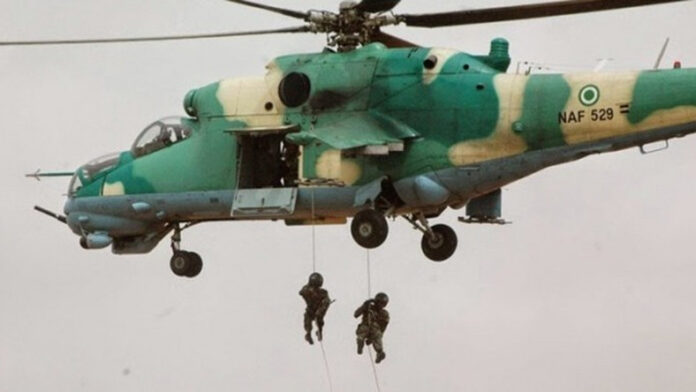
File photo of men of the Nigerian Air Force (NAF) disembark from a combat helicopter.
Nigeria’s Air Task Force (ATF) of the Operation LAFIYA DOLE has successfully neutralized some Islamic State of west Africa Province (ISWAP) commanders and knocked out logistics facilities at Bukar Meram on the fringes of the Lake Chad in Borno State.
The development was made known on Wednesday by Coordinator of Media Operations, Defence Headquarters, Major General John Enenche, in a statement sighted by Echotitbits.
Enenche stated that the air strike which is part of continued efforts conducted under subsidiary Operation HAIL STORM also neutralized several terrorists at Dole, a settlement in the Southern part of Borno State.
“The air interdiction missions were executed on 17 August 2020 on the heels of credible intelligence reports indicating a resurgence of terrorists’ activities in the 2 settlements.
“Bukar Meram, a major ISWAP logistics hub linking other Island settlements of the Lake Chad, which also houses several of their fighters and some of their key leaders, was attacked by an enhanced force package of Nigerian Air Force (NAF) fighter jets and helicopter gunships which hit designated targets in the area leading to the destruction of the logistics facilities and neutralization of several of the terrorists and their leaders” Major General Enenche stated.
He added that prior to carrying out the attack at Dole, Intelligence, Surveillance and Reconnaissance (ISR) missions were conducted, which showed a buildup of activities in the area.
The DHq media coordinator said the buildup was discovered to be a result of the relocation of some terrorists from nearby settlements of Kokiwa and Yale.
“Overhead the area the ISR aircraft spotted no fewer than 20 terrorists in the area, which were taken out by the NAF attack aircraft, Enenche added.
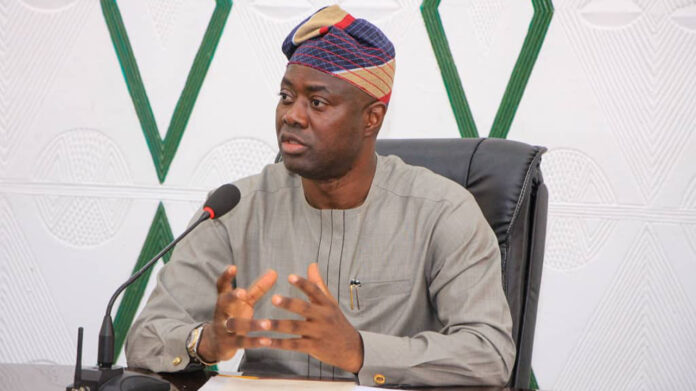
Oyo State government on Tuesday decried the incessant killings at the Akinyele Local Council Area of the state after yet another murder of a middle-aged woman identified as Mrs. Funmilayo, by a suspected serial rapist and killer who escaped from police custody after being paraded by the Oyo State Police command barely a month ago.
The Special Adviser to Governor Makinde on Security, Fatai Owoseni, at at a security town hall meeting with stakeholders in the council, stated that providing security for a community should be devoid of ethnic, religious and other biases.
The retired police commissioner maintained that the state government would continue to place a premium on security as the backbone of sustainable development.
He, therefore, urged non-state actors, especially residents of the affected communities, to give their maximum support to the government and security agencies during the period of the operation through intelligence sharing mechanism.
Similarly, Oyo State House of Assembly has ruled that the police re-arrest the suspected serial rapist and killer, Sunday Sodipe.
Speaker, Oyo State House of Assembly, Adebo Ogundoyin
As part of resolutions reached by the House on Tuesday after deliberations on the matter under urgent public importance, the Committee on Security and Strategy was directed to urgently meet with the Oyo State Police Commissioner, Joe Nwachukwu Enwonwu, to ascertain and unravel the circumstances surrounding the escape of the prime suspect in the serial killings in Akinyele Local Council Area of the state.
Urging the Oyo State Commissioner of Police on a prompt re-arrest and prosecution of the suspect, Sodipe, who confessed to killing five people, the House called for the deployment of more security agents to the council area.
Furthermore, Oyo House also appealed to the Board of Oyo State Security Network, code-named Operation Amotekun, to expedite action on the ongoing recruitment of officers of the security outfit to enable them collaborate with other security agencies for the promotion of peace and security in the state.
We use cookies to ensure that we give you the best experience on our website. If you continue to use this site we will assume that you are happy with it.