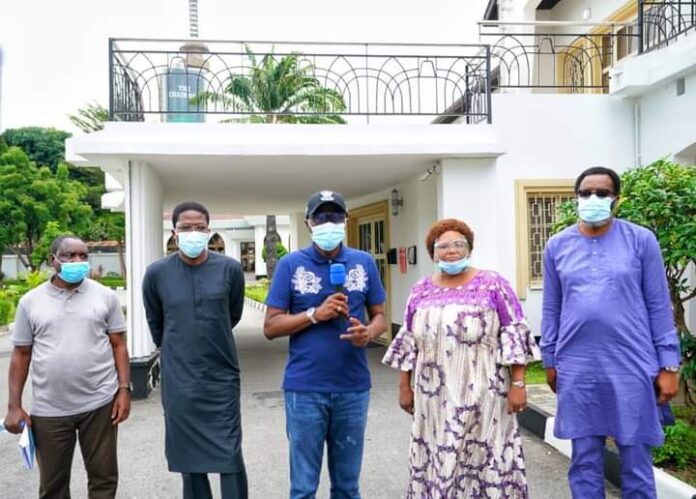
Lagos State Governor, Mr. Babajide Sanwo-Olu, on Saturday, received in audience, Justice Doris Okuwobi (rtd), chairman of the Judicial Panel of Inquiry and Restitution set up to investigate cases of brutality and human rights violations committed by operatives of the dissolved Special Anti-Robbery Squad (SARS) in the State.
Okuwobi’s visit to the Governor came ahead of swearing in of the panel members, which will hold in Alausa on Monday and their inaugural sitting at LASWA Building on Falomo Road in Ikoyi.
The meeting, held behind closed doors, was attended by the Attorney General of the State, Mr. Moyosore Onigbanjo, SAN, Head of Service, Mr. Hakeem Muri-Okunola, and Commissioner for Information and Strategy, Mr. Gbenga Omotoso.
The discussion in the meeting, it was gathered, focused on improvement in the composition of the panel membership and expectations of members of the public in the discharge of the panel’s duties.
After the meeting, Gov. Sanwo-Olu stated that the meeting was necessary to intimate the panel chairman on new developments and expectations of the Government.
The Governor disclosed that the membership slot reserved for the youth had been increased to two, saying the move was to ensure young people, who are mostly the victims of SARS brutality, had strong voice and contributions in the panel’s activities.
“The panel will commence its sitting next Monday after the official swearing in of its members in Alausa. We expect members of the public who have complaints against SARS operatives will approach the panel and bring forward their claims.
“It is also important to mention that we have increased the expected nomination from the youth. At the announcement of the panel two days ago, we asked the youth to bring forward one representative. We have increased the youth representation to two.
“I understand there is a process which the youth are using to nominate their representatives, which is very good. We will be expecting them to forward the names of their nominees to us before Monday. We believe that the increment in youth representation will further enrich the composition of the panel and diversity of the panel’s recommendations”, Sanwo-Olu said.
The Governor explained that the venue of the panel’s sitting was purposely chosen to create room for large occupancy should there be high number of complainants. He said the help desk lines specifically created to reach the panel members would be opened for calls from Monday.
He urged members of the public who had valid cases of brutality, human rights violations and extra-judicial killings to approach the panel for justice and compensation.
Other members of the panel include Mr. Ebun Adegboruwa, SAN (representing the Civil Society), Taiwo Lakanu (a retired Deputy Inspector General of Police), Ms Patience Udoh (representing the Civil Society), Mr. Segun Awosanya (Human Rights Activist), Mrs. Olutoyin Odusanya (Director, Lagos Citizens Mediation Center), and a representative of the Human Rights Commission.
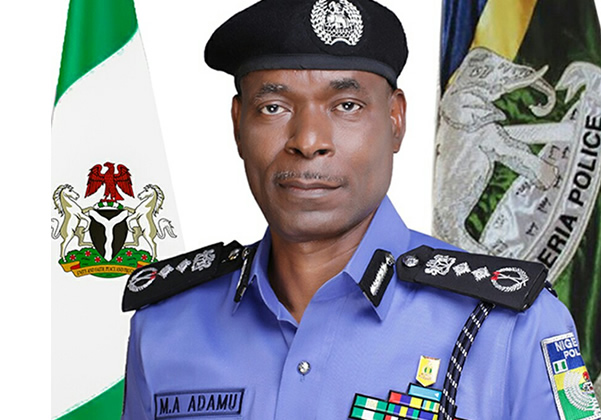
Nigeria's Inspector General of Police (IGP), Mohammed Adamu.
Inspector General of Police (IGP), Mohammed Adamu, has been wiggling between the demands by the protesters to discountenance the creation of Special Weapons and Tactics (SWAT) and the necessity for the immediate establishment of the new team to fill voids created by the dissolution of Special Anti-Robbery Squad (SARS), particularly during the Ember months traditionally characterised with upsurge in armed robbery and other violent crimes in the country.
But, protesters are not ready to back down as more cities and towns have been joining the #EndSARS movement.
Adamu has been seeking the cooperation of the citizens in the ongoing development drive for a new and reformed Nigeria Police Force.
He has constantly been appealing to them to be patient and to believe in the reform processes which are all directed at ensuring the security, safety and rights of all.
The police chief reaffirmed that the new Police Tactical Team would operate within very high professional and ethical standards, rule of law and dictates of best international policing practices.
Adamu explained that Nigeria Police Force is partnering with the International Committee of the Red Cross (ICRC) and other Development Partners for the training of the Tactical Team which commences October 19 at Police Mobile Force (PMF) Training School in Ila Oragun, Osun State and PMF Training School, Ende Hills in Nasarawa State.
He reiterated that no personnel of the defunct SARS would be a member the new Tactical Team, noting that “the officers selected for the training are young, smart and energetic officers who have acquired not less than seven years working experience with clean service records – no pending disciplinary matters, no record of violation of rights of citizens or misuse of firearms – and are physically fit to withstand the rigour of SWAT Training and Operations.”
According to him, “The selected officers shall be subjected to physical fitness test, medical and toxicology screening etc and those found to be unsuitable shall be discharged.
“ICRC, an independent International human rights and humanitarian support organisation with over 71 years experience in humanitarian services and institutional support and development, will provide resource persons and materials to handle the human rights components of the training programme.
“Specifically, they will handle topics touching on humanitarian laws, police conduct in conflict situation, human rights standard especially in the use of force and firearms, arrest and detention amongst others.
“Other areas of the training program will include modern-day police ethics and values, Intelligence-led policing, Operation planning/Tactical decision making processes, Hostage rescue tactics and operation, weapon handling, first aid/basic life saving skills, stress/fear management, police-citizens relations and emotional intelligence etc.
“The training modules will be handled by other carefully selected development partners, security experts as well as veterans from the civil society and human rights community.”
Adamu, in a statement by the Force Public Relations Officer, Frank Mba, charged the training coordinators to ensure a diligent and timely delivery of the Tactical Team.
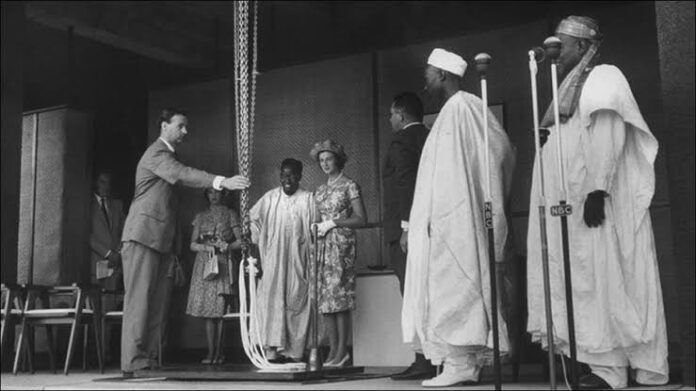
Prime Minister of Nigeria Abubakar Tafawa Balewa (2R), Princess Alexandra (C)PHOTO: www.bbc.co.uk
In the first part of this article, published on October 1st, Nigeria’s 60th independence day, an assessment of the nation’s progress so far in governance, and impact of military intervention was discussed.
One other critical area of assessment is policy making.
Many times government had come up with policies that put the masses in more difficult situations, deepening their burden and frustration. A number of times citizens had kicked against policies that are perceived to be anti-people. This is bound to happen because there is a wide gap of mistrust between the governed and the government.
In normal climes, public office holders are servants of the people, whereas, the reverse is the case in a country like Nigeria. Invariably, government decisions ought to always have the people in mind. In other words, policies shouldn’t be made without a honest effort to know what the people want, what they yearn for, also importantly is how much adverse impact such policies would have on their living standard in comparison to long term gains.
This is where inclusion comes in the day to day running of the affairs of the state, also are transparency and accountability.
The procurement law stipulates that before a project is designed, a need assessment should be carried out. it is however unethical to wake up on a good day and single-handedly decide that what people need is a bridge. How did you know that’s exactly what the masses need? A need assessment should firstly, be carried out to ascertain the real needs of the people. Unfortunately, what our leaders do is to “feel” on behalf of the people, what their needs are. All they do is to have a feeling that this is good for the people and they jump at it and fritter away billions of Naira on a project that gets abandoned, unused by the community.
The increase in Value Added Tax (VAT), and the recent hike in electricity tariff makes one wonder to what end these policies are, if not to further burden and impoverish the masses rather than lifting the out of poverty. At the centre of government policies and citizens’ response are two critical elements. One is inclusion. Majority of Nigerians don’t trust government, and this is correctly so because of many years of empty promises and pledges. It is essentially profitable for government to adopt inclusion in the way it runs the affairs of the country by involving the masses in its plans. Two is transparency, been open with information.
However, to further make sense of the journey of Nigeria so far, albeit a dance by the precipice of disintegration and every stress that has threatened the unity of the most populous black nation in the world, I’ll present a perspective of a senior colleague, a veteran journalist who retired as a senior official of the Nigerian Broadcasting Corporation (NBC), Eddy Aina.
The Failed Labour Strike Over Electricity Tariff
“Looking at the shenanigans that took place between labour and the federal government, it would be right to say nothing has really changed because the strategy has always been that we will go on strike, they’ll infiltrate labour, you’ll hold meetings and meetings and postpone those meetings and hold the last one at night, and come out with some decisions.
“And if you look at the decisions, there are about four, five of them, they want to look at the rationale behind the increase in tariff. Why that tariff, you are trying to justify it. Well for me, that tariff can not be justified because at the initial stage it (electricity distributing companies) was not given to the right people. Somebody even confessed that, to use his words he said “we shared it among ourselves”. The privatization was not done in the proper way in the sense that it was not given to people who have the financial capability, administrative know how, and even the technical know how, and that is the reason why we are where we are now.
“They didn’t talk about metering, you want to meter 6million out of 200million people, that is neither here nor there. And they spoke about gas, that is providing gas bus, that is futuristic. You don’t have those buses now, and if you recall, under GEJ (former President Goodluck Ebele Jonathan), the Federal Government gave money to Labour, what has become of those buses now? So for me it is just pushing the thing ahead. The fact remains that they didn’t give it to the right caliber of people.
“Talking about the deregulation of the downstream sector, the fact remains that the Federal Government hasn’t done what it ought to have done. Provide refineries to work in Nigeria, modular refineries, whatever you want to provide, but you have refused to do it. And the reason the Federal Government is insisting, for me, is because of the breathing hood institutions: IMF, World Bank and even to an appreciable extent, African Development Bank (AfDB) because we are heavily indebted to them and they dictate to us what we should do.
“I want to believe that it is a sellout between the labour and the government. Sellout in the sense that when you look at all those decisions, they plan to give 240,000 workers… how many people is the Federal Government making provisions for our of over 200,000 million Nigerians? Look at housing, recall that at the Federal Government level, there was a housing policy, whereby you contribute money on monthly basis, they deducted it from source. And at the end of the day, when your money gets to a particular extent, you ask for loan to build your house, how many people were given? In fact, I know so many people in the Federal Civil Service that were not given. To recoup your money, even after retirement…for me it took me over two years to recoup my money. So this for me is out of the point.
“Now look a at privatization that we are talking about, the only privatization that has been properly done in this country is telecommunications. How could you have privatized a particular business and you are now giving money to them to run it. For instance, according to the Vice President, ₦1.7 trillion has been given to these Discos just within a short period. So for me it’s a sellout.
Another area is the MOU for the sales of Discos. The Federal Government now suddenly wants Labour and other people to examine the MOU. Whereas, if it had been properly done at the initial stage, all you needed to do was to say you are not tagging along with what was agreed, so either bring in another set of people to run the Discos. It is baffling that they are afraid to bring in another set of people because the people they sold the assets to are big wigs, former heads of state, wives of former heads of state, that is incredible.
“For instance, when we signed a loan agreement with China, China ensured that there are clauses that will enable them take over part of the country. So what did we do in that direction?
“Now you are even talking of oil. They want to justify the issues around oil, that is privatizing the oil sector. Fine they want to privatise, but they are not doing the proper thing. Number one, look at the amount of money that was spent on turnaround maintenance, trillions of dollars. Now they want to go back to rejigging the refineries, I think something is wrong somewhere.
“Before former President Olusegun Obasanjo left office, he privatized it, but Yar Adua came and canceled the process. Now government wants to go back to it, I think they are not serious. For me, it’s a sell out because none of those things listed as cushion can work. Five million people to be given solar energy, how do they select those 5 million people out of 200 million people. I think it’s just a stop gap, let’s give them two weeks, we’ll run around it. I know they (Labour) cannot go back to strike again, no way they can do it.”
Politics, governance, the issue of political instability, interventions from the military.
“I remember when Nigeria gained independence in 1960, students were taken to the frontage of the Ake Palace (Abeokuta, Ogun State capital) then and were given a plate of rice. Frankly, Nigeria was a British protectorate in 1901, after independence in 1960, the country went republic in 1963.
“Between that time and now a lot of water had passed under the ground, some savoury, some unsavoury. But mostly unsavoury things have happened and that is why we are where we are now. Between that time and now, if you look at it critically, we can spend a whole day discussing it, looking at events before independence, then 1960 and from 1963 to 1966 the period of military intervention. What actually caused those military intervention, are those factors that were there then still prevalent now? To answer the question is to affirm that those factors are still there.
“If you look at so many authors, B. J. Dudley feels that the type of election we had in 1979 is still what we had in 2019 and 2020, even the election in Edo reflected it. We are not changing in that direction.
“In 1964, the fracas in the then Western Region was brought about because there was massive rigging of election and so many other factors and the military came in. Between 1963 and even 1979, because of ethnicity, multi religiosity, our multi dimensional society, and because of our leaders, we were not skillful enough, not patriotic enough, we didn’t have that aura to manage our diversity that is why we are where we are today. There is ethnic problems all over the place.
“Look at southern Kaduna, between the Hausas and non-Hausas, look at Plateau state between the Berom, the Hausas and Fulanis. Look at Delta, the Ijaws, the Urhobos and the Isekiris. Even when you look at the South West, it’s the same thing. All these factors to the extent that we cannot even count ourselves. How do you even plan when we cannot count ourselves? Recall that the military intervention came about because of the Tiv riots, because of the census that were contested in 1962 and because of fraudulent elections. All these things are still there because we have not had a leader to manage all these diversities. In fact, rather than manage all of these diversities, our leaders continue to use it to divide us into cleavages. Ethnic, religious, even fundamental cleavages. All of these things came on board and that is why we are where we are today.
“In 1999 till date, we have had 21 years, which is good enough. Some people would say at least we have had 20 years without military intervention. But look at it, before, the military interventions prevented Nigeria from moving, no economic growth, no good welfare for the people, people don’t have what they ought to have, no water, no electricity, and even between 1999 till date, some people will even argue that those things are still there now. Are they not there? In fact they are worse because we have leaders who are nepotistic, everything is ethnic based. Even when you are distributing largess, infrastructural facilities like roads, rail, electricity and water, still based on ethnicity. So those things are still there to the extent that our fault lines are clearly demarcated now and Nigeria is at the edge of the precipice and if care is not taken we might tip into it because we don’t have a leader that can manage our diversity and turn it round to give economic growth, development to the people, jobs for the youths who are about 60% of the population, and then women.
“For me, 1960 till date, good enough, bad enough. We have had worse, we have had everything.
“Nigeria’s problem is foundational in the sense that the British brought together people who had no business to be together. Unfortunately, because of the grab and take philosophy of colonialism through which the British penetrated our society, some authors will argue, they came with bible in one hand and gun in the other hand. But when they came they studied the situation critically, and they found out that they had to favour one group to the others. What do I mean? If you look at what we have on ground now, the argument of the British is that the North is 3/4 of Nigeria while the rest is 1/4. In terms of population they believe that they have half of the population of Nigeria.
If you also look at the election that preceded 1960, that is 1959, in the House of Representatives at the parliament, there were 312 representatives the North won 134 seats, the East 89, and the West 73. So that was what made Obafemi Awolowo an opposition leader and handed the reins of government to Ladoke Akintola, who then went to align with the North.
“Awolowo and the group said no, Akintola couldn’t do that without taking Action Group along. The situation snowballed into an attempt to remove Akintola as the Premier of Western Region when they went to parliament and there was problem. The rest is history, because it actually led to why the military came into power. But even at the point when we wanted independence, some people didn’t want it because they wanted to continue to enjoy that benefit, the vantage they have, and that’s the North. The North on many occasion, in fact twice they wanted to leave but the colonialist said don’t go.
If you read Just Before Dawn by Kole Omotoso, the British encouraged the Northerners to go and bring their people, their boys to join the army and that is the edge they have in the army today. So, those advantages are there, they didn’t want independence. Haven’t won independence, the North won it on a brighter side in terms of population, land size, which is three quarters. Now, that is the problem we have at the moment, they do not want to hand over that edge.
“As per a round table discussion, we can talk, the pressure is on now. After all, President Muhammadu Buhari and the All Progressives Congress (APC) promised us that they would restructure. They set up a committee headed by the Governor of Kaduna State, Nasir El-Rufai, it has come out with nothing because they have not really restructured anything.
“Likewise, there is this other panel headed by the Deputy Senate President, Ovie Omo-Agege, that wants to go through the constitution but it cannot work. This is because it would be cosmetic. If you want to restructure, you have to involve the right set and number of people. We have about 400 ethnic groups in this country, call the heads together whichever way they want to gather us together and let us discuss.
“Also, let their be referendum, if there is plebiscite clause in there we can at any point in time call out Nigerians to decide if they want this or not, then they vote just like you have in Ethiopia and Mauritania.
Government Policy so far
“There’s a quote by I.F Stone, every politician is a liar, don’t ever believe what they tell you. It is imperative to conduct baseline studies when policies and projects are being developed. Is it water they need, or food, is it electricity and all that. You conduct that baseline study to arrive at what the masses really need, that is talking to the stakeholders.
“Let’s look at the development plans that we’ve had over the years, that of Adedeji ìn 2010, water for all, housing for all and all that. We are in 2020, all of that had gone down the drain. Now we are talking of 2050. The point is, it’s not the policy, the ones they had in the past, how did they handle them? Did they consult the experts and key stakeholders? Did they provide money? Did they have timelines for stage by stage accomplishment of the plans?”
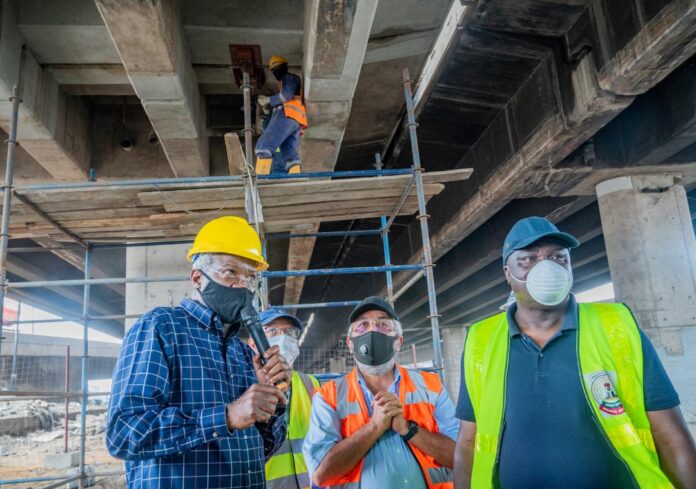
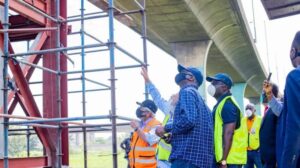
File Photo: Hon. Minister of Works and Housing, Mr Babatunde Fashola,SAN (left) joined by the Federal Controller of Works in Lagos, Engr.Olukayode Popoola (left) and Chairman of Buildwell Plants and Equipment Industries Ltd, Riad Abou Habib as he explains work being done underneath to Journalists during his inspection of the Ongoing Emergency Repairs of Marine Bridge in Apapa, Lagos State on Thursday, 8th October 2020.
Minister of Works and Housing, Babatunde Fashola, SAN, has directed that both Eko and Marine Bridges in Lagos State be reopened to traffic starting from Monday (October 19).
The minister, who issued the directives over the weekend after completing urgently needed repair works on the bridges, thanked Lagosians for their resilience, patience, understanding and cooperation while sections of the both bridges were closed.
Fashola’s approval for the reopening of the completed first phase of the repairs on the bridges by midnight of October 18 was sequel to the report by the contractor handling the projects, Messrs. Buildwell Plant & Equipment Industries Limited that the emergency repair works had been completed 100 per cent.
The minister has also directed that members of the public should be well informed ahead of any restriction to traffic while work is ongoing on the second phase of the project.
Fashola added that while the completed section of Eko Bridge (Lagos Island bound) should be reopened to traffic, work should commence immediately on Alaka bound side of the project.
Giving further explanation on the next phase of repair works on the bridges, Director Highways (Bridges & Designs) in the ministry, Emmanuel Adeoye, said work was taking off without the need for either partial or complete closure of the bridges.
He, however, said the public would be informed adequately should there be any need for either partial or complete closure.
The 1,350-metre Eko Bridge, built in phases between 1965 and 1975, links Lagos Island to Mainland. It was closed to traffic in March this year in order to replace faulty joints and bearings. But, as a result of the Coronavirus (COVID-19) lockdown, actual repair works commenced in the first week of June.
For Marine Bridge, work commenced in May on the first of the three phases in which repair works on the bridge was divided. The repairs on the bridge, which is part of a network of complex bridges with several loops taking traffic in and out of Apapa area of Lagos, included jacketing and skin repairs of the piers, lifting the bridge section deck in order to change the electrometric bearing, milling and placing a new wearing course of asphalt among others.
Essentially, the repair works on Eko and Marine Bridges were part of the ongoing Federal Government’s Bridge Maintenance Programme which involves the repairs and rehabilitation of over 37 bridges nationwide with a substantial number already completed, while others are at different stages of completion, said a statement by the ministry’s Director of Press and Publicity, Boade Akinola.
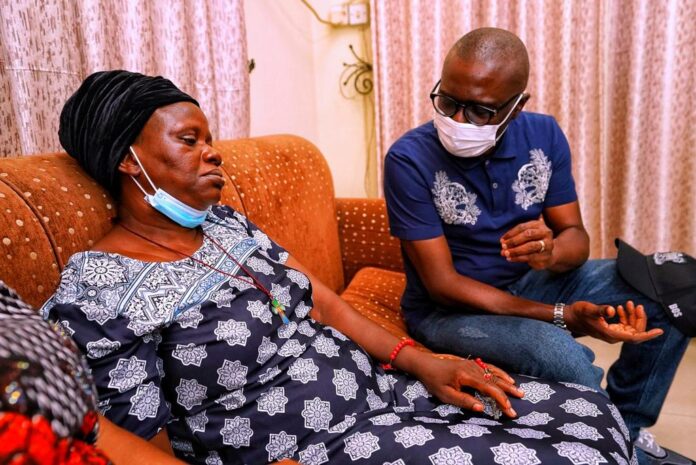
To further demonstrate his heart-led leadership qualities, Lagos State Governor, Babajide Sanwo-Olu, visited the widow of the driver hit by stray bullet during the last Monday demonstration by youths in Surulere for the dissolution of the Special Anti-Robbery Squad (SARS).
The protest ended bloody when the police attempted to disperse some of the protesters who were moving towards Anti-Cultism Police Command in the area. In the ensuing chaos, Okechukwu Iloamuazor, 55, was hit by bullet and died on the spot.
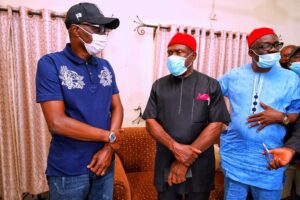
The governor arrived at the deceased’s house at 2pm and was received by family members led by their head, Bede Enewally. The family house was enveloped in gloom as the Number One Lagos State citizen visited the grief-stricken widow, Ngozi Iloamuazor.
Sanwo-Olu commiserated with the family over the incident, which he described as unfortunate. He said late Iloamuazor should not have died under the circumstance, but assured the family members that the perpetrators would be brought to book.
Already, all the four policemen who opened fire on the protesters in Surulere had been identified by the government and the police authorities. They are currently undergoing orderly room trial at Lagos State Police Command.
But, Sanwo-Olu assured that his administration would take the officers’ punishment beyond the established disciplinary guidelines of the police.
According to him, “On behalf of Lagos State Government, and the people of Lagos, I commiserate with the family over this mindless brutality that led to the death of your son. We condemn endless killing of innocent citizens to the highest level. It is highly disheartening to learn that the victim, Mr. Iloamuazor, was performing his legitimate duty when the unfortunate incident happened. He hurt no one to have subjected to such pain death.
“The officers involved are undergoing orderly room trial as we speak, but we will allow the police complete their investigation. We will certainly take the case out of the police and bring the full wrath of the law on the officers who perpetrated this irresponsible act. This will be clear signal for other trigger-happy officers.
“Mr. Iloamuazor’s death is a sad loss not only for the family but to the entire citizenry that has clamoured for an end to police brutality. I assure you that his death won’t be in vain and the case will not be swept under the carpet. This is going to be the beginning of real change that people want to see in law enforcement.”
Sanwo-Olu reiterated that his administration remained on the side of those calling for change in policing method. He said all those maimed or killed in Lagos in the course of the demonstration would be duly compensated, adding that his administration would honour their sacrifices by pushing for reforms that would bring about a policing system that would uphold rights of the citizens.
He said: “As a government, we have stood on the side of the protesters and we totally believe their agitation is legitimate. We need total reform in the policing system and it is a clarion call on all of us, who are exercising powers on behalf of the citizens.”
A policeman, Inspector Ayodeji Erinfolami, also died in the incident.
Late Iloamuazor’s boss, Sam Okafor, who witnessed how the driver got hit by stray bullet, relived the incident.
Okafor cleared the air that the deceased was not partaking in the protest, pointing out they were both heading to Ilupeju when they ran into the protesters in Surulere.
“We were stuck in the traffic caused by the protesters who were shouting #EndSARS. For more than 40 minutes, there was no movement. I wound down the windshield for fresh air, while Iloamuazor got down from the car to stretch his body. After stretching, he put his both hands into his pockets and trying to figure out where the traffic started.
“Suddenly we heard gunshot three times. The next thing I saw was Iloamuazor falling from his position. His hands remained in his pockets as he fell. I ran out of the car and screamed for help. People came and started performing all sort of things to save him. The police came to the scene and I told them my driver had been shot on the spot,” he said.
Okafor urged the governor to ensure justice was served in the matter, noting that he was yet to be relieved of the shock.
Enewally said Iloamuazor’s death threw the family into a state of perpetual sorrow, noting that the deceased carried several responsibilities in the family. He said the family put its trust in the governor to ensure justice was served at the end of the day.
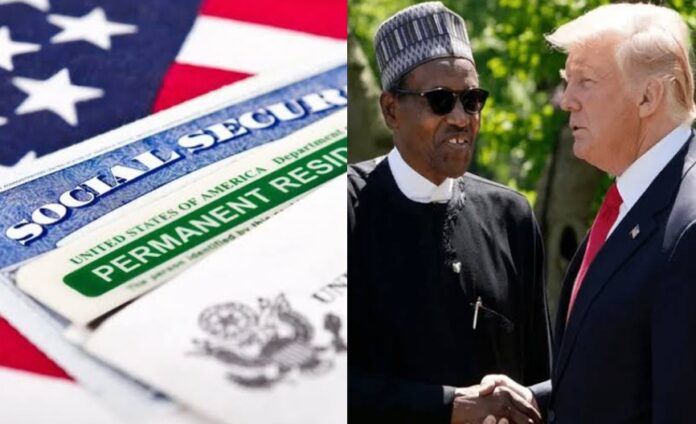
A document obtained from the United States Government website has shown that Nigeria has been barred from the popular US Visa Lottery Application for 2022.
In a 19-page document published on the website, Nigeria is the only African country barred from the lottery.
“For DV-2022, persons born in the following countries are not eligible to apply, because more than, 50,000 natives of these countries immigrated to the United States in the previous five years: Bangladesh, Brazil, Canada, China (including Hong Kong SAR), Colombia, Dominican Republic, El Salvador, Guatemala, Haiti, Honduras, India, Jamaica, Mexico, Nigeria, Pakistan, Philippines, South Korea, United Kingdom (except Northern Ireland) and its dependent territories, and Vietnam.
“Persons born in Macau SAR and Taiwan are eligible,” the document said.
While natives of other African countries are allowed to apply, the document explained that “persons born in the areas administered prior to June 1967 by Israel, Jordan, Syria, and Egypt are chargeable, respectively, to Israel, Jordan, Syria, and Egypt.”
It added: “Persons born in the Gaza Strip are chargeable to Egypt; persons born in the West Bank are chargeable to Jordan; persons born in the Golan Heights are chargeable to Syria.”
Titled: “Instructions for the 2022 Diversity Immigrant Visa Program (DV-2022),” the document explained that prospective applicants must meet certain guidelines to be eligible for the visa lottery.
According to the document, “The Department of State determines selectees through a randomized computer drawing.
“The Department of State distributes diversity visas among six geographic regions, and no single country may receive more than seven per cent of the available DVs in any one year.”
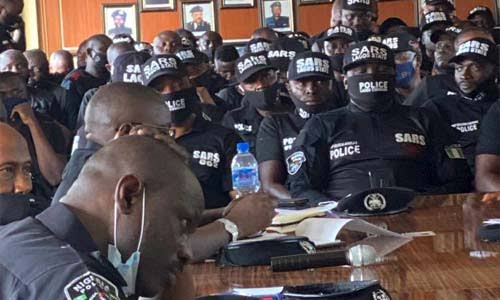
A cross section of officers attached to the disbanded Special Anti Robbery Squad (SARS), a notorious tactical squad of the Nigerian Police Force accused of impunity and gross human rights violations.
No fewer than 37 police officers attached to the disbanded Special Anti-Robbery Squad (SARS) have been recommended for dismissal over allegations bordering on human rights violations.
From the data contained in the report of the Special Presidential Panel set up by the Federal Government in 2018 on reform of SARS, no fewer than 24 officers would face prosecution over various professional misconducts.
Youths across Nigeria troop to the streets protesting against Special Anti Robbery Squad (SARS), a notorious tactical squad of the Nigerian Police Force accused of impunity and gross human rights violations.
Disclosing this while submitting the report of the panel to the Police Service Commission, the Executive Secretary of National Human Rights Commission (NHRC), Tony Ojukwu, charged the commission to ensure speedy implementation of the findings.
Besides, the panel submitted that capable, professional and credible people must be selected into SWAT unit as part of efforts to bring reform into the police force.
“There must also be close supervision of the newly selected officers so that the nation will not experience the rot that became the fate of the disbanded unit.
“The panel also directed the Inspector General of Police to unravel the identity of 22 officers involved in the violation of the human rights of innocent citizens,” the report pointed out.
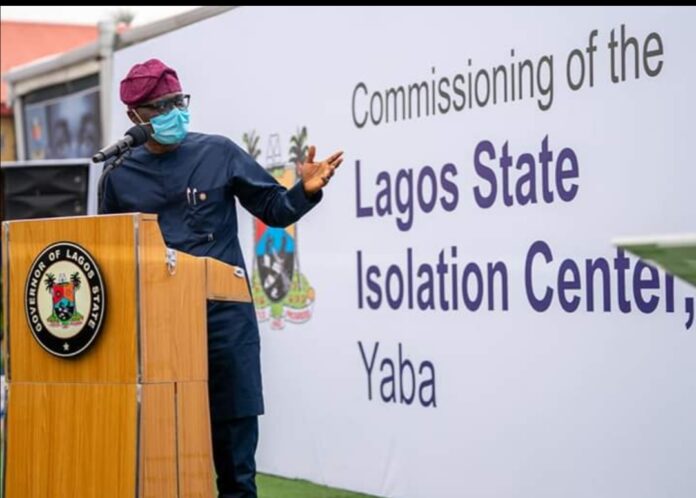
Governor Sanwo-Olu at the Commissioning of the Lagos State isolation Centre, Yaba Lagos
The Governor Babajide Sanwo-Olu-led Lagos State Government Friday said a total of 181 students and members of staff of a private boarding school located in Lekki area of the state have tested positive for the Coronavirus (COVID-19).
The Sanwo-Olu administration disclosed that the positive cases were detected during surveillance and case investigation in the school.
The state government, however, did not disclose the name of the school.
“181 students and staff members of a private school located in a suburb of Lekki tested positive to COVID19 during surveillance and case investigation in the school.
“There are 441 students and staff in the school.
“A 14-year-old SS1 female student fell ill on the 3rd of October and was sent home after receiving first aid at the school.
“The student subsequently tested positive for COVID-19 on Tuesday 6th of October in one of the accredited private labs in Lagos.
“There is a total lockdown and movement restriction in the school with the Epidemiology and Surveillance Pillar of the EOC and Ibeju-Lekki Local Government Area State Disease Surveillance and Notification Officer (DSNO) reporting at the school daily to conduct further investigation.
“Positive students and staff have been isolated on the premises and given the COVID-19 home-care treatment packs and are being monitored in isolation within the school premises,” said a statement by Lagos State Commissioner for Health, Akin Abayomi, entitled: ‘Lagos confirms COVID-19 infection in a private school.’
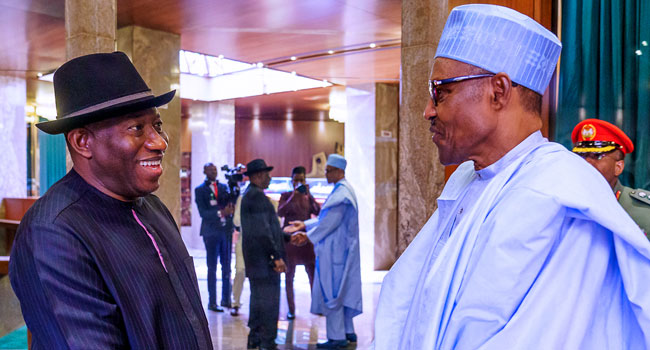
A file photo of former President Goodluck Jonathan and President Muhammadu Buhari.
President Muhammadu Buhari and former President Goodluck Jonathan Thursday met in Abuja over the political crisis in Mali.
Giving updates on the considerable improvement in the management of the crisis in Mali, Jonathan, who is the Special Envoy/Mediator to the West African country, said the mission given to him by the leaders of the Economic Community of West African States (ECOWAS) was almost fully done, as a transition government with a largely civilian face has been inaugurated in Mali.
He said: “The President has been sworn in, the Prime Minister, and Ministers too. The military has only four portfolios for serving officers, and the government has taken off.
According to him, “We can’t do hop, step and jump like other developed nations of the world, but one is delighted at the successes recorded.”
It would be recalled that after the intervention by the military in Mali, ECOWAS leaders had insisted on a transition government led by a civilian, and return to constitutional order within 12-18 months, among other demands.
We use cookies to ensure that we give you the best experience on our website. If you continue to use this site we will assume that you are happy with it.