Category: Africa

  • Mali Crisis: Buhari, Jonathan Celebrate Considerable Successes

    Mali Crisis: Buhari, Jonathan Celebrate Considerable Successes

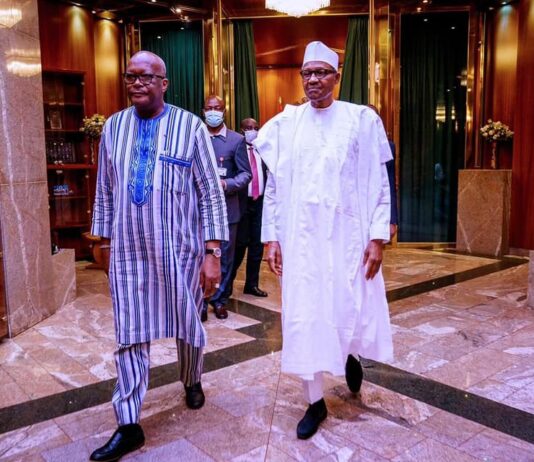
    President Muhammadu Buhari and former President Goodluck Jonathan Thursday met in Abuja over the political crisis in Mali.

    Giving updates on the considerable improvement in the management of the crisis in Mali, Jonathan, who is the Special Envoy/Mediator to the West African country, said the mission given to him by the leaders of the Economic Community of West African States (ECOWAS) was almost fully done, as a transition government with a largely civilian face has been inaugurated in Mali.

    He said: “The President has been sworn in, the Prime Minister, and Ministers too. The military has only four portfolios for serving officers, and the government has taken off.

    READ ALSO:

    Obiano Sacks Security Aide, James Nwafor, over Violations of Human Rights

    “The Council, which will work like parliamentarians, will be inaugurated soon.”

    Jonathan added that ECOWAS Chairman, President Nana Akufo-Addo of Ghana would formally brief West African leaders soon.

    Responding, Buhari expressed delight that crisis in Mali had calmed down considerably, following interventions by ECOWAS leaders.

    READ ALSO:

    INEC Fixes February 18, 2023 for Next Presidential Poll

    According to him, “We can’t do hop, step and jump like other developed nations of the world, but one is delighted at the successes recorded.”

    It would be recalled that after the intervention by the military in Mali, ECOWAS leaders had insisted on a transition government led by a civilian, and return to constitutional order within 12-18 months, among other demands.

    Idowu Sowunmi

  • African Development Bank Appoints Yacine Fal as Director-General, President’s Cabinet Office

    African Development Bank Appoints Yacine Fal as Director-General, President’s Cabinet Office

    For effective administrative and operational work and activities at the President’s Cabinet Office, African Development Bank Group has announced the appointment of Yacine Fal as the office’s Director General effective November 1.

    Fal, a Senegalese, has been described as a seasoned and results-oriented business development and service delivery professional with over 20 years of experience in banking, legal and procurement fields.

    As Director-General, Fal would primarily provide oversight of all units and departments directly reporting to the President.

    She would also ensure enhanced delivery efficiency and effectiveness for all presidential initiatives and bank operations, as per agreements with respective Vice Presidency Complexes.

    The new director-general would oversee the work of senior staff to improve overall coordination and engagement of the President and Chairman of the Board of Directors with the Board.

    Speaking on the appointment of the new director-general, President of the African Development Bank Group, Akinwumi Adesina, described Fal as “a highly capable manager.”

    According to him, “Fal brings vast knowledge and experience of the bank’s legal, procurement, human resources, processes, systems, and operations to her new position.

    “I am delighted to have Fal lead a restructured Cabinet Office of the President that will comprehensively support the delivery of my vision and mandate to strengthen the bank and accelerate Africa’s development.”

    Also commenting on her appointment, Fal said: “I am greatly honoured by the confidence reposed in me by President Adesina to support him in ensuring the successful implementation of his bold vision for the bank and the continent.

    “I look forward to leading teams in the President’s Cabinet Office to provide managerial, administrative and operational bandwidth and to assure the success of the President’s vision and mandate following his historic re-election with 100 per cent vote of the bank’s shareholders.”

    Fal joined the African Development Bank as a Principal Legal Counsel in the procurement unit (1998-2007) and subsequently served as Manager in charge of the reform implementation team in the office of the President (2007-2008).

    She was appointed Officer in Charge of the Procurement and Fiduciary Services Department (2010-2011); and Manager of the Procurement Services Division (2008-2013). She later served as the Resident Representative of the bank’s Morocco Office (2014-2017).

    In 2016, Adesina appointed Fal as the Deputy Director General of the North Africa Business Development and Service Delivery Office.

    Fal holds a Masters of Law degree (1984) from University of Dakar, where she specialised in corporate and tax law, and a postgraduate degree in International Law (1987) from University of Paris X.

    Idowu Sowunmi

  • Aftermath of #EndSARS: Presidential Panel on Police Reforms Okays Five-point Demand of Protesters

    Aftermath of #EndSARS: Presidential Panel on Police Reforms Okays Five-point Demand of Protesters

    A meeting with the leadership of Nigeria Police Force and other stakeholders had agreed to meet the demands of the #EndSARS protesters which included halting use of force against demonstrators and unconditional release of arrested Nigerians.

    The meeting affirmed and described the five-point demands of the protesters and the #EndSARS movement as genuine concerns that should be urgently addressed by the Federal Government.

    In a communiqué issued at the end of the stakeholders’ meeting on the Implementation of the Recommendations of the Presidential Panel on the Reform of the Special Anti-Robbery Squad (SARS), it was agreed thus:

    “Following the public protests regarding various forms of human rights violations by the Special Anti-Robbery Squad (SARS) and the consequent disbandment of the unit by the Inspector General of Police, Mohammed Adamu, there arose the need for stakeholder engagement to build trust and restore public confidence in law enforcement.

    “The agitations also brought to the fore, the need to implement the recommendations of the Presidential Panel on the Reform of the Special Anti-Robbery Squad (SARS).

    “The Forum was addressed by the Inspector General of Police and the Executive Secretary of the National Human Rights Commission.

    “The Forum collectively: welcomed the dissolution of the Special Anti-Robbery Squad (SARS) by the Inspector General of Police, Mohammed Adamu; reaffirmed the constitutional rights of Nigerians to peaceful assembly and protest; further affirmed the sanctity of life of every Nigerian and the role of the Police in protecting this right; affirmed that the five-point demands of the protesters and the #EndSARS movement are genuine concerns and will be addressed by the government.”

    Police Killings: IGP Adamu Bans FSARS, Other Tactical Squads from Patrols

    Following directives by President Muhammadu Buhari on dissolution of SARS and immediate response to yearnings of Nigerians, Adamu Tuesday replaced the squad with a new team called Special Weapons and Tactics (SWAT) and convened a stakeholders’ meeting.

    The meeting, organised by the Office of the Inspector General of Police and National Human Rights Commission (NHRC), was a multi-stakeholders’ forum attended by Ministry of Police Affairs, Police Service Commission, leaders and representatives of civil society organisations in Nigeria, activists from the entertainment industry and the #EndSARS movement and development partners.

    According to the communiqué signed by the Inspector General of Police and Executive Secretary of the National Human Rights Commission, Tony Ojukwu, Esq, the Forum noted that the dissolution of SARS presents an opportunity to embark on comprehensive reforms aimed at repositioning the Nigerian Police Force as a modern, responsive and citizens-centred law enforcement organisation.

    “The Forum further notes that the proposed reforms should be anchored under the basis of the White Paper on the Report of the Presidential Panel on the Reform of the Special Anti-Robbery Squad which was jointly authored by the National Human Rights Commission, the Federal Ministry of Justice, and the Nigeria Police Force.

    #EndSARS: Sanwo-Olu Identifies with Demonstrators, Meets Buhari Tomorrow

    “The Forum affirms that reform proposals for the Nigerian Police Force will be based on Constitution of the Federal Republic of Nigeria and existing legislations such as the Nigeria Police Act, 2020, the Nigeria Police Trust Fund Act, 2019, the Administration of Criminal Justice Act, 2015 the Anti-Torture Act, 2017, and the National Human Rights Commission Act, 2010 amongst others.

    “Following the dissolution of SARS, the Forum calls for the following immediate steps to be taken in restoring public confidence and trust in the Police: an order by the Inspector General of Police to all State Commands to halt the use of force against protesters; unconditional release of arrested protesters and citizens; open communication and outreach to citizens to establish trust and confidence and a roadmap for the implementation of the White Paper of the Presidential Panel on the Reform of the SARS.

    “The Forum welcomed the proposal to set up an Independent Investigation Panel to look into the violations of human rights by the defunct SARS and other segments of the Nigerian Police. The Forum agrees to the setting up of this Independent Panel by the National Human Rights Commission within the next one week. An open call for Memoranda from members of the public whose rights have been violated by the defunct SARS and other segments of the Police will be released by the Commission within one week.

    “The Forum recommends the psychological evaluation, training and retraining of disbanded SARS officials prior to re-deployment. The Forum resolves to set up the following Technical Sub-Committees to design an implementation roadmap and work plan for the implementation of the White Paper: Training, Capacity and Re-orientation; Logistics: Infrastructure, Communications and Technology; Arrest, Detention, and Investigations; Regulations, Oversight and Accountability and Financing and Partnerships.”

    Buhari-led Government Approves 5for5 Demand of #EndSARS Protesters

    The communiqué stated that sub-Committees would be supported by the National Human Rights Commission and other civil society organisations.

    Those who attended the meeting include: Kole Shettima of MAC Arthur Foundation; Innocent Chukwuma of Ford Foundation; Jude Ilo of OSIWA; Segun Awosanya (segalinks) of #EndSARS Movement; Yemi Adamolekun of Enough is Enough; Clément Nwankwo of PLAC; Rafsanjani of CISLAC; Kemi Okonyedo of PWAN; YZ of CITAD; Folarin Falana Falz; Deji Adekunle of NIALS; Chris Ngwodo ( SSA to President Research & Policy); Fatima Waziri (Rule of Law Adviser); and Abdulrahman Yakubu of NHRC Secretariat.

    Others are: Hilary Ogbonna of NHRC secretariat; Halilu Adamu of NHRC Secretariat; Ben Aguh of NHRC secretariat; Uju Agomuoh of PRAWA; and Onyinye Ndubuisi of UNDP.

    Idowu Sowunmi

  • At Nordic-African Business Meeting, AfDB Calls for Transformational Agro-industrialisation Projects

    At Nordic-African Business Meeting, AfDB Calls for Transformational Agro-industrialisation Projects

    African Development Bank (AfDB) has made case for agro-industrialisation projects by seeking support from Nordic country partners towards adding value to the competitive production of commodities such as cocoa, livestock and cotton in order to leverage the African Continental Free Trade Agreement (AfCFTA).

    Speaking at a webinar held on Thursday by Nordic-African Business Association (NABA), Vice President for Private Sector, Infrastructure and Industrialisation at African Development Bank, Solomon Quaynor, called for a strategic investment opportunities in Africa.

    He explained that this singular gesture would allow “African production to participate more in these value chains and also to increase jobs and increase incomes to private sector and also the African economy.”

    READ ALSO:

    Buhari Presents ₦13trillion Budget, National Assembly Gets ₦128b, Housing ₦20b

    One good example of this is Africa Finance Corporation (AFC) and AP Moller Capital’s Arise Group of Companies, in partnership with Olam of Singapore.

    The digital webcast, jointly organised by NABA, Norwegian Ministry of Foreign Affairs, Scatec Solar and AFC, was part of a day-long event aimed at reconnecting Nordic businesses with the continent.

    Nordic-African Business Summit has been hosted for nine consecutive years in Oslo – with more than 3,000 guests and 300 speakers from over 40 countries taking part so far.

    Quaynor, who was joined by African Development Bank’s Executive Director for the Nordic countries, Ireland and India, Paal Bjornestad, addressed a virtual audience made up of Nordic business representatives, government and private sector and interested individuals.

    The panel entertained various questions, such as that of bankability which includes market and profitability/cashflow risk, lack of a conducive enabling environment, properly conducted Environmental and Social Impact Assessment (ESIA), and challenges of integrity of sponsors and contractors.

    Other questions focused on project financing available for investors, trade finance, and whether the bank has invested in tourism projects.

    Responding, African Development Bank said it supported “all projects which support economic development, but we have decided to be selective and focus on areas of our comparative advantage.”

    The bank is being more selective and targeting larger transformational industrialisation projects. “We also support financial institutions to indirectly support smaller projects. We will also be pivoting more from maximising our direct loans to using guarantees to crowd in other private investors,” Quaynor added.

    On the criteria for Bank support in smaller projects, he said: “In areas where the opportunities are small but very important, such as off-grid renewable energy, we support through platforms such as SEFA (the Sustainable Energy Fund for Africa)…

    “Overall we need bankable projects, credible business plans…and we need to be sure that ESG and compliance work has been done.”

    The bank’s mandate to spur sustainable economic development and social progress on the African continent, saw $9 billion in commercial and concessionary lending in 2019, Quaynor outlined, during his presentation on the bank’s activities and priority areas, which was followed by a question and answer session.

    This lending went towards its priority High5s, across its key cross-cutting themes – that is mainstreaming gender, support to fragile markets, and climate-friendly projects. Twenty five per cent was to the private sector.

    READ ALSO:

    Youths Are Pivotal Actors in Achieving Peace, Sustainable Development- Lagos Youth Commissioner

    One example of this is Boko Mine and Port in Guinea, described as a “truly transformative project.”

    The $1.4 billion integrated mining and related transport infrastructure project has benefitted from a 14-year senior loan of up to $100 million from African Development Bank, with up to a three-year grace period.

    The project is expected to add $400 million to Guinea’s GDP, $300 million to the country’s trade balance annually during the operational phase.

    Additionally, over 4,000 jobs would be created during its construction phase, as well as 700 permanent and 1,500 temporary jobs during the operational phase.

    Idowu Sowunmi

  • Mali: ECOWAS Lifts Post-Coup Sanctions

    Mali: ECOWAS Lifts Post-Coup Sanctions

    The West African regional bloc ECOWAS has lifted sanctions it imposed against Mali over military coup that ousted ex-president Ibrahim Boubacar Keita in August.

    According to a statement on Tuesday, the Economic Community of West African States (ECOWAS) said it was ending the sanctions.

    “Heads of state and government have decided to lift sanctions” after noting positive steps towards a constitutional government” the statement read.

    For many months, agrieived opposition and civil groups campaigned for the removal of Keita, a situation that finally led to a coup by the nations military.

    The bloodless coup in the landlocked nation was not well received by the 15-nation group, fearing that a polarised nation under a military rule might further pose security and instability in the region and so imposed tough sanctions against one of Africa’s poorest countries.

    A coup in 2012 was followed by an uprising in northern Mali which morphed into a bloody Islamist insurgency, claiming thousands of lives and threatening neighbouring Niger and Burkina Faso.

    The ECOWAS sanctions, imposed on August 20, included border closures and a ban on commercial trade and financial flows but not basic necessities, drugs, equipment to fight coronavirus, fuel or electricity.

    Under pressure, Mali’s junta endorsed a “charter” to restore civilian rule within 18 months and appointed a committee which chose 70-year-old retired colonel Bah Ndaw as interim president.

    Despite this, ECOWAS insisted on the publication of the transition roadmap and warned it could not accept junta leader Colonel Assimi Goita, who is interim vice president, as Ndaw’s potential replacement.

    The bloc has now taken into account “notable advances towards constitutional normalisation,” according to a French text of Tuesday’s statement, signed by President Nana Akufo-Addo of Ghana, who currently chairs ECOWAS.

    It also called on “all bilateral and multilateral partners to support Mali.”

    The communique also called for civilian and military officers detained during the coup to be released, and for the junta, which calls itself the National Council for the Salvation of the People (CNSP), to be dissolved.

    The statement was issued a day after Ndaw appointed a government, headed by former foreign minister Moctar Ouane, in which junta members occupy key positions.

    The “charter” also sets down the goals of re-establishing security across the nation, two-thirds of which are outside government control; of “restoring the state”; and of staging general elections, The Guardian reports.

  • As Military Head, I Fought Corruption Headlong, President Buhari Recalls, Meets Jonathan Over Mali

    As Military Head, I Fought Corruption Headlong, President Buhari Recalls, Meets Jonathan Over Mali

    • At Launch Of National Ethics And Integrity Policy, President Buhari Calls For Rediscovery Of Our Cherished Traditional Ethical Values
    • Mali: Ecowas To Deliberate Again On Grey Areas, As Special Envoy, Goodluck Jonathan Briefs President Buhari

    President Muhammadu Buhari has declared that the National Ethics and Integrity Policy “projects government’s aspiration for rediscovery of our cherished traditional ethical values of honesty, integrity, hard-work, truth and justice, unity, faith, and consideration for one another irrespective of status or background. Corruption and corruptive tendencies are abhorrent to these core ethical values.”

    The President said this Monday in Abuja at the Independent Corrupt Practices and Other Related Offences Commission (ICPC) 2nd National Summit on Diminishing Corruption and launch of the National Ethics and Integrity Policy, an event to mark the 20th anniversary of the establishment of the anti-corruption agency. The Policy was put together by the ICPC, in collaboration with the Office of the Secretary to Government of the Federation, and the National Orientation Agency.

    The President recalled that, “as military Head of State, I fought corruption headlong and held public officers who abused their office or misused public funds to account. Furthermore, I introduced the War Against Indiscipline (WAI), one of whose cardinal objectives was promotion of our cherished culture of ethical conduct, integrity and hard work.

    “I recognized in 1984 as I do even more now that corruption poses a clear danger to Nigeria, so, we cannot relent in efforts to eradicate it from our society. As I have often reminded Nigerians, ‘If we do not kill corruption, corruption will kill Nigeria.’”

    He reiterated his belief that progress could only be achieved in the delivery of dividends for the citizenry when the arms and tiers of government work together.

    “I believe that it is when the three arms and the three levels of government work together that government will be enabled to serve the country. We will also see the positive impact of our efforts reaching all and sundry across the country.”

    According to the President, “bearing this critical factor in mind, I am happy that the theme of this year’s Summit by ICPC is, TOGETHER AGAINST CORRUPTION. I am aware that this theme derives from the theme of our 60th anniversary celebration. Together as a nation, as a people, the three arms and three tiers of government working together, we can attack corruption and realize the vast potentials of our country.”

    President Buhari reiterated his earlier call on the judiciary to undertake reforms that will fast-rack delivery of justice for the common good.

    “We need to deploy resources to address our common needs rather than the greed of a callous few. We need a corruption-free public sector to achieve this transformation; we need a judicial system that dispenses justice without undue delay and technicality.

    “We need laws and legal system to be reformed to deliver justice to every citizen without regard to status and finally we need ethical re-orientation of the people to achieve this goal. When we work together against corruption we can defeat it.”

    He emphasized that enlightening Nigerians on preventive measures remains the key component in fighting corruption and commends ICPC in this regard.

    “I wish to reiterate the role of preventive measures, public education and enlightenment against corruption. This government through the Open Treasury initiative, TSA, GIFMIS, BVN and many more is implementing different corruption prevention measures to track and retain government revenue for the use of the people.

    “I commend the ICPC for its enforcement and prevention measures including system review of capital and personnel budget, regular analysis of the Open Treasury platform, enforcement action against diversion and mismanagement of public funds, working with the Federal Inland Revenue Service to increase the number of companies and persons within the tax net, tracking of constituency project budget utilization for the benefit of ordinary Nigerians and its monitoring of implementation of budget by the Executive in key sectors like Agriculture sector.”

    Apart from presenting publications by the Commission, President Buhari also commended and presented awards to Opeyemi Peter Adeboye, Chikezie Favour and Matilda Daniels winners of the ICPC Youth Music and Essay Competitions on promotion of anti-corruption values as well as the 2020 Public Service Integrity Awardees; CSP Francis Osagie Erhabor of the Nigeria Police and Hamza Adamu Buwai of the Federal Ministry of Industry, Trade & Investment who demonstrated the will to look away from graft and corruption.

    He told them, “I congratulate all the awardees. Even though COVID-19 has not permitted the kind of ceremony that you deserve, Nigeria is proud of you. You are a pride to your families, institutions and to Nigeria.”

    There were goodwill messages from the Senate President Ahmed Lawan, Chief Justice of Nigeria, Ibrahim Tanko Mohammed, Governor Kayode Fayemi of Ekiti State, Minister of Justice and Attorney General Abubakar Malami (SAN) and United Nations Resident Coordinator Edward Kallon. The UN Coordinator particularly said the level of transparency in fighting corruption under President Muhammadu Buhari was ‘unequivocal.’

    In another development, Heads of State and Government of the Economic Community of West African States (ECOWAS), at the behest of their Chairman, President Nana Akufo-Addo of Ghana, may confer again to discuss outstanding grey areas in the Mali political situation, President Muhammadu Buhari has indicated.

    The President spoke after receiving briefing at State House, Abuja, Monday, from ECOWAS Special Envoy to Mali, former Nigerian President, Dr Goodluck Jonathan.

    Mali has appointed a civilian as Interim President, who will stay in office for 18 months, and lead the country back to constitutional order, after the military had taken over power in the country. That was part of irreducible demands by West African leaders before sanctions imposed on the country could be lifted.

    However, according to the Special Envoy, the military leaders are yet to satisfy ECOWAS demand of a full civilian as Vice President, and what his roles would be in government. That position is currently being held by a serving military officer, who was also one of the leaders of the take-over.

    President Buhari counseled the Special Envoy to present a formal report to the new ECOWAS Chairman, President Nana Akufo-Addo of Ghana, “who will then write us officially, and we then determine the next steps.”

    The President said with about two-thirds of Mali currently under occupation by terrorists, “the priority of the military should be to secure their country,” rather than hold on to power.

  • South Africa’s Minister of Defence Loses 3Month Salary for Flying State Jet on Political Trip

    South Africa’s Minister of Defence Loses 3Month Salary for Flying State Jet on Political Trip

    South Africa’s Minister of Defence, Nosiviwe Mapisa-Nqakula, has been sanctioned for using a state jet for political trip, which is clearly outside official activities permitted for such.

    The nation’s President, Cyril Ramaphosa stated that Mapisa-Nqakula’s salary would be docked for three months over her use of state jet for an ANC September trip to Zimbabwe.

    The Defence Minister also gave a jet-ride to an entire ANC delegation including Secretary General Ace Magashule, who traveled to meet with members of the Zanu-PF, Zimbabwe’s ruling party, over political happenings in the nation.

    According to acting president’s spokesman Tyrone Seale “The President has further sanctioned the Minister by imposing a salary sacrifice on the Minister’s salary for three months, starting from 1 November 2020,”

    President Ramaphosa said: “it was an error of judgment” to use a state aircraft to deliver a political message to another country.

    The amount would be paid to the Solidarity Fund set up to respond to the COVID-19 pandemic.

    Ramaphosa has also informed the minister to direct the ANC to repay the costs of the flight to Harare and report to him once that has been completed.

  • Photo Story: President Buhari attends Guinea Bissau’s 47th Anniversary

    Photo Story: President Buhari attends Guinea Bissau’s 47th Anniversary

    President Muhammadu Buhari participates at Programme of Guinea Bissau National Day Celebration in Bissau on 24th Sep 2020.

    President Muhammadu Buhari arrives Guinea Bissau where he attends the co-West African nation’s 47th independence anniversary. He was received by President Umaro Sissocco Embalo and other top government officials.
    President Muhammadu Buhari arrives Guinea Bissau where he attends the co-West African nation’s 47th independence anniversary. he is welcomed by a troupe.

    Later in the capital city of Bissau, President Buhari commissioned a road named in his honour
    Later in the capital city of Bissau, President Buhari commissioned a road named in his honour
  • Guinea Bissau at 47: President Buhari Pledges Nigeria’s Increased Support for Stability

    Guinea Bissau at 47: President Buhari Pledges Nigeria’s Increased Support for Stability

    President Muhammadu Buhari Thursday pledged that Nigeria will continue to assist Guinea-Bissau in any way possible, saying ‘‘a peaceful and prosperous Guinea-Bissau is a win for West Africa and for Africa.’’

    According to Special Adviser on Media and Publicity, Femi Adesina, the President joined the Heads of State and Government of Senegal, Mauritania and Burkina Faso to celebrate the 47th independence anniversary of Guinea Bissau at the 24 de Setembro National Stadium, Bissau.

    Speaking at the event, President Buhari said he was proud of the support Nigeria provided to past electoral processes in the West African country’s commendable efforts to entrench democracy.

    ‘‘This support can only be increased under my tenure,’’ he said.

    The President also placed on record Nigeria’s contribution of troops under the auspices of ECOWAS Mission in Guinea Bissau (ECOMIB), noting that they played an important role in maintaining peace and security.

    Congratulating President Umaro Sissocco Embalo, the government and people of Guinea Bissau on the 47th Independence anniversary, the Nigerian leader said it was his sincere hope and prayer that Guinea-Bissau and its people will continue to grow in strength and prosperity.

    He also expressed good wishes for greater achievements in the years ahead for the West African country.

    President Buhari said:

    ‘‘I feel delighted because this is my first official visit to Guinea Bissau since my assumption of office in 2015 and because I am here to join you, brotherly people of Guinea Bissau, as you celebrate this great day with renewed hope and aspiration.

    ‘‘I am truly grateful for the warm reception accorded me and my delegation, since our arrival in this city.

    ‘‘As you mark your freedom as a nation “free forever’, let me seize this opportunity to salute all Bissau Guineans both at home as well as in the Diaspora, for the strides you have made as a country. Permit me to say Parabens! Congratulations!’’

    President Buhari recounted that on September 10, 1974 Guinea Bissau declared its independence from Portugal, after a protracted struggle for freedom, which brought Portuguese colonization to an end.

    ‘‘It is fitting on this august occasion to remember your forebears and to celebrate them for the sacrifices they made for you to be free.

    ‘‘The highest tribute we can pay them is to build on the gains of independence. It is my sincere prayer that your country will continue on the path of national cohesion, growth and unity,’’ he said.

    On the return to democracy in the West African country, President Buhari noted that in the aftermath of the peaceful presidential elections in 2019, which ushered in the present administration of President Embalo, Guinea Bissau had a great opportunity to unleash the great economic potential of this country.

    ‘‘The international community attested to the fairness of the elections now endorsed by the Supreme Court of Guinea Bissau.

    ‘‘I, therefore, congratulate you, the people of Guinea-Bissau for this achievement and urge you to sustain your unity of purpose,’’ he said.

    The Nigerian leader also used the occasion to reflect on the excellent relations between Nigeria and Guinea, pledging that his administration will take it to a new height.

    ‘‘Relations between Nigeria and the Republic of Guinea Bissau which dates back to the country’s liberation struggle against Portugal have been extremely warm.

    ‘‘I am determined to carry this excellent relationship to the next level of fruitful cooperation and partnership, together with my brother Umaro Embalo,’’ he said.

    On regional integration, President Buhari stressed the need for ECOWAS member countries to remain committed to realising the vision of its founding fathers.

    ‘‘It is my desire that Nigeria and Guinea-Bissau as well as other member countries of the Economic Community of West African States (ECOWAS) will continue to provide the impetus in realizing the objectives and ideals of its Founding Fathers and to ensure security, peace and development of our region,’’ he said.

    The President thanked President Embalo, the government and good people of the Republic of Guinea-Bissau for being a good host to Nigerians resident in the country, saying ‘‘colonial boundaries will never break the bond of kinship that binds us’’.

    Later in the capital city of Bissau, President Buhari commissioned a road named in his honour.

  • Nigeria-Ghana Relation: Buhari, Akufo-Addo Meet At State House Abuja

    Nigeria-Ghana Relation: Buhari, Akufo-Addo Meet At State House Abuja

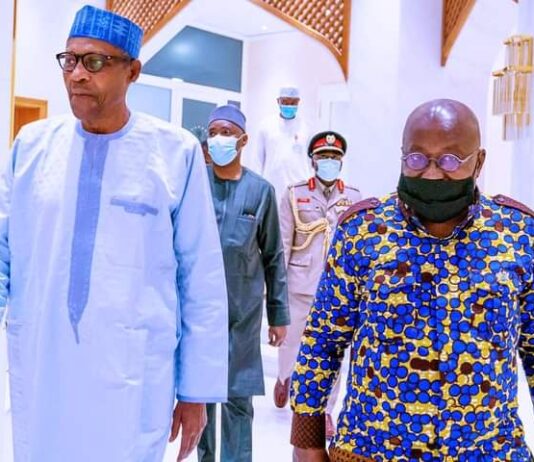
    President Muhammadu Buhari on Sunday night met with the President of Ghana, Nana Akufo-Addo at the Presidential Villa, Abuja.

    The meeting was confirmed by the Special Adviser to the President on Media and Publicity, Femi Adesina who posted pictures of the two West-African leaders walking side by side on his Facebook page.

    READ ALSO:

    Video: Another ‘Trade War’ is Brewing Between Nigeria and Ghana

    Although, Adesina did not reveal the agenda of the meeting in his post, it is however believed not unconnected with heightened tensions between the two neighbouring Nations caused by the closure of shops owned by Nigerian traders in Ghana.

    President Buhari receives in audience Ghanian President H.E. Nana Akufo-Addo in State House on 20th Sep 2020

    The trade tension compelled Nigeria’s Minister of Foreign Affairs, Geoffrey Onyeama to summon Ghana’s Charge d Affaires to Nigeria, Ms Iva Denoo for discussions.

    Onyeama had also met with representatives of Nigerian traders in Ghana, led by Jasper Emenike, the National President of Progressive Ambassadors of Nigeria (PAN), and the organisation’s National Director, Ruth Ango over the matter.

    Recall Echotitbits reported that Speaker, House of Representatives, Femi Gbajabiamila visited Ghana on Sept. 2 with a view to seeing how the issues at stake could be resolved amicably.

    READ ALSO:

    Gbajabiamila’s Legislative Diplomacy to Accra, Akufo-Addo Endorses Nigeria-Ghana Business Council to Resolve Trade & Investment Disputes

    Speaking at a meeting with the Speaker of the House of Representatives, Femi Gbajabiamila, Akufo-Addo said a request by the speaker for a review of Ghana Investment Promotion Centre (GIPC) Act to make certain concessions was in order as it “makes a lot of sense”.

    The Ghanaian President, at that meeting promised to also raise the issue with President Muhammadu Buhari.