Category: Articles

  • International Women’s Day 2021: Challenging Inequality

    International Women’s Day 2021: Challenging Inequality

    By Tobiloba Kolawole

    A week ago, First of March, when the deserving first Woman and African Director-General of the World Trade Organization, Ngozi Okonjo-Iweala, NOI was resuming to her new job in high spirit, enthusiastic about how to deliver reforms at the 26Year old international institution, CH Media, a newspaper operator based in Switzerland ran an article with the title: This Grandmother Will be the New Chief of the World Trade Centre.

    This headline was nothing but a bias. Collectively agreed by leaders of thought, it smacks of sexism, a remark that would likely not be made if NOI were a 66year old man taking up the job.

    Despite this setback however, something cheering happened. UN Women leaders and 124 Ambassadors in Geneva, among them men, rose in her defense and signed a petition calling out the sexist remarks in that newspaper. We need to call out this behaviour when it happens. This, is the very essence of the International Women’s Day, to challenge ourselves to do better as women to women, as men to women, as one equal people to one another and importantly to celebrate women for their contributions to the socio-economic advancement of our society for we cannot wish away their many resounding successes and important achievements in our society.

    According to WTO, women hold 21% of ministerial positions worldwide and, in business, make up 8% of Fortune 500 CEOs. This is not enough and we must choose to challenge the status quo, shatter the glass ceiling and close this gap of inequality.

    Do we really want change? Are the men comfortable with the statistics knowing that they have sisters and daughters who should not be caught in this imbalance.

    Gender bias and inequality problems still stare us in the face. Uneven access to education. Around the world, women still have less access to education than men, Lack of employment equality, Job segregation, Lack of legal protections, Lack of bodily autonomy, Poor medical care, Lack of religious freedom and Lack of political representation.

    In my opinion, I would think it is morally unacceptable for anyone to think it is ok to ostracize a gender. We must all join hands to change the narrative and make life better for scores of women out there, including generations yet unborn. We must #ChooseToChallenge.

    A world that is challenged stays alert, and as Individuals, we’re all responsible for our own thoughts and actions.

    We can all choose to challenge and call out gender bias and inequality. We can all choose to seek out and celebrate women’s achievements. Collectively, we can all help create an inclusive world.

    From challenge comes change, so let’s all choose to challenge and make our world a better place for all.

  • If Trump were a Nigerian President, 10 Things would Likely Happen

    If Trump were a Nigerian President, 10 Things would Likely Happen

    The just concluded US presidential election on many accounts births new records that earned it the ‘unprescedented’ label and also reserved it a frontline spot in the history of the one time world-power nation.

    President-elect Joe Biden tallied votes not less than 74 million, numbers described as the highest recorded by a candidate in the history of America’s presidential election.

    President-elect, Joe Biden and Vice President-elect, Kamala Harris at their acceptance speech event Saturday night, Nov 7, 2020.

    Similarly, running mate and now Vice President-elect Kamala Harris shattered the glass ceiling setting new records of not only becoming the first woman, but also the first black woman of Asian root to become Vice President of the United States of America. It was as though she knew of the election outcome before hand when she chose ‘Pioneer’ as her Secret Service call-sign many weeks ago.

    READ ALSO:

    Stakeholders in Nigeria’s South-West Demand Youth Empowerment After EndSARS

    In an article published on Sunday by National Geographic, Amy McKeever said: “Even though Joe Biden has secured enough votes to become president-elect of the United States, President Donald Trump has given every indication that he won’t accept the result as fair. Trump also has refused to commit to a peaceful transfer of power.

    “Both moves would be historical firsts if Trump refuses to concede even after all legal challenges are resolved. U.S. history has seen a handful of bitterly contested elections, most recently in 2000, when Democrat Al Gore called Republican George W. Bush to concede in the early hours after election night—only to call back and retract his concession when the race unexpectedly tightened up. While their first conversation was congenial, the second was tense, with Gore famously telling Bush.”

    In ways that are familiar to Nigerians, a London based Nigerian journalist, Ayo Akinfe on www.ayoakinfe.com highlights 10 things that would likely have happened had Donald Trump been a Nigerian president.

    File Photo: Nigeria President Muhammadu Buhari visits US President Donald Trump at the White House in Washington.

    (1) First of all, many Inec officials would have obeyed his instructions to stop counting the votes immediately the president called for it

    (2) Leaders from his ethnic group would have held meetings and declared their unalloyed support for him

    (3) Troops would have been dispatched to seize all those ballot papers at the counting centres

    (4) Troops, policemen and DSS operatives would have been dispatched to seal off any media networks that defied the order and continued reporting results

    (5) The youth from the president’s ethnic group would have held solidarity marches in his support

    (6) Counter-marches would of course been organised but troops would have been sent to open fire on them as we saw at the Lekki Toll Gate

    (7) Those Inec officials who refused to be intimidated, insisting on showing integrity, would have been picked up by the DSS

    (8) The EFCC and Code of Conduct Tribunal would have been used to arrest and bring charges against the owners of media houses who keep announcing results, as happened to Walter Onnoghen

    (9) There would have been no shortage of sycophants and praise singers taking to the media to back the president. His own party in particular would be solidly behind him

    (10) By now, the uncounted ballot papers would have been destroyed prompting calls for a fresh election. Court orders would have been obtained making this legal

    Against the popular finger pointing at Nigerian leaders as the main culprit in the many woes that the most popular black nation suffers, Akinfe differs that: “We complain about Nigeria a lot but refuse to accept that the only problem with Nigeria is Nigerians themselves.

    READ ALSO:

    US President Elect Will Have Challenges No Incoming President Ever Has

    “When I see how leaders of the #EndsSars movement are currently being persecuted and how a shameful meeting in Kaduna recently backed the government, I just shudder.

    “Nigerians are their own worst enemies. What is most scary is the number of sycophants wanting to eat crumbs from the oga-at-the-top’s table who will mortgage their consciences for a mess of porridge.”

    Also commenting about the heterogeneous ethnic nature of the Nigerian social milieu, a peculiar factor that has been critical in the many ethnic stress experienced from time to time, Akinfe stated that: “One other thing that makes my blood boil is the way Nigerians take sides based on ethnicity and religion. I just hope this latest US saga helps debunk the myth that the problem with Nigeria is bad leadership.

    “Our biggest problem is poor followership. Bad leaders like Trump exist everywhere but how far the people are prepared to go to resist them is what makes the difference between good and bad governance.”

    President Donald Trump’s refusal to acknowledge his loss in the 2020 election has sparked concerns that the presidential transition would be sabotaged.

    The Guardian on Monday reported that a Trump appointee refused to sign off on funding for the transition and the Trump campaign announced an expanded legal strategy in a quest to reverse the election result.

    The Center for Presidential Transition, a nonpartisan advisory board, urged the Trump administration on Sunday to begin the handoff to staff supporting Joe Biden, whose victory continued to grow in magnitude as states completed their ballot counts.

    READ ALSO:

    Zimbabwean Businessman, Socialite Dies In Car Accident After a Party [Video]

    “We urge the Trump administration to immediately begin the post-election transition process and the Biden team to take full advantage of the resources available under the presidential transition act,” the transition center said in a letter Sunday.

    “This was a hard-fought campaign, but history is replete with examples of presidents who emerged from such campaigns to graciously assist their successors.”

    However, neither Trump nor his campaign nor political appointees has the power to stop the transition, and there was no sign that the basic steps toward Biden’s installation as president were at risk of interruption.

    But non-cooperation by the Trump administration in the transition could slow the ability of some agencies to act on directives by Biden in essential areas such as pandemic response and the reinstatement of environmental regulations, protections for migrants and international accords, The Guardian wrote.

    By Tobiloba Kolawole

  • Wait! Before You Click Submit, See Review Tips Before Tues. Chevening Scholarship Deadline

    Wait! Before You Click Submit, See Review Tips Before Tues. Chevening Scholarship Deadline

    As the Chevening UK Scholarship 2021 nears the November 3, 12noon deadline, some scholars of the programme have put together tips on how applicants can increase their chances of winning the award, which opened for application September 3, 2021.

    Ugochukwu Stephen Ugwudi, who is currently taking MSc in Entrepreneurship and Innovation at the University of Sussex under the Chevening UK Scholarship programme is the lead in the organized remote mentoring programme that is helping over 200 young Africans through applications for the renowned award.

    In a chat, he expressed enthusiasm about the leverage and impact that the Chevening programme would have on his career.

    He said: “it would afford me the opportunity to study for an MSc program in one of the world’s most prestigious universities in a country considered to be among the most diverse in term of multi cultural population. Being a fully sponsored scholarship program, I will have the opportunity to focus more on my studies and not have any reason to worry because the scholarship provides me with stipend to take care of my socio-economic needs”, Stephen Ugwudi said.

    He disclosed that: “this is an opportunity I have been longing for; to progress my career. To connect with world class experts, stakeholders in various spheres of life.

    “Chevening alumni network has over 53,000 members, for me this is a community with the most diverse group of people from over 160 countries. I believe I can make reasonable connection, build strategic partnership and cross pollinate grass root ideas with both peers and experts. These will further help me to achieve my set goals as well as contribute to national development by building cross border initiatives.”

    Leadership Essay

    Another Chevening scholar, Terhemen Agabo, an economist and social researcher based in Nigeria, now studying MA Development Economics at the University of Sussex, Brighton, shared tips on writing the Chevening leadership esssay during one of the mentoring session

    In giving a good account of leadership experience, Agabo pointed out thus:

    “Points to note while Developing your essay.

    “Chevening wants you to list instances where you demonstrated leadership. An ideal example will have you show how you helped to solve a problem or achieve a goal for your team and the impact of your leadership action.

    “Follow the STAR approach: A great friend used to say “never change the winning team”, the STAR approach to writing your Chevening essays is very effective. It makes your essays concise and makes a good impression of you before the reviewers. Please follow the STAR approach as it would help you manage your essay word count too.

    “It is Good to List many Leadership Examples: Imagine that as a reviewer I am tasked to choose one essay out of ten and all essays were well written. I would probably consider the person who mentioned four examples of leadership ahead of the one that mentioned only two.

    “Yes its true that you only have 500 words to cover in your leadership essay but you can list up to 5 examples. In my essay I mentioned five, I elaborated on 3 and wrote two lines for the remaining two.

    “Every sentence should be a hit: Yes friends, Chevening is very competitive. While writing your leadership essay, make sure every sentence conveys a strong message. Avoid repeating points already mentioned as your word count is limited.

    “Some leadership Examples may stand out So if you take a look at the score guide for Chevening interviews. The criteria for scoring the highest in your leadership section highlights that candidate holds a leadership position in a professional capacity including voluntary organisation (NGO, University ,society etc) provides strong evidence that they have shaped opinion through debating, blogging, social media or policy work.

    “As you can see, leadership roles such as leading in school or in a community matters and you need to show that.

    “Brew your essays over a long time: So, as you know Chevening is very competitive and often shocks many competent young leaders. So if you think you will write your essays in ten days and succeed, I will say you can but your chances are slim as preparation takes time. And the best prepared candidate takes weeks and some months to write their essays.

    “Tell a fine and touching story: Yes, Chevening scholars are heroes. So, tell a story of a heroic leader. Use touching words e.g. “My forum saved 40 orphan children from dropping out of school”. It will increase your chances of beign chosen.

    “Facts: Your leadership essay should be very specific to mention names of places, persons, programs that played out. No room for ambiguity.

    “I began my leadership essay with a quote: Progress occurs when courageous, skillful leaders seize the opportunity to change things for the better- Harry S. Trueman.

    “Then followed by an example in the next paragraph: As a teacher in 2017, I organized a forum in response to the high number of secondary school students that skipped school activities in Jalingo town, Taraba state in Nigeria. The forum focused on students from Government schools, and sought to provide the missing motivation that made students skip classes.

    “I arranged for motivational talks, bringing in speakers from diverse backgrounds to speak to the students. The students were taught different skills to nurture their creativity including poem writing. 800 students benefited from the motivation that the forum provided.

    “Through feedback it was recorded that over 400 students improved their participation in academic activities at school after the forum. Currently, 20 of the participants under my mentorship have proceeded to higher institutions.

    “Mentioned three more examples then conclude thus: “A Chevening scholarship will strengthen my leadership capability and enable me exert a positive influence over a greater number of young and vulnerable Nigerians”, Terhemen Agabo, Chevening 2020 scholar advised.

    While responding to a question from one of the participants in the mentorship session, which sought to know if applicant who has a record of social initiative stands a higher chance of qualifying, Agbo posited that: “No, I wouldn’t say so. This is because the Chevening Scholarship is judged on leadership, networking, academic and career potential as well as on potential impact on society. Social impact, scientific impact and other kinds of impact matter equally.

    “Hence, a scientist who has never left the lab can also win the Scholarship judging from the impact of his laboratory activities.

    “During my application a friend told me not to bother if I didn’t own an NGO. I wasn’t discouraged and I am here today. So whatever it is that you do to move society forward you are good for a Chevening award.”

    Networking Essay

    Another Chevening 2020 scholar, Hawa a legal practitioner and founder of Westwood Law, an Abuja firm that speciises in human rights law, election petitions and corporate law advised 2021 Chevening Award applicants on writing compelling networking essay.

    Hawa, also a consultant at Waiza Rafique Advocates and Legal Consultants (WRALC), Lahore- Pakistan, emphasised that many people “many people find this part of the Chevening Essays to be the most difficult, ambiguous and tasking”.

    Hawa, who had scaled through the application a year ago and now selected to study a one year LLM programme in International Development Law & Human Rights at the University of Warwick, United Kingdom suite that: “You don’t need to define what networking means to you here.

    “Also, try to take a timeline, it makes the story more sequential and captivating to the reader.

    “In this essay area, also try and give submissions using at least three distinct examples in three separate paragraphs.

    “These examples do not have to relate to your discipline or subject area.

    “What you must try to do here, is to show how you establish relationships with preferably important people, and how you nurture such relationships and ultimately, went ahead to leverage these relationships to find solutions to problems within your own context.

    “In each paragraph, for the networking essay, you can do what I call the “modified STAR approach.

    “Preferably, the easiest way to open the paragraph is to start by a conference/meeting/community engagement/dinner/social gathering you once attended.

    “State the name of the meeting, the date, the location and possibly the purpose of the gathering. Be explicit!

    “Then try to convince the reader of how you met an important or influential person at that meeting and what kind of discussions or engagements you had.

    “Again, mention the name of the person, what his/her status/portfolio was at that time and what position the person holds now. Try to also convince the reader that you are still in touch with this person.

    “Now, try to convince the reader how you used this contact to get access to possibly another very important personality, or how that contact was able to catapult you into a space that was hitherto not possible.

    “Again, you must show that the progress you made impacted a group of people positively, whether directly or indirectly.

    “For the second paragraph, you can open it by stating some professional associations/fraternity/political affiliations/community groups you belong to. You can also embed this in any of the three paragraphs. It is not cast in stone.

    “Chevening is looking for persons who already have a trajectory. That is, have strong networks, know important people, have valuable contacts whether politically or professionally. Just think about it as though you are the Manager of Real Madrid football club and you are looking for players to buy in the transfer market.

    “Chevening wants super stars.

    “Convince them that you are one by linking yourself to some strong associations.

    “Try to convince the reader of how you leveraged such associations you belonged to, to unlock opportunities to meet people who mattered in any discipline. Then, drive your points again of how you leveraged the contacts to bring change or solve a problem.

    “Repeat the drill for the third paragraph

    “To score the maximum marks in the Networking essay area, it is strategic to include a brief 4th paragraph.

    “This paragraph will briefly state how you hope to engage the Chevening network in the future and this has to align with your long term goals which you will elaborate in the 4th section of the Chevening essays (Career goals).

    “Me personally, the example I used was…. I went to a paralegal conference in Abuja and we were saddled with the responsibility of drafting a legal framework for paralegals….. I met Mrs Aimee Ongeso from Kenya in that Conference….. through this connection I made I became part of the Global Legal Empowerment Network that gives access to justice at grass roots across the globe.

    “Notice how i made connection at the conference.

    “For the 4th paragraph you can mention how you connected with Chevening scholars like Hawa and Stephen via telegram

    “Mention names of scholars and alumni in your essays.

    “It shows you are already engaging chevening community”.

    UK University Choices

    Arafa Mahayadine Salah a Chevening scholar from Chad who holds a masters degree in International Business Law and another in Expertise and Taxes advice work at The National Water Fund as Tax and Legal advisor.

    Salah, who is now pursuing a LLM International Human Rights Law at the University of Sussex dealt with choosing a UK University in the 20221 Chevening Scholarship Award.

    ” 1) First of all choose wisely the course you want to do in the UK. It must be coherent with your career plan and with your background!

    ” 2) Chevening offers the possibility to applicants to choose 3 different courses in the same university or 3 same courses in 3 different universities (highly recommended). Take a deep look at universities ranks,modules, entry requirements, city of location etc. As all of us want to study in the highly ranked universities, people must be realistic in their choices and pick universities that are likely to accept them.

    “British higher education is among the best in the world so no matter the university rank, you can be sure that the education will be excellent. Also, be aware that you cannot change your university choices after the interview. So you have until mid February-March to make the right choices.

    ” 3) In your essay, start by putting an emphasy on why you choose this specific area for your study and what your degree will help you to accomplish in your country. After that explain your university choices one by one by specifying what you particularly liked and what makes these universities special for you.

    “Last tip: go to universities website, look at student’s YouTube channels or personal websites, it can help you in choosing wisely.

    “I think so because for my course for example they’ve asked a background in law or related fields. But sometimes they study case by case especially when the student doesn’t have the background but have experience in the same field

    When probed about choosing a university that isn’t listed among Chevening partners, Salah said: “chosing a university that does not have partnership with chevening doesn’t affect your application”.

    As an addition to Salah’s points, Steven Ugothe convener of the mentorship sessions for 2021 Chevening Scholarship Award applicants added that: “although you are at liberty to choose any university.

    “It is advisable you choose a partner university (this you can see on Chevening website). This is so because in the event that the non Chevening partner university that you choose refuses to pay the 20% contribution to the programme then it will be paid by you”, he added.

    On the possibility of being accepted by all 3 university choices, Salah said: “Yes it’s possible. I have been accepted in my 3 universities. If this happens, you’re suppose to choose your first choice. But if you want to go with your 2nd or third choice you will have the obligation to explain to chevening why and have a valuable reason.

    Giving her thoughts on what makes a compelling essay, she said:

    “Essays: Be yourself! Don’t copy another scholar’s essay and be coherent. Leadership and influence: give concrete examples of your leadership skills in different areas (school, work, neighborhood or family).

    “Before my application I had the wrong idea that chevening was looking for people who already accomplished great things like creating associations or having a leadership position. Chevening is also looking for potential leaders and people who serve others in their own small way. I gave example on how I’ve helped some student in university with some modules, how I’ve convinced my uncle to let my niece go to school etc. Your achievement can seem small to you but chevening will still consider it.

    “Networking: again give examples of how you built your network and how your networking skills advantage you in personal and professional life.

    “Studying in the UK: I think that this is the most important part of the essays. Choose wisely your course and your universities (take a look at universities rank, modules, entry requirements). Explain why you choose these universities and why they’re your first second or third choice.

    “Career Plan: in this part you need to make a link between your background, your future career, UK work in your country and your course choice. Explain your short term, mid term and long term goal that your chosen course will enable you to reach.”

    Career Goals Essay

    Yusuf has spent considerable years in social works, a community development practitioner, who is passionate about leveraging development projects to influence social change within the domain of security, governance, inequalities, poverty and development advised on writing the career goals essay.

    Armed with a Bachelor’s degree in Geography, with first class honours from Ahmadu Bello University, Yusuf was awarded the Chevening scholarship to study a masters program in Conflict, Statebuilding and Development at the University of Birmingham.

    Yusuf advised thus: ” 1. Take as much time as you can to digest the essay prompt. If possible, take a whole day until you’re certain to be up for the task. This is the most important essay you’ll write as the return on investment for the UK is dependent on it.

    “Next, utilize the scoreguide below in every step of the .

    ” 2. Essay Scoreguide:

    ” a. Applicant is at senior level in his/her field.

    ” b. Potentials to achieve ambitious but realistic innovative goals in his/her chosen sector.

    ” c. Demonstrated how the Chevening program will help develop the chosen sector.

    ” d. Demonstrates a strong understanding of the UK priorities in the country.

    ” e. Shows how the Chevening Scholarship would increase his/her ability to have influence and enable change in his/her work and home country.

    Do not fret if you’re not in a senior position yet, he said.

    “One way to solve that problem is to envision yourself as a highly profiled individual in the future, and then present yourself that way in the essay

    “You can fulfil 2b, 2c, 2d and 2e with ease by leveraging your imagination and also studying the UKDFID (Now UKFCDO) projects in your country.

    “Then connect your imagination to the problems and/or UK projects in your country

    “3. Essay Structure

    Now that you have an understanding of the essay prompt, you should then proceed with drafting your essay in a very organized manner.

    “Like the usual academic essays we write in school, your Career Plan essay should be organized in three distinct structure:

    a. Introduction

    b. Body

    c. Conclusion

    “3a. Introduction

    It is very important that you hook the reviewer with an engaging opening—most preferably a problem statement. Try to be concise and straightforward with what you want. Take my example below for instance:

    “Problem statement in BOLD TEXT (aim for 50 to 70 words)

    “I seek to develop a career that will ultimately position me to influence policy and advisory services necessary to foster peace, state-building and development in Nigeria. Conflict and insecurity is currently a problem that can reverse decades of development in the country. It has disrupted local and foreign trades, destroyed infrastructures, halted educational development of displaced youths and children, and has subjected millions of Nigerians to extreme poverty – 65 words.

    “3b Body

    “The bulk of the Chevening investment is directed to this part of your essay. Therefore, you should consider this section as a business deal where you pitch yourself as a long term viable investment.

    “It should be clear from your essay what the UK stands to gain.

    “Question: are they investing in a student who wants to explore the UK or an internationl trade expert?

    “As you write this part of your essay, endeavour to work closely with the essay prompt and score guide highlight as 1&2 above.

    “The structure of the body should be classified in 3 paragraphs.

    1. Short term plan (2 years post-study)

    2. Mid term plan (2-5 years)

    3. Long term plan (5 years and above)

    “For the three parts of the BODY, it is highly recommended that you use the SMART Approach.

    S-Specific

    M-Measurable

    A-Actionable

    R-Realistic

    T-Time bound

    “Avoid a statement that looks like this: I plan to reduce unemployment and empower youths. Or, I will contribute by working with many youths and mentoring them, or:

    “I will work to address gender inequalities in my country and become a youth minister in future, or:

    I will institute public health programmes to address the worrisome spate of maternal and child mortality in Mozambique.

    “I’ll show you what the SMART Approach looks like using a snippet from my essay

    “Ensure to use proper signage when writing each paragraph e.g.

    “Use openings like: In the short term (or Upon completion of my masters) I intend to…

    In the mid-term (or 5 years down the line) I intend to…

    In the long term (or going forward) I aspire to…..

    “You may choose to adopt a different format but make your plans clear

    “Short Term Plan: Using SMART approach

    “In the short-term, I envisage working with conflict-oriented organizations like ActionAid International Nigeria as a Programme Coordinator, where I will seize the opportunity to leverage the skills gained from my study, to practice conflict policy planning, advocacy, and peacebuilding projects especially in the North-east region of Nigeria, with the aim to strengthen the resilience of at least 2,000 vulnerable youths against extremism recruitment over 2 years.

    “Specific- Work with ActionAid as a Program Officer

    “Measureable- 2,000 vulnerable youths

    “Actionable- presence of required skill-set to actualize the project.

    “Realistic- 1,000 youths per year, approximately 3 youths per day.

    “Time bound- 2 years…

    “Although, this example helped me through the review stage but I will advise that you use shorter sentences. Mine can be killing actually.

    Yusuf gave more tips: “Try to be as ambitious as you can, but do not exaggerate in this part of the essay. My final example presented me as someone who will be leading as a Rapporteur at UN meetings.

    “Bottom line, dream as wide as you can but make sure you tell them how you’ll get there.

    “3c. Conclusion

    “Now that all has been said, you should give an overview that captures how your plan fits with what the UK is doing in your country, and how you’ll be a useful tool to effect a positive change THROUGH THE CHEVENING SCHOLARSHIP.

    “Here’s the conclusion I used in my own essay: Overall, my training in the UK will equip me with the relevant skills needed to spearhead peace and development in Nigeria, by connecting to an invaluable network of resources and collaborations that will contribute to Nigeria’s pursuit for improved economic growth and development, a major objective of the UK’s DFID due to its significance in strengthening future bilateral affairs.”

    Yusuf explained further on his background experience and do of study.

    “I studied Geography, worked as a computer operator in a Cyber cafe and I’m pursuing Conflict studies.

    “So from my experience, you work experience doesn’t have to match up with you chosen course. What is important is that you have identified a problem in your country, and that you’re passionate about being a part of the solution to that problem. The only way you need to CONNECT the two is to present the Chevening scholarship as the bridge for you to achieving your goals.

    “Forget your work experience and focus on how the obtainable skills from your program will propel you to reach the position you’re aspiring for.

    “One thing is that Chevening wants people who are ambitious and aspiring to lead regardless of the organizational structure. As a prospective Chevening scholar, it is okay to return and still work as an employee BUT at a higher level, probably a managerial role not an errand fellow.

    “On the other hand, if you want to be independent, for instance a Founder of an NGO, it is still okay to present your plans that way.

    “What Chevening look out for is your aspiration to rise above where you are—not for a selfish aim, but for the greater good of the society or the people your work with.”

    by Tobiloba Kolawole


  • Our Winter of Discontent

    Our Winter of Discontent

    By Dapo Akande

    Free provision of food and water. Atypical orderly queues. Free medical care. Free legal representation. Spontaneous crowdfunding to purchase a prosthetic leg for a female amputee protester who refused to be deterred. Fund raising target was N1.5m in one month. N4.1m raised in three hours. Lesson; accompany compassion with will and anything is possible.

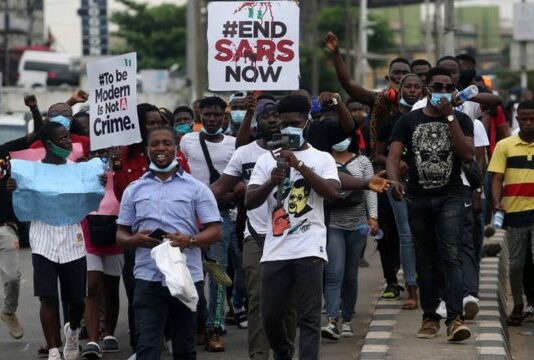
    Raised banners. Fluttering national flags. Impassioned anthem singing…then a rain of bullets. Sudden tragedy. Eerie screams. Pandemonium. So who amongst these were thugs? Tuesday, October 20, 2020 was yet another dark day for our fledgling democracy. Yet another, because it wasn’t the first. Over 300 Shiites were reportedly killed in cold blood by our armed forces in 2015. The IPOB propagators suffered a similar fate. Lesson; injustice meted out anywhere is injustice everywhere. Never turn a blind eye because it doesn’t directly affect you. One day it may arrive at your doorstep.

    Many western nations are preparing for a potentially harrowing winter as Covid 19 cases spike. The annual season of influenza approaches and portends a winter of discontent, if we’re to borrow a line from Shakespeare. Nigeria, blessed with comparatively low cases of the dreaded Coronavirus has yet again used it’s own hands to invite a disaster that should never have been. The utterly heartless and cowardly slaughter of unarmed and peaceful protesting youths, has foolishly ushered in it’s own winter of discontent.

    Fed up with staring hopelessly into a bleak future, our youths finally came of age to say enough is enough. Attracting the admiration and respect of all well meaning Nigerians, they took to the streets in the most spontaneous yet orderly, legal and organized fashion to register their discontent. I, for one, doff my hat to them not just because they’ve finally woken up to the fact that power resides in their hands (no matter what anybody says) but because of the incredibly efficient, clever and united way in which they did it. They displayed a front of solidarity rarely seen on these shores, which thankfully put a lie to the tribal, religious divisions that the old guard have sold to us for far too long. It brought tears of pride to my eyes to watch as the Christians amongst them formed a wall of protection around their Muslim brothers and sisters as they took to their Friday Jumat prayers. The Muslims reciprocated by standing by the Christian faithful during the Sunday service. Such simple gestures of camaraderie speak volumes and to me signify the birth of a new Nigeria. One where the lies of the past have finally been exposed for what they are, lies.

    By far the largest demographic group in the country, with about 70% of the population under the age of 35, whichever way they go, the country must surely go. They only needed to come to that realization and it looks like they finally have. Their time has come and no bullet, no senseless thugs, no method of intimidation and no divide and rule tactic can stop them. They hold the future and by God’s grace, they will arrive there.

    It pleases me that people are finally waking up to the fact that we shouldn’t have to fast and pray for God to elevate one of our relatives or friends to a government position before we should hope to enjoy the good life. We can no longer wait patiently for crumbs to fall off our “benefactor’s” table. Every Nigerian, no matter where he hails from, his religion or who he knows or doesn’t know, should have high hopes of living the good life as long as he’s willing to work hard and work smart. Ask those in societies that work and they will tell you that you don’t need to be a millionaire to live a comfortable and meaningful life. You don’t have to be rich to buy a new car, give your children a good education, have peace of mind that any medical eventuality would be met without much struggle or even take your family on annual holidays; something considered a luxury by 99% of Nigerians but which Oyinbo has since realized is critical for his health and a sense of well being. It takes its place amongst the plethora of factors which determine a nation’s average life expectancy and partly explains the gap of over 25 years between that of Nigeria and that of Western Europe.

    About 70% of illnesses can be linked to stress and unfortunately, we have plenty of that here. Is it the endless hours spent in traffic or the absence of constant electricity supply which makes restful sleep an impossibility for the majority? Or is it having to sleep with one eye open because of the horrendous security situation? Or the constant harassment by security forces and the agony of having to part with money that was already not enough? Stress is something we have adapted to living with but only few realize that adapting to it does nothing to minimize the damage it does to our health. Contrary to popular belief, you’re not strong or tough because you’re able to work like a jack ass without taking commensurate rest, you’re just foolish. Sooner or later one’s body will tell one that. Don’t let that be you.

    Back to being rich or not rich. I will add this. In countries where leaders lead and don’t rule; where leaders respect the rights of the people to aspire to a good life; where the social contract is clear about what the people should expect of their government and what the government should in turn expect of their people that will enable them (government) fulfill their obligations, you don’t even have to be rich to own your own house. Lee Kuan Yew read his people well and concluded that a people opportuned to live in their own houses will be more patriotic and will fervently protect the stability of their society because they have too much to lose. Acutely conscious of their tangible stake in it they’ll never watch it burn.

    All we need to enjoy all the above is good governance and that can only be the fall out of having leaders that care. To our most recent fallen heroes, may you rest in peace, in the knowledge that your ultimate sacrifice shall not be in vain. A grateful and mournful nation acknowledges you and says thank you.

    Changing the nation…one mind at a time.

    Oladapo Akande is a Surrey University (UK) English graduate with a Masters in Professional Ethics. He’s an alumnus of the National Institute for Transformation and a two time author; The Last Flight and Shifting Anchors. He writes from Lagos.

  • Health Journalism: How the Reporting of Covid-19 Has Transformed the Jobs of African Journalists

    Health Journalism: How the Reporting of Covid-19 Has Transformed the Jobs of African Journalists

    By Wole Elegbede

    Health journalists in Africa have been given fecund avenue to discuss the impact of Covid-19 on their works at the 16th edition of the African Investigative Journalism Conference (AIJC2020) hosted by the Journalism Programme of the University of Witwatersrand, Johannesburg, South Africa.

    This year’s conference (October 6-30) holds virtually for the first time because of coronavirus concerns, and boasts of being the African continent’s biggest gathering of journalists. The conference deals with varied topics where the journalists shared experiences and learn new skills, techniques and tools to enhance their work.

    On 13th October 2020, there was a session on the topic “Journalism in the time of Covid” which dwelt on those issues and provided solutions on how journalists can navigate the complexities of reporting the virus. The session’s panel was moderated by Mia Malan, Editor-in-chief/Executive Director of Bhekisica Centre for Health Journalism in Johannesburg, South Africa, who opened up on the core issue of how the pandemic forced journalists to become emergency health reporters to “report on science research results and health policies that they were previously unfamiliar with”. She then posed thought-provoking questions like “Is this kind of situation good for health journalism or does it lead to misinformation, and how have business, investigative and political journalists cope with the situation?”

    Ferial Haffajee, influential South African journalist well-known for business, investigative and political reporting before the outbreak of the virus and who has never reported on a pandemic before now, said after her dive into reporting Covid-19 pandemic, she discovered the stereotype about the health beat as “soft” was wrong, adding that it is “probably the most vital of the beats; it’s literally a matter of life and death”.

    Hafajee has been able to overcome the challenges by her sheer resoluteness, and the epidemiological course she undertook in July this year in India together with other journalists from across the world. Journalists from 18 African countries participated in the training and a third of the total number of participants are non-health journalists.

    “For me, that (epidemiological course) is the way to go because it used every single technology, and then together with people like Dr. Taryn Young (an epidemiologist), it taught us how to ensure that we knew about vaccine trials, how to ensure that we understood the signs and that has been completely invaluable to me”, she opined.

    While on coronavirus beat, Haffajee learned that reporting the virus could lend itself to the methods of conventional investigation because of the fall outs of the disease such as Covid-19 corruption, police brutality, human rights abuses and unscientific vaccine claims.

    She said the reporting of Covid-19 “did become more conventionally investigative”, adding “that’s when we learned that all the billions of Rand (South Africa’s currency) that were being invested into the response in South Africa, but I know it’s also happening in the rest of Africa, was as usual being corrupted. We have to get at the top and watch how the money is planned and then how It’s spent, and for me, that’s where health reporting should go, in the next couple of years, to catch corruption before it happens”.

    Asha Mwilu, a Kenyan traditional television journalist and CNN African journalist of year 2016, disclosed that coronavirus changed her life and that she had to put aside her role as an editor to go to the field to report on the virus.

    “I started going to the markets and talking to people and seeing how coronavirus was affecting lives and livelihoods, and I just had to go back to the basics of reporting, and then I had to re-learn a lot of things”, she remarked.

    After Mwilu resigned from her post as Editor, Special Projects, Citizen Television, Kenya, she launched Debunk Media on July 1, 2020, where she currently serves as Founder/Editor-at-large. The platform came in the midst of Covid-19 and this development changed its orientation.

    “The plan was to launch Debunk in April, but we had to put it on hold”, she explains. “First and foremost, the content that we had created could not even resonate with the audience because everyone was talking about coronavirus. We had created content around issues like legalization of marijuana, feel good content around music but using data to drive those stories. What coronavirus did for us is to really center us into what Debunk Media wanted to do, and is now doing, which is putting data at the center of storytelling “.

    At a time that fatigue was setting in the coverage of the pandemic, her team decided to look for areas that had not been reported on, and learned how to scrape data from the web to give new dimensions to reporting the disease.

    Professor Taryn Young, an epidemiologist and Director of the Centre for Evidence-based Healthcare at Stellenbosch University, South Africa, who has collaborated effectively with journalists, said health reporters need basic knowledge of science and research assessment to be able to write critically on health, and to prevent misinformation.

    “Yes, I have seen misinformation and flawed research being reported in the media”, she disclosed. “An example is linked to the big difference between association and causation. For instance, there have been reports linked to smoking, that if you smoke more, you are less likely to become inflicted with Covid-19 but these studies are reported without critically about how big was the study. Was the result big enough to give a robust answer?”
    Speaking on the epidemiological course in which she was one of the hosts, Young said on a certain day at the event “there were more than 60 people online all joining to learn more about epidemiology, to learn more about different types of research designs, different types of bias, and talking about error, and also covering tips on how to critically appraise medical research”.

    Journalists and medical researchers need to work together to enhance the reporting of research findings, she suggests.

    In her own contribution, Ida Jooste, who works for the International Media Development Organization called Internews, said Covid-19 had brought many other areas of life into storytelling and cited the instance of mathematics and statistics.

    “It’s brought mathematics and statistics and dealing with numbers right into our faces every single day”, adding that this is something that journalists should learn to add to their understanding of Covid-19 reporting.

    The author:
    Elegbede is a Multimedia journalist and Project Director of Press Attack Monitor, a platform that exposes press freedom violations in Nigeria. He was chosen by the Journalism Program (Wits Journalism) of the University of Witwatersrand, Johannesburg, South Africa, as a fellow of the African Investigative Journalism Conference 2020 hosted by Wits Journalism.

  • When The Moderates Take A Walk

    When The Moderates Take A Walk

    By Dapo Akande

    Have you ever found yourself in a situation where you wish you had done the comparatively little thing someone had asked of you instead of dilly dallying to the point when the person vexes and says, “forget it, now I want it all?” Or, “I’m not even doing again?” If government had adequately tackled the SARS issue after repeated complaints by the people in the past, the current crisis may never have occurred. Now, the government has come out to propose a new outfit, giving assurances on how they’ll operate strictly by the book but with a loud voice the people have responded, “this is not enough! We want more.”

    In a small segment on CNN titled CNN Modern Explorers, I heard Bertrand Piccard, a Swiss psychiatrist and arguably the world’s most famous balloonist, say something remarkably profound. For a man who happens to be the first to ever circumnavigate the globe non stop in a hot air balloon, I was surprised to hear him remark that the modern day explorer is not one who searches out new territories but instead is one who seeks new ways to bring better meaning to human existence and improve the quality of human life. It surprised me to no end that a man who also holds the record of being the first to successfully fly around the world in a solar powered plane, would relegate the thrill and novelty of such an astonishing achievement to second place, in terms of his motivation. The impetus that drove his ambition can therefore be better traced to finding ways to surmount issues which trouble the wellbeing of much of humanity than to discovering new frontiers. His submission gave me a refreshingly new perspective to Edmund Burke’s quote which says, “The only thing necessary for the triumph of evil is for good men to do nothing”.

    Following the embarrassingly acrimonious US Presidential debate between President Trump and former Vice President Biden which took place recently, and where Trump, in typical Third World dictator-style, seemed to be preparing the electorate’s mind to the possibility of him not accepting the election results, Thomas Friedman offered the country a stark warning. He said, “when extremists go all the way, and moderates just go away, the system can break.” He based this on what he witnessed as a foreign correspondent when he covered Lebanon’s second civil war. While not repudiating Mr Friedman’s submission in any way, kindly permit me to direct this statement to the Nigerian situation in a way that’s relevant to this discourse.

    For the sake of this article, let’s apply the “extremists” term to those who go all out to make sure they grab political power at all cost in Nigeria. The often better qualified in terms of character, ability and noble intention, whom we can refer to as moderates, on the other hand, refuse to struggle and are not given to making any sacrifices for what they want; and what the country obviously needs. Unwisely, they remain in the shadows. They “go away” as it were and when the time comes to vote, they either don’t bother to vote or finding themselves faced with a lack of credible alternatives, they end up voting for one of the very same people who put us all in this mess in the first place. Funny thing is that that won’t stop them from complaining when the leopard proves he’s still a leopard and is unable to change his spots. And the sad cycle continues. It was Christian D. Larson who once said that, “To keep any great nation up to a high standard of civilization there must be enough superior characters to hold the balance of power, but the very moment the balance of power gets into the hands of second-rate men and women, a decline of that nation is inevitable.”

    Rafael Nadal, my favourite tennis player, is a phenomenon by any standard. Born right handed but converted to left handed as a child by his uncle and coach,Tony. Uninhibited by any cultural or social considerations, uncle Tony, as he’s fondly called, made what could only be described as a cold and very incisive calculation. Having done extensive research, he discovered that left handed tennis players proved very difficult and tricky to play against and so he set about his plan to convert his young nephew, who had shown visible promise and who undoubtedly possessed an impressive tennis brain, into a left handed player. He wasn’t wrong. Because of that singular move, Rafa escaped the distinct possibility of growing up to become a good but forgettable right handed tennis player to becoming a living legend. His uncle’s gamble paid off. To prove it, he recently equalled Roger Federer’s record of winning 20 Grand Slams. That’s an extremist right there, if ever I saw one. His motivation however is infinitely more noble.

    The one track minded, vigorous, unrelenting pursuit by our second-rate men to ensure they fill all meaningful decision making positions in our political space and the complicit, lackadaisical attitude of our most competent men, tilted the balance of power to the detriment of our society a long time ago. But are we currently witnessing the precursor to a seismic shift? Is this the eve of a new day? I guess only time will tell.

    If we’re to be guided by those who went before us though, it may appear fitting to close with the timeless words of one of history’s most revered freedom fighters, Martin Luther King Jr who cautioned, “In the end, we will remember not the words of our enemies, but the silence of our friends.” When all the proverbial dust settles, I hope those without a voice won’t turn on those of us who do, but were never seen or heard to have used them. There’s something I’ve always said and it’s this. The problem isn’t that people don’t know what the problems are, it’s that they don’t see themselves as part of the problem. Ponder on that for a moment. We all have a part to play.

    #ENDSARS….what do they say about an idea whose time has come? It’s unstoppable!!!

    Changing the nation…one mind at a time.

    Oladapo Akande is a Surrey University (UK) English graduate with a Masters in Professional Ethics. He’s an alumnus of the National Institute for Transformation and a two time author; The Last Flight and Shifting Anchors. He writes from Lagos.

  • Nigeria at 60: A Dance by the Precipice- Politics, Governance, Policy Making [Part II]

    Nigeria at 60: A Dance by the Precipice- Politics, Governance, Policy Making [Part II]

    In the first part of this article, published on October 1st, Nigeria’s 60th independence day, an assessment of the nation’s progress so far in governance, and impact of military intervention was discussed.

    One other critical area of assessment is policy making.

    Many times government had come up with policies that put the masses in more difficult situations, deepening their burden and frustration. A number of times citizens had kicked against policies that are perceived to be anti-people. This is bound to happen because there is a wide gap of mistrust between the governed and the government.

    In normal climes, public office holders are servants of the people, whereas, the reverse is the case in a country like Nigeria. Invariably, government decisions ought to always have the people in mind. In other words, policies shouldn’t be made without a honest effort to know what the people want, what they yearn for, also importantly is how much adverse impact such policies would have on their living standard in comparison to long term gains.

    This is where inclusion comes in the day to day running of the affairs of the state, also are transparency and accountability.

    The procurement law stipulates that before a project is designed, a need assessment should be carried out. it is however unethical to wake up on a good day and single-handedly decide that what people need is a bridge. How did you know that’s exactly what the masses need? A need assessment should firstly, be carried out to ascertain the real needs of the people. Unfortunately, what our leaders do is to “feel” on behalf of the people, what their needs are. All they do is to have a feeling that this is good for the people and they jump at it and fritter away billions of Naira on a project that gets abandoned, unused by the community.

    The increase in Value Added Tax (VAT), and the recent hike in electricity tariff makes one wonder to what end these policies are, if not to further burden and impoverish the masses rather than lifting the out of poverty. At the centre of government policies and citizens’ response are two critical elements. One is inclusion. Majority of Nigerians don’t trust government, and this is correctly so because of many years of empty promises and pledges. It is essentially profitable for government to adopt inclusion in the way it runs the affairs of the country by involving the masses in its plans. Two is transparency, been open with information.

    However, to further make sense of the journey of Nigeria so far, albeit a dance by the precipice of disintegration and every stress that has threatened the unity of the most populous black nation in the world, I’ll present a perspective of a senior colleague, a veteran journalist who retired as a senior official of the Nigerian Broadcasting Corporation (NBC), Eddy Aina.

    The Failed Labour Strike Over Electricity Tariff

    “Looking at the shenanigans that took place between labour and the federal government, it would be right to say nothing has really changed because the strategy has always been that we will go on strike, they’ll infiltrate labour, you’ll hold meetings and meetings and postpone those meetings and hold the last one at night, and come out with some decisions.

    “And if you look at the decisions, there are about four, five of them, they want to look at the rationale behind the increase in tariff. Why that tariff, you are trying to justify it. Well for me, that tariff can not be justified because at the initial stage it (electricity distributing companies) was not given to the right people. Somebody even confessed that, to use his words he said “we shared it among ourselves”. The privatization was not done in the proper way in the sense that it was not given to people who have the financial capability, administrative know how, and even the technical know how, and that is the reason why we are where we are now.

    “They didn’t talk about metering, you want to meter 6million out of 200million people, that is neither here nor there. And they spoke about gas, that is providing gas bus, that is futuristic. You don’t have those buses now, and if you recall, under GEJ (former President Goodluck Ebele Jonathan), the Federal Government gave money to Labour, what has become of those buses now? So for me it is just pushing the thing ahead. The fact remains that they didn’t give it to the right caliber of people.

    “Talking about the deregulation of the downstream sector, the fact remains that the Federal Government hasn’t done what it ought to have done. Provide refineries to work in Nigeria, modular refineries, whatever you want to provide, but you have refused to do it. And the reason the Federal Government is insisting, for me, is because of the breathing hood institutions: IMF, World Bank and even to an appreciable extent, African Development Bank (AfDB) because we are heavily indebted to them and they dictate to us what we should do.

    “I want to believe that it is a sellout between the labour and the government. Sellout in the sense that when you look at all those decisions, they plan to give 240,000 workers… how many people is the Federal Government making provisions for our of over 200,000 million Nigerians? Look at housing, recall that at the Federal Government level, there was a housing policy, whereby you contribute money on monthly basis, they deducted it from source. And at the end of the day, when your money gets to a particular extent, you ask for loan to build your house, how many people were given? In fact, I know so many people in the Federal Civil Service that were not given. To recoup your money, even after retirement…for me it took me over two years to recoup my money. So this for me is out of the point.

    “Now look a at privatization that we are talking about, the only privatization that has been properly done in this country is telecommunications. How could you have privatized a particular business and you are now giving money to them to run it. For instance, according to the Vice President, ₦1.7 trillion has been given to these Discos just within a short period. So for me it’s a sellout.

    Another area is the MOU for the sales of Discos. The Federal Government now suddenly wants Labour and other people to examine the MOU. Whereas, if it had been properly done at the initial stage, all you needed to do was to say you are not tagging along with what was agreed, so either bring in another set of people to run the Discos. It is baffling that they are afraid to bring in another set of people because the people they sold the assets to are big wigs, former heads of state, wives of former heads of state, that is incredible.

    “For instance, when we signed a loan agreement with China, China ensured that there are clauses that will enable them take over part of the country. So what did we do in that direction?

    “Now you are even talking of oil. They want to justify the issues around oil, that is privatizing the oil sector. Fine they want to privatise, but they are not doing the proper thing. Number one, look at the amount of money that was spent on turnaround maintenance, trillions of dollars. Now they want to go back to rejigging the refineries, I think something is wrong somewhere.

    “Before former President Olusegun Obasanjo left office, he privatized it, but Yar Adua came and canceled the process. Now government wants to go back to it, I think they are not serious. For me, it’s a sell out because none of those things listed as cushion can work. Five million people to be given solar energy, how do they select those 5 million people out of 200 million people. I think it’s just a stop gap, let’s give them two weeks, we’ll run around it. I know they (Labour) cannot go back to strike again, no way they can do it.”

    Politics, governance, the issue of political instability, interventions from the military.

    “I remember when Nigeria gained independence in 1960, students were taken to the frontage of the Ake Palace (Abeokuta, Ogun State capital) then and were given a plate of rice. Frankly, Nigeria was a British protectorate in 1901, after independence in 1960, the country went republic in 1963.

    “Between that time and now a lot of water had passed under the ground, some savoury, some unsavoury. But mostly unsavoury things have happened and that is why we are where we are now. Between that time and now, if you look at it critically, we can spend a whole day discussing it, looking at events before independence, then 1960 and from 1963 to 1966 the period of military intervention. What actually caused those military intervention, are those factors that were there then still prevalent now? To answer the question is to affirm that those factors are still there.

    “If you look at so many authors, B. J. Dudley feels that the type of election we had in 1979 is still what we had in 2019 and 2020, even the election in Edo reflected it. We are not changing in that direction.

    “In 1964, the fracas in the then Western Region was brought about because there was massive rigging of election and so many other factors and the military came in. Between 1963 and even 1979, because of ethnicity, multi religiosity, our multi dimensional society, and because of our leaders, we were not skillful enough, not patriotic enough, we didn’t have that aura to manage our diversity that is why we are where we are today. There is ethnic problems all over the place.

    “Look at southern Kaduna, between the Hausas and non-Hausas, look at Plateau state between the Berom, the Hausas and Fulanis. Look at Delta, the Ijaws, the Urhobos and the Isekiris. Even when you look at the South West, it’s the same thing. All these factors to the extent that we cannot even count ourselves. How do you even plan when we cannot count ourselves? Recall that the military intervention came about because of the Tiv riots, because of the census that were contested in 1962 and because of fraudulent elections. All these things are still there because we have not had a leader to manage all these diversities. In fact, rather than manage all of these diversities, our leaders continue to use it to divide us into cleavages. Ethnic, religious, even fundamental cleavages. All of these things came on board and that is why we are where we are today.

    “In 1999 till date, we have had 21 years, which is good enough. Some people would say at least we have had 20 years without military intervention. But look at it, before, the military interventions prevented Nigeria from moving, no economic growth, no good welfare for the people, people don’t have what they ought to have, no water, no electricity, and even between 1999 till date, some people will even argue that those things are still there now. Are they not there? In fact they are worse because we have leaders who are nepotistic, everything is ethnic based. Even when you are distributing largess, infrastructural facilities like roads, rail, electricity and water, still based on ethnicity. So those things are still there to the extent that our fault lines are clearly demarcated now and Nigeria is at the edge of the precipice and if care is not taken we might tip into it because we don’t have a leader that can manage our diversity and turn it round to give economic growth, development to the people, jobs for the youths who are about 60% of the population, and then women.

    “For me, 1960 till date, good enough, bad enough. We have had worse, we have had everything.

    “Nigeria’s problem is foundational in the sense that the British brought together people who had no business to be together. Unfortunately, because of the grab and take philosophy of colonialism through which the British penetrated our society, some authors will argue, they came with bible in one hand and gun in the other hand. But when they came they studied the situation critically, and they found out that they had to favour one group to the others. What do I mean? If you look at what we have on ground now, the argument of the British is that the North is 3/4 of Nigeria while the rest is 1/4. In terms of population they believe that they have half of the population of Nigeria.

    If you also look at the election that preceded 1960, that is 1959, in the House of Representatives at the parliament, there were 312 representatives the North won 134 seats, the East 89, and the West 73. So that was what made Obafemi Awolowo an opposition leader and handed the reins of government to Ladoke Akintola, who then went to align with the North.

    “Awolowo and the group said no, Akintola couldn’t do that without taking Action Group along. The situation snowballed into an attempt to remove Akintola as the Premier of Western Region when they went to parliament and there was problem. The rest is history, because it actually led to why the military came into power. But even at the point when we wanted independence, some people didn’t want it because they wanted to continue to enjoy that benefit, the vantage they have, and that’s the North. The North on many occasion, in fact twice they wanted to leave but the colonialist said don’t go.

    If you read Just Before Dawn by Kole Omotoso, the British encouraged the Northerners to go and bring their people, their boys to join the army and that is the edge they have in the army today. So, those advantages are there, they didn’t want independence. Haven’t won independence, the North won it on a brighter side in terms of population, land size, which is three quarters. Now, that is the problem we have at the moment, they do not want to hand over that edge.

    “As per a round table discussion, we can talk, the pressure is on now. After all, President Muhammadu Buhari and the All Progressives Congress (APC) promised us that they would restructure. They set up a committee headed by the Governor of Kaduna State, Nasir El-Rufai, it has come out with nothing because they have not really restructured anything.

    “Likewise, there is this other panel headed by the Deputy Senate President, Ovie Omo-Agege, that wants to go through the constitution but it cannot work. This is because it would be cosmetic. If you want to restructure, you have to involve the right set and number of people. We have about 400 ethnic groups in this country, call the heads together whichever way they want to gather us together and let us discuss.

    “Also, let their be referendum, if there is plebiscite clause in there we can at any point in time call out Nigerians to decide if they want this or not, then they vote just like you have in Ethiopia and Mauritania.

    Government Policy so far

    “There’s a quote by I.F Stone, every politician is a liar, don’t ever believe what they tell you. It is imperative to conduct baseline studies when policies and projects are being developed. Is it water they need, or food, is it electricity and all that. You conduct that baseline study to arrive at what the masses really need, that is talking to the stakeholders.

    “Let’s look at the development plans that we’ve had over the years, that of Adedeji ìn 2010, water for all, housing for all and all that. We are in 2020, all of that had gone down the drain. Now we are talking of 2050. The point is, it’s not the policy, the ones they had in the past, how did they handle them? Did they consult the experts and key stakeholders? Did they provide money? Did they have timelines for stage by stage accomplishment of the plans?”

    By Tobiloba Kolawole

  • How Long?

    How Long?

    By Dapo Akande

    For how long will our country continue to put forward it’s worst XI instead of it’s 1st XI team? For how long will our leaders portray a country blessed with some of the most brilliant minds anywhere in the world as “no good doers” who know how to say all the right things but whose sincerity somehow always comes into question when it comes to execution?

    For how long will mediocrity be celebrated in our nation, confounding the rest of the world who see the genius of our people in their countries everyday? For how long will Nigeria be presented to the world in awfully bad light causing us to bow our heads in shame and disbelief? For how long will our leaders continue to blot out the dazzling stars that we are? For how long shall we continue to ascribe the alarming rate of unnecessary deaths to acts of God?

    The average life expectancy in Nigeria is a pitiable 53 years compared to 71 years in wartorn Syria. Ponder on that for a moment. For how long will we question why we even bothered to go to school if at the end of the day, we’ll be overlooked in favour of another, who knows next to nothing? For how long will our leaders continue to ignore the most obvious solutions to the myriad of problems bedevilling our society in favour of a glaringly hopeless alternative, leaving the hapless people to pray and fast for a miracle that will invariably never come?

    Two plus two will always equal four no matter how hard you pray or how deep in the sand you bury your head. For how long will our children continue to ask “Why?”. “Why is the country like this?” “Why do things not work?” “Why will my country not support me to fly like the eagle that I am?” “Why are my ambitions being deliberately thwarted by officials whose job it is to ensure I succeed?” “Why can I not move from point A to point B without the fear of being accosted or brutalised by those who swore an oath to serve and protect me?”

    “Why do I feel as if I’m being sidelined or worse still, victimized for my God given talent?” “Why should I have to grovel and beg for what should be mine by right?” “Why is it that everyone appears to be so religious yet it’s the evil ones who seem to thrive?” “Why is our generation still praying for the same things your generation has been praying for, for so long?”

    “Daddy, for how long will we continue to deceive ourselves and hope for a better future when tomorrow never seems to come?” “Why…Why…Why?”

    Folks of my generation have offered their children every explanation in the book, in a vain attempt to convince them all will still be well. We began by uttering them with confidence, albeit contrived. We then appealed to their faith in God.

    Unsuccessful yet again, we resorted to reversed psychology by chiding them for their unbelief. Before we knew it, we found ourselves attempting to temper their fury by empathizing with their frustrations. It soon dawns on us that we have come full circle and things are yet to change.

    Filled with questionably placed patriotism, we sold them a vision of a good tomorrow. The same ones our parents sold us in adolescence and which many of us, refusing to give up hope, continue to sell ourselves even now in maturity.

    Taking a good look around, it all begins to sound hollow and hollower by the day. No longer totally convinced ourselves, it becomes an increasingly herculean task to convince the other. For how long shall we continue to excuse the inexcusable? How many more stories can we tell our children, in good conscience? I think you’ll agree that one of the things which make us human and distinguishes us from robots is our individuality.

    This extends to our threshold also and that’s why some who find themselves out of excuses, having exhausted all they could think of, to the same questions over the years, simply throw their hands up in surrender. They give up altogether and before you know it, whisk their children out as they wave with undisguised lament, “so long” to their country. With a deep sigh of relief and yet as if to console themselves too, they say to no-one in particular, “at least I tried”. For how long will this be our story? I wish I could answer that.

    One day our children scattered across the diaspora will hear of that distant land where because of poor leadership, the sun was said to have smitten the people by day and the moon in solidarity, did same by night. But our prayer is that the story they’ll hear then, will be very different to the one we tell today.

    We hope by then we would have transmuted from a nation where possible is selfishly made impossible to a nation where impossible becomes possible. We hope by then, our people here in Nigeria will be supported, enabled and given the opportunity to equal and even best the achievement of their kinsmen in foreign lands. We hope by then we would have gotten our groove back and will proudly display our full ability as a great people for the whole world to acknowledge and admire.

    We hope by then, we shall no longer be a source of disappointment to our expectant African brothers because of our penchant to under perform, much like a man dancing with two left feet. And I hope this rallying cry will touch the heart of all, so this dream will one day become our reality. To all the above, may I please hear a loud Amen!

    *#ENDSARS*…what do they say about an idea whose time has come? *It’s unstoppable*!!!

    Changing the nation…one child at a time.

    Oladapo Akande is a Surrey University (UK) English graduate with a Masters in Professional Ethics. He’s an alumnus of the National Institute for Transformation and a two time author; The Last Flight and Shifting Anchors. He writes from Lagos.

  • Beyond SARS

    Beyond SARS

    By Sanmi Obasa

    From the statement of the inspector general of police, Mr. Mohammed Adamu, SARS will come back very soon in another name. Meaning there will be a change in nomenclature, but police extortion and brutality remain intact; because it serves many purposes for the system or the state/government, police force and police officers. For the government, the specialized branch is the evidence that it is working against violent crimes. For the police force and its officers, it is a means to an end of gaining wealth through extortion of both criminals and innocent citizens. As usual, it appears the #EndSARS won the battle, but the state and the police won the war. Aluta continua!

    The justification for the forerunner of SARS, SARS and successor of SARS will remain the need to arrest the unending occurrence of violent crimes like armed robbery, kidnapping, ritual killings, etc in the country. There’s always a need for a special or specialized branch of the police force for this endemic crisis. Each time, the specialized branch ends up becoming an organized crime on its own, albeit, a legal one, armed by the state to rob and maim the innocent populace.

    The root of the crimes that necessitates the specialized branch is the same. Their root is poverty, resulting from unemployment, mismanagement and corruption by government, the political class and the civil servants. Mismanagement and corruption that take the lead in engendering unemployment and crimes are products of how the state organizes primarily the economic and the ensuing political systems.

    The vicious cycle runs thus: the people are poor because they don’t have jobs or sustainable means of livelihood. They don’t have jobs, not because they don’t want to work but because, government, the policy maker hasn’t put forward policies or framework that lead to jobs being created by the appropriate job creators, namely, firms and households. The economic activities of households and firms, through effective government policies lead to employment of resources, including that of labour.

    In Nigeria, the government has remained derelict in its duty of fashioning appropriate policy. At the same time over the years, its officials are busy helping themselves with the resources of state that are supposed to support policies in actualizing prosperity for all. We thus have double jeopardy of government dereliction of duty and corruption aiding and abetting unemployment and crimes by criminals, police, customs, immigration, military and paramilitary.

    Meanwhile, Nigerians are made to carry all the yokes of both criminals and state agents as criminals. Armed robbers, kidnappers, ritual killers and spiritual robbers and the state agents concurrently attack, steal and destroy Nigerians mercilessly.

    A Third Jeopardy arises to Nigerians whenever they revolt against the unholy alliance and oppression by criminals and state criminals. They are killed by the police, representing the state to put down the revolt. But the reality in this case is, the police is both defending the derelict government and their loots and means of continuous stealing from the people they are supposed to be protecting.

    Poverty, emanating from unemployment has a link to crime. The response of the state to crime is law and order. But law and order isn’t the direct solution to crime resulting from unemployment. Unemployment and poverty are economic problems and their solution is also in the realm of economics, not law and order. While law and order is necessary for economic activities to take place unhindered, it can only accompany or subordinate to the primacy of economic solution.

    The issues of safety from criminals and extortionist SARS men and women and state agents generally are far beyond SARS. The inspector general of police has already informed that SARS will be back in another name. Its mission and operations, which is to kill, steal and destroy will remain the same. As long as Nigeria remains a unitary state with a derelict government and with a police force that sees extortion of the citizens as a way to make up economically and financially, SARS and its successor will remain a terror to Nigerians.

    The issues and the resolution of the oppression against the people of Nigeria from unemployment, poverty, crimes and state agents extortion and exploitation are in the realms of economics and the dissolution of the unitary constitution foisted on Nigeria by the oligarchs. Nigeria is naturally a federal state by circumstances and history, that should allow the federating units to pursue their independent economic and security philosophies and arrangements. Inherent in their independence will be the economic and security architecture that suits them.

    Economic well-being of citizen is number one security enhancer. A situation where the federating units are incapacitated from deciding the economic direction of their states because of the unitary constitution and the falsehood that the oil resources are sufficient to take care of everybody undermines the ability of the states to ensure economic prosperity as insurance against poverty and crimes.

    For obvious selfish reasons, while majority of Nigerians are daily stridently calling for true federalism and restructuring (TFR) the ruling oligarchs continue to turn deaf ears to it and use the state machinery to vilify whoever advocates for it. The government is definitely not correctly reading the hands of history and reality. Because it’s not heeding the call for true federalism and restructuring, secessionist agitations are metamorphosing in IPOB’s Biafra and Oduduwa republics agitations. The protagonists of Biafra and Oduduwa republics aren’t necessarily calling for the dissolution of Nigeria. They are only giving a counsel that’s akin to the elders’ counsel to king Rehoboam of old Judah kingdom as against the counsel of his benefiting friends. If the oligarchs stick to their gun, then we shall definitely experience a ‘to your tent O Nigerians’.

    #EndSARS is good, but it’s not an end. It’s one of the means to the end. It is obvious that the current ruling oligarchs are deaf and obstinate to the cry of Nigerians for independence from poverty, crimes and injustices. It is important for #EndSARS to continue and align with the real movement for true federalism and restructuring; a movement that will bring about structures that will address the recurring problems of SARS and its successor.

    As the inspector general of police promised, a successor of SARS will soon be named with some cosmetic and window dressing. But the motives and operations will remain the same. It does seem imperative that while we are at it now, #EndSARS’ should dovetail into the real agenda for the freedom of Nigeria from poverty, unemployment, crimes and police brutality and exploitation occasioned by the unitary constitution. The unitary constitution is the culprit and the people who are refusing to yield to the demand that it must be dismantled are culpable of heinous crimes against Nigerians.

    #EndSARS mustn’t be deceived into the euphoria that it has won anything, not even the battle by the promised dissolution of SARS in all states and Abuja. The IGP is very clear that a successor is coming. Nothing is going to change for good. Only a restructuring of Nigeria that gives independence to the federating units will bring about positive development to Nigeria in terms of economic growth and security of life and properties. The IGP doesn’t have authority to initiate that. Only president Buhari can set the ball rolling in the direction of TFR, as he has been inundated with calls from nationalities, groups and eminent Nigerians.

    Sanmi Obasa is a research analyst, he teaches business studies at Centennial College, Toronto.

  • Subsidy Removal and Deregulation: Matters Arising

    Subsidy Removal and Deregulation: Matters Arising

    By Sanmi Obasa

    Nigerian government is talking about removal of subsidy on oil products and deregulation of the sector again. This issue is always ever with us. Though the All Progressives Congress (APC) and its civil society partners campaigned against it the last time it came up in 2012, it’s now the turn of the APC government to see it as a viable option. Herein the following matters arise.

    One, it is fraudulent and cowardice on the part of the Nigerian government to use the World Bank and IMF as a cover and drop their names as the motivators of subsidy removal. That’s not true. IMF and the World Bank will not insist nor make any country to embark on a policy it doesn’t want. They only advise based on their neoclassical background.

    A neoclassical economy requires free market, capitalism, deregulation, liberalization and privatization. That’s what IMF and the World Bank believe in, and they are not apologetic about it. And they need not be apologetic. You believe what you believe; the responsibility is on the other party to convince you of the alternative. They are not devil or criminal because they are not thinking like you.

    Therefore, the responsibility to deregulate either down or upper stream of the oil sector is that of the Nigerian government. All it needs to do is to convince Nigerians that its decision on the matter is in their best interest that may not be immediately evident, but in the medium and long runs. And if Nigerians believe it is sincere they may buy its proposition. If otherwise, it has to keep on trying until they are both on the same page.

    Curiously too, the opposition Peoples Democratic Party’s (PDP( hypocrisy and anti subsidy removal posture is very fraudulent. PDP government of President Jonathan marshaled and articulated a good argument for subsidy removal in 2012 through many officials, including the then Governor of Edo State, Mr. Oshiomhole who had previously led many protests and strikes against it when he was a labour union leader.

    Whereas, a good understanding of Mr. Atiku Abubakar’s economic blueprint dovetails to an eventual removal of subsidies as it is predicated on neoclassical assumptions. Therefore, there is no reason for PDP to play opposition politics for the sake of it.

    A smarter move by PDP would have been to let APC know its hypocrisy in 2012 and coming into term with reality now which PDP canvassed then. It should have seized the opportunity to have a joint platform with the government to dialogue with the people, on why if subsidy is removed and well implemented, it will definitely bring pains but many benefits in the long run.

    The same position goes to the labour. Many of them like Oshiomhole, know the theoretical foundation and reality of subsidy removal and they accept it. But they are torn between Marxist and pro masses rhetoric. So therefore they take a dubious position of pretending that they will fight government against subsidy removal. But the truth has finally arrived.

    The tragedy of the labour’s position is, it opens itself to be called pro APC, pro Buhari and pro Fulani. It removed a big chunk from the credibility of already fading and largely irrelevant movement.

    So Nigeria will finally remove oil subsidy. Let’s hope so. But is there really any subsidy at anytime? Or is it normal lie, trust politicians?

    They have actually been lying about the existence of any subsidy to Nigerian masses. Only the rich, government officials, bank and oil companies and big business workers are being subsidized.

    What they have been camouflaging as subsidy which they must remove is the appropriate pricing of oil products. The inappropriate pricing have many problems for the economy. It makes the oil sector and the whole economy inefficient. It adversely selects investors or it keeps investors and needed capital away from the economy.

    The market economy thrives on the appropriate role of the price. If the price is right, as determined by the market forces, then other things will be right, including employment of resources and inflow of capital.

    The above position is what government officials should be canvassing rather than lying about subsidy that doesn’t exist. Because Nigerian officials aren’t informed and are dubious, they haven’t been able to get the people on the same page with them. As a result they have allowed Nigerians to be exploited by self seeking labour leaders, civil society profiteers and dishonest politicians.

    It doesn’t matter whether a government is a socialist or capitalist, if it runs its affairs contrary to theories and principles, it will find itself in trouble. Economic and political theories and principles intertwine and at the same time they have boundaries. Those boundaries must be respected for policies to be effective and meaningful for growth and development.

    The disregard for those boundaries has been responsible for ineffectiveness of economic policies in the underdeveloped countries, especially in Africa. If the issue or objective is to reduce poverty and corruption and engender growth, we must pay attention to particular theories and principles that will make them realizable.

    It is meaningless protesting and going on strike if access to economic resources is the solution to our problem. Rhetoric and good speeches may massage our pain for a while, but our pain will surface again after the anaesthetic effect of speeches and rhetoric has waned off.

    If government’s objectives in the long run is growth, development, poverty and corruption reduction, the policy option to pursue now is, appropriate pricing, deregulation, liberalization, privatization, true federalism and restructuring of the Nigerian state. Let’s do it now.

    Sanmi Obasa is a research analyst, he teaches business studies at Centennial College, Toronto.